No products in the cart.
One of the things we talk about constantly is circadian rhythm.
It’s one of the most powerful and underappreciated tools for health and longevity, and it’s absolutely free.
You don’t need a supplement. You don’t need a fancy diet. You just need to understand your body’s internal clock and work with it, not against it.
One of the simplest, most impactful things you can do?
Eat your dinner before 7 PM.
It sounds almost too simple. But the science behind early dinners is profound.

AI-generated image
Your Body Has a Clock. Your Meals Should Respect It.
Every cell in your body runs on a roughly 24-hour cycle called the circadian rhythm.
- This internal clock governs everything from hormone secretion and digestion to blood sugar regulation and cell repair.
- It evolved over millions of years in sync with light and dark cycles, which means your body is biologically wired to be active and digestive during daylight and to rest and repair after dark.
Here’s the problem: most of us are eating our biggest meals at night, right when our metabolism is slowing down.
Research confirmed that peripheral clocks in the liver, gut, and pancreas are all time-sensitive.
- When you eat late, you’re feeding organs that have already started their overnight shutdown process.
- The result? Poor digestion, elevated blood sugar, disrupted sleep, and weight gain.
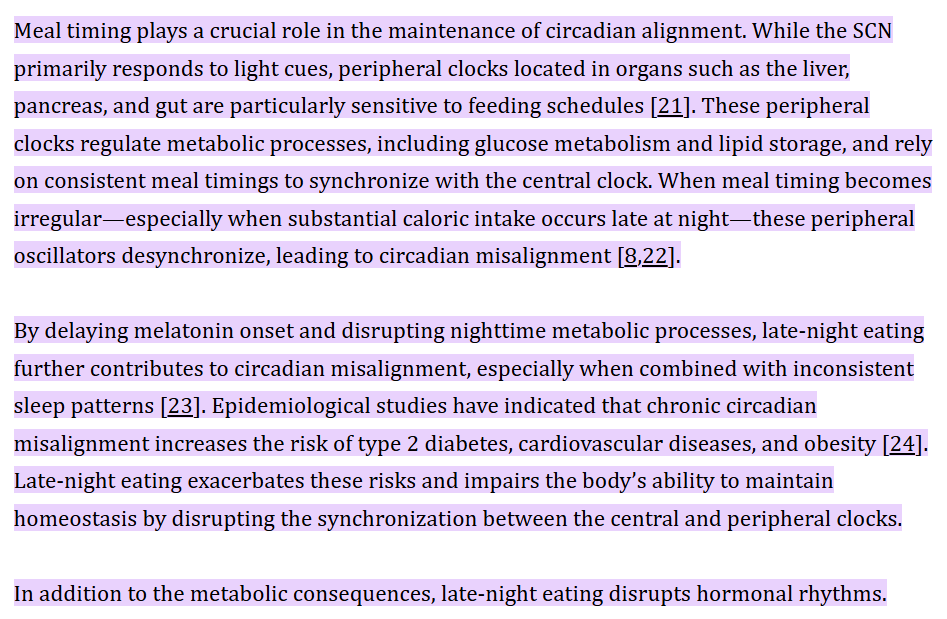
Source: Kim YI, Kim E, Lee Y, Park J. Role of late-night eating in circadian disruption and depression: a review of emotional health impacts. Phys Act Nutr. 2025 Mar;29(1):18-24. doi: 10.20463/pan.2025.0003. Epub 2025 Mar 31. PMID: 40443246; PMCID: PMC12127805.
Want to learn how to eat, sleep, and live in sync with your body clock?
Enroll in our online educational course, Circadian Rhythm: A New Way Of Living Beyond Medicine, and get a step-by-step plan built around your biology. Start living with your clock, not against it.
What Actually Happens When You Eat Before 7 PM
1. Your Metabolism Works Harder (In a Good Way)
Your metabolism is not a flat, constant engine. It peaks in the morning and early afternoon and drops significantly by evening.
- The same meal eaten in the morning burned significantly more calories than when eaten in the evening, due to the thermic effect of food being higher earlier in the day. In other words, your body is more efficient at processing and burning food during daylight hours.
When you eat before 7 PM:
- Insulin sensitivity is higher, meaning your cells absorb glucose more efficiently
- The thermic effect of food (energy burned during digestion) is greater
- Postprandial blood sugar spikes are lower and shorter
2. Blood Sugar Stays Stable
Late-night eating is directly linked to higher blood glucose levels.
A study showed that people who ate their largest meal at night had significantly higher 24-hour blood glucose levels compared to those who frontloaded their calories earlier in the day.
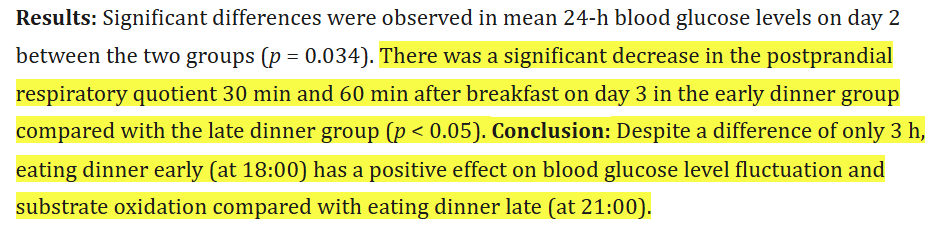
Source: Nakamura K, Tajiri E, Hatamoto Y, Ando T, Shimoda S, Yoshimura E. Eating Dinner Early Improves 24-h Blood Glucose Levels and Boosts Lipid Metabolism after Breakfast the Next Day: A Randomized Cross-Over Trial. Nutrients. 2021 Jul 15;13(7):2424. doi: 10.3390/nu13072424. PMID: 34371933; PMCID: PMC8308587.
This matters because chronically elevated blood sugar is at the root of metabolic syndrome, Type 2 diabetes, and systemic inflammation.
Early dinner = better glycemic control. It’s that straightforward.
3. Sleep Quality Improves Dramatically
Here’s one that surprises people: what you eat and WHEN you eat directly affects your sleep.
- When you eat a heavy meal close to bedtime, your body stays in a digestive, metabolically active state when it should be winding down.
- Core body temperature stays elevated, melatonin secretion is suppressed, and your sleep architecture gets disrupted, especially deep, restorative slow-wave sleep.
A study found a direct correlation between late eating and reduced sleep quality, including more nighttime awakenings and less REM sleep.
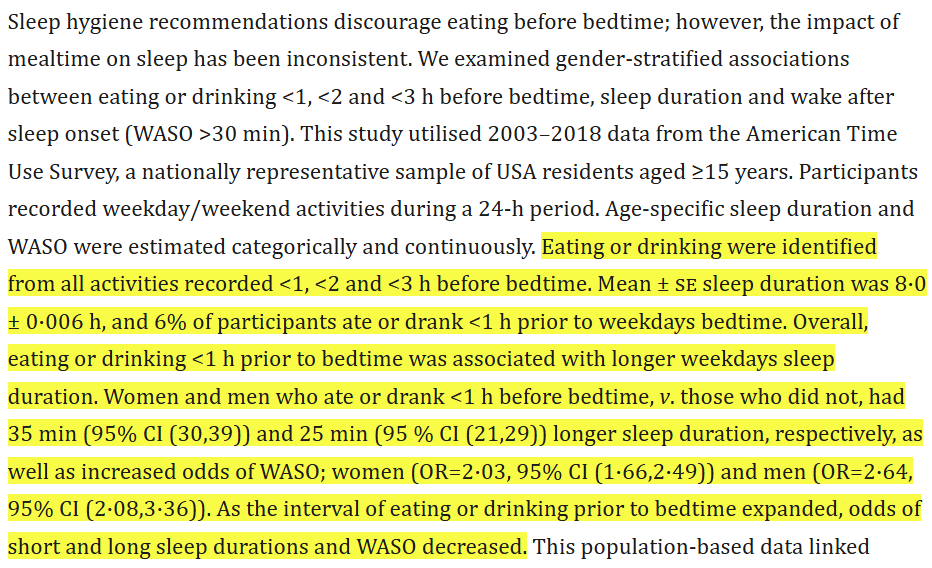
Source: Iao SI, Jansen E, Shedden K, O’Brien LM, Chervin RD, Knutson KL, Dunietz GL. Associations between bedtime eating or drinking, sleep duration and wake after sleep onset: findings from the American time use survey. Br J Nutr. 2022 Jun 28;127(12):1888-1897. doi: 10.1017/S0007114521003597. Epub 2021 Sep 13. PMID: 34511160; PMCID: PMC9092657.
Eating before 7 PM gives your body 3 to 4 hours to complete the heaviest phase of digestion before sleep, allowing:
- Melatonin to rise naturally
- Core body temperature to drop (a key trigger for sleep onset)
- Growth hormone to be secreted properly during deep sleep
4. Digestion Gets a Real Chance to Work
Your gut, like the rest of your body, follows a circadian rhythm.
Gastric motility (the movement of food through your digestive tract), enzyme production, and bile secretion all peak during the day and wind down at night.
- Gastrointestinal transit time is significantly slower in the evening, meaning food eaten late sits in your gut longer, increasing gas, bloating, acid reflux, and discomfort.
| Digestive Factor | Morning/Afternoon | Evening/Night |
| Gastric motility | High | Low |
| Enzyme production | Peak | Reduced |
| Bile secretion | Optimal | Suboptimal |
| Risk of acid reflux | Lower | Higher |
| Food transit time | Faster | Slower |
5. It Naturally Supports Intermittent Fasting
If you eat dinner by 6:30 or 7 PM and breakfast at 8 or 9 AM, you’ve just completed a 13 to 14-hour fast without even trying.
- This is sometimes called early time-restricted eating (eTRE), and it’s one of the most researched and supported eating patterns in circadian medicine.
Early time-restricted eating, even without calorie restriction, improved insulin sensitivity, blood pressure, and oxidative stress markers in men with metabolic syndrome.
This is the intermittent fasting approach we consistently advocate for: not extreme fasting windows, but simply aligning your eating window with daylight hours.
What Happens When You Eat Late at Night
Let’s flip it. Here’s what consistent late eating does:
- Weight gain: Late eaters lose significantly less weight than early eaters, despite consuming the same number of calories
- Higher cortisol at night: Late eating disrupts cortisol rhythms, keeping your stress response elevated when it should be dropping
- Increased cardiovascular risk: Eating after 9 PM was associated with a 28% higher risk of stroke in women
- Microbiome disruption: Your gut bacteria follow circadian rhythms, too. Late eating shifts the composition of your microbiome toward inflammation-promoting strains
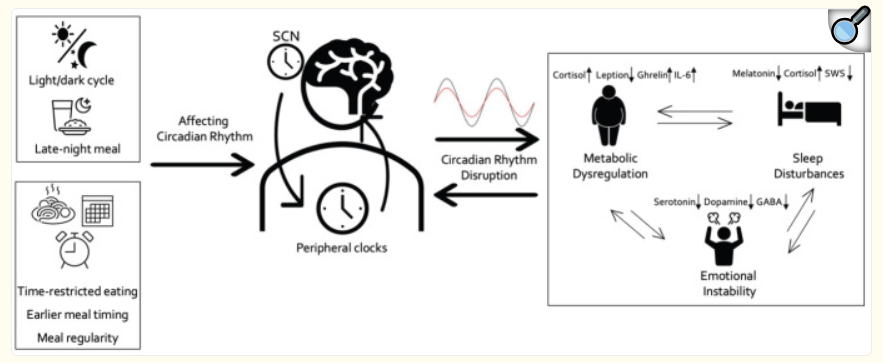
Source: Kim YI, Kim E, Lee Y, Park J. Role of late-night eating in circadian disruption and depression: a review of emotional health impacts. Phys Act Nutr. 2025 Mar;29(1):18-24. doi: 10.20463/pan.2025.0003. Epub 2025 Mar 31. PMID: 40443246; PMCID: PMC12127805.
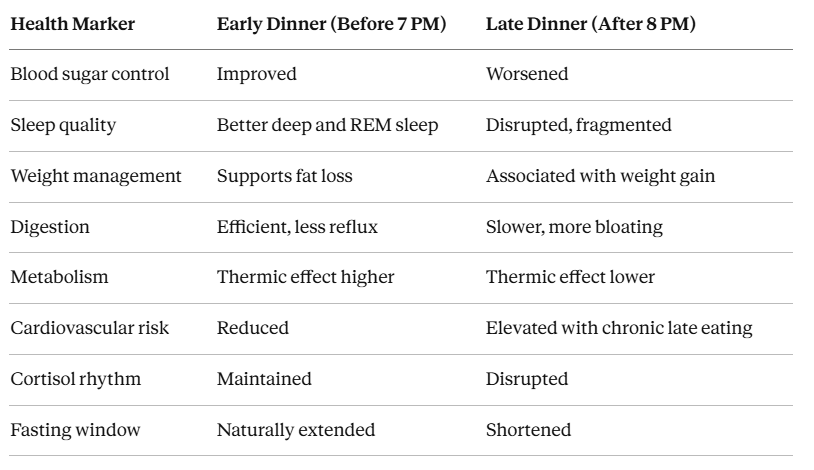
Early Dinner vs. Late Dinner: A Side-by-Side Look
The Circadian Rhythm Diet: What We Actually Recommend
Our philosophy is rooted in one core idea: biology is not optional.
You can override your circadian clock for a while, but eventually, your body keeps score.
Here’s what a circadian rhythm eating schedule looks like in practice:
- Breakfast: 7 to 9 AM (within 1 to 2 hours of waking, after some movement or sunlight)
- Lunch: 12 to 2 PM (your largest, most nutrient-dense meal)
- Dinner: 5:30 to 7 PM (light, easy to digest)
- Post-dinner: No food. Herbal tea, water, or nothing.
This is not about deprivation. It’s about timing nutrition with the body’s natural rhythms so that every calorie you eat is used better, digested better, and converted to energy rather than stored as fat or metabolic chaos.
Simple Tips to Make Early Dinner a Habit
Shifting dinner earlier can feel hard at first, especially if you have late work hours, family schedules, or social dinners.
Here’s how to ease into early dinners:
- Move dinner back by 15 minutes every few days instead of making a dramatic shift overnight
- Have a substantial, protein-rich lunch so you’re not ravenously hungry at 9 PM
- Prep dinner in advance so it’s ready by 6:30 PM without effort
- Set a “kitchen closed” time as a household boundary; 7 PM is a good starting point
- If you get hungry late, opt for a small handful of nuts or herbal tea rather than a full meal
- Communicate with your family about why this matters. Longevity is a team sport.

AI-generated image
The Bottom Line
The evidence is clear and consistent across hundreds of studies: when you eat matters as much as what you eat.
Early dinner is not a trend or a hack. It is an alignment with millions of years of human biology.
This is why Team Luke talks about early dinners relentlessly.
It is one of the highest-leverage, zero-cost lifestyle interventions available to anyone. You don’t need to overhaul your entire diet overnight. Start by moving your dinner 30 minutes earlier this week.
Your circadian clock is always ticking. You might as well work with it.
Disclaimer: The information provided here is for educational and informational purposes only. It is not intended as a substitute for professional medical advice, diagnosis, or treatment. Always consult your healthcare provider before making changes to your nutrition, lifestyle, or healthcare regimen, especially if you have existing medical conditions or are taking prescribed medications.
Want personalized guidance on meal timing?
We help you find a way.
Set up a one-on-one consultation with our integrative team or explore our Wellness Programs to optimize your lifestyle goals.
Reach out to us at 1800 102 0253 or write to us at [email protected].