No products in the cart.
You open your lab report casually.
It’s just another routine check.
Your eyes move past cholesterol, hemoglobin… then pause.
HbA1c: 5.9%
Not diabetic. Not even close to 6.5%.
So you’re fine… right?
That’s what most people think.
But here’s what rarely gets said:
HbA1c isn’t just a diabetes marker.
It’s a three-month snapshot of how your body has been handling sugar, stress, and inflammation.
And that 5.9%?
It’s not “normal.”
It’s your body saying, “I’m managing… but just about.”
Because HbA1c doesn’t suddenly matter at 6.5%.
It has been telling a story long before that.
A story most of us don’t know how to read.
New research is repositioning this marker as a window into your metabolic health, inflammation, and cardiovascular risk. And the implications for Indians are not something you can afford to ignore. Most people only hear the words “HbA1c” (glycated hemoglobin) when their doctor suspects diabetes or is managing one. And for years, that is largely how the medical world treated it: a diabetic checkpoint. Below 5.7%, great, move on. Above 6.5%, now we have a problem.
But something is shifting in research circles, and it needs to shift in everyday conversations too. Because HbA1c is telling us something far broader about the state of your metabolic health, regardless of whether you have diabetes or not. If you have been dismissing this number because you are “not diabetic,” this is for you.
What HbA1c Actually Measures
HbA1c, or glycated hemoglobin, reflects your average blood sugar over the past two to three months. When glucose in your blood binds to hemoglobin in your red blood cells, it forms HbA1c. The higher your blood sugar stays over time, the higher this number climbs. It does not care about one good or one bad day. It is a rolling average. And that makes it one of the most honest metabolic markers we have.
The New Science: What ‘Mildly Elevated’ Really Means
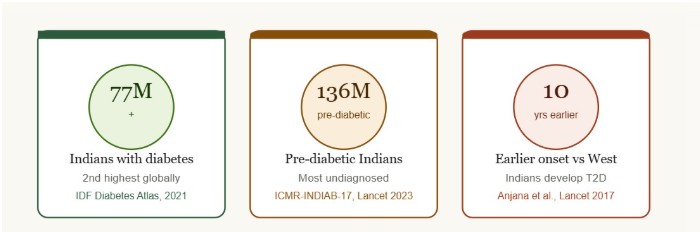
An HbA1c between 5.7% and 6.4% is classified as pre-diabetes. Millions of Indians sit in this zone and are told to “watch their diet” and come back in six months. What they are not told is what the research is now making very clear.
A landmark study published in the New England Journal of Medicine tracked 11,092 non-diabetic adults over 15 years and found that for every 1 percentage point rise in HbA1c, coronary heart disease risk increased significantly, even among people who were not yet diabetic. [1] HbA1c was found to be a stronger predictor of cardiovascular risk than fasting glucose alone. Even within the 5.5% to 6.0% range, a zone most doctors would call borderline normal, hazard ratios for coronary disease were already rising.
And it goes beyond the heart. Research shows that elevated HbA1c, even below the diabetic threshold, is independently linked to elevated C-reactive protein (CRP), a key marker of systemic inflammation. The chronic fatigue, brain fog, achy joints, frequent infections, and sluggish recovery you may be experiencing are not just lifestyle complaints. They may have a measurable metabolic root cause that shows up in this single number.
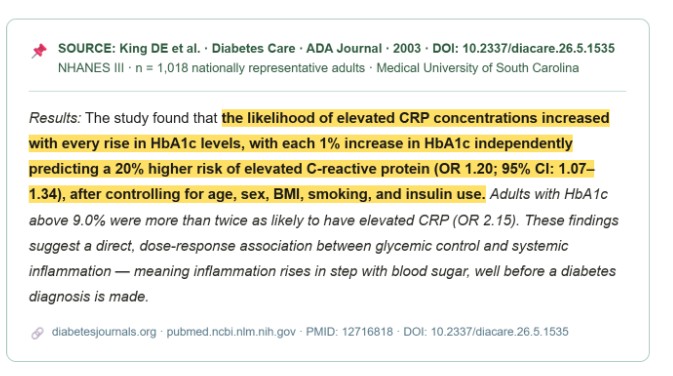
You do not need to be diabetic for elevated blood sugar to be quietly inflaming your arteries, taxing your immune system, and ageing your organs faster than your years.
HbA1c Reference Ranges (WHO and ADA criteria)
| Optimal | Pre-diabetic Zone | Diabetic |
|---|---|---|
| Below 5.7% | 5.7% to 6.4% | 6.5% and above |
The Inflammation Connection Nobody Talks About
Chronically elevated blood sugar triggers oxidative stress and releases pro-inflammatory cytokines, including interleukin-6 and TNF-alpha. These damage the endothelium, the delicate lining of your blood vessels, and this is the first step in arterial disease. Selvin et al. confirmed that HbA1c remained significantly associated with cardiovascular disease and death even after accounting for baseline fasting glucose levels. [1]
If you feel tired despite sleeping, get sick easily, struggle to lose weight even while eating reasonably, or have been told your CRP is high, your HbA1c trend is worth knowing. It is often the thread that ties these symptoms together.
What Actually Moves This Number, With the Evidence
- Walk for 10 to 15 minutes after meals. A study in the Journal of the American Medical Directors Association found that 20 minutes of post-dinner walking lowered plasma glucose more than walking done before the meal. A follow-up Diabetes Care trial confirmed that three 15-minute post-meal walks improved 24-hour glycemic control better than a single long session.
Source: Colberg et al., JAMDA 2009
Action: Start tonight. After dinner, walk. Even in your building corridor counts.
2. Protect 7 to 8 hours of sleep as if it were medicine. A randomized crossover study in the Annals of Internal Medicine showed that restricting sleep to 5.5 hours nightly for just two weeks significantly impaired insulin sensitivity and promoted fat retention, even with identical caloric intake.
Source: Nedeltcheva et al., Ann Intern Med 2010
Action: Set a non-negotiable sleep time. Your HbA1c will reflect it in 8 weeks.
3. Eat protein and fiber before your carbohydrates. A Weill Cornell pilot study in Diabetes Care found that eating protein and vegetables before carbohydrates at the same meal reduced postprandial blood glucose by up to 37% at 60 minutes and lowered insulin area under the curve significantly, compared to eating carbohydrates first.
Source: Shukla et al., Diabetes Care 2015
Action: Start with dal, sabzi, or eggs before reaching for rice or roti.
4. Replace refined grains with millets. A systematic review in Frontiers in Nutrition found that millet-based diets lowered fasting blood glucose by 12% and HbA1c by an average of 0.5% in people with pre-diabetes and type 2 diabetes. Jowar, ragi, and bajra are science-backed metabolic tools.
Source: Anitha et al., Frontiers in Nutrition 2021
Action: Swap one meal of white rice or maida a day. That is where you start.
5. Lift weights or do resistance training twice a week. Skeletal muscle is the largest glucose sink in the body. A meta-analysis found that resistance training improved HbA1c by an average of 0.48% in people with type 2 diabetes, comparable to many oral medications.
Source: Strasser & Pesta, BioMed Research International 2013
Action: Two sessions a week. 30 minutes each. Your insulin sensitivity will shift.
6. Address chronic stress as a metabolic issue, not just a mental one. Cortisol and adrenaline raise blood sugar directly through gluconeogenesis, independent of diet. Unmanaged stress can keep your HbA1c elevated even when your food and exercise are on point.
Source: Rosmond, Psychoneuroendocrinology 2005
Action: Breathwork, prayer, nature, stillness. Pick one. Do it daily.
Your body is not broken. It is responding to signals you are sending it every single day through food, sleep, movement, stress, and thought. HbA1c is one of the clearest readouts of those cumulative signals. The number can go down. It goes down all the time, in people who decide to take it seriously and act with consistency, not perfection.
You do not need a diagnosis to deserve prevention. And you do not need to wait until the damage is done to start reversing it.
Disclaimer: This content is for informational and educational purposes only, and is not a substitute for professional medical advice, diagnosis, or treatment. Always consult your physician or qualified healthcare provider before making any changes to your diet, lifestyle, or medication, especially if you have an existing medical condition or are on treatment. Never disregard professional medical advice or delay seeking it based on something you have read here.
Ready to Take Charge of Your Metabolic Health?
Your HbA1c is not just a number. It is a reflection of your daily choices, your routines, and your long-term health trajectory.
Start your journey with our Wellness Program, designed to help you lower inflammation, improve insulin sensitivity, and take control of your metabolic health from the root.
Book a one-on-one consultation with Team Luke today.
📞 Call us at 1800 102 0253
📧 Email: [email protected]
References
[1] Selvin E, Steffes MW, Zhu H, et al.. “Glycated hemoglobin, diabetes, and cardiovascular risk in nondiabetic adults.” New England Journal of Medicine, 362(9):800-811, 2010. doi: 10.1056/NEJMoa0908359 [11,092 participants | 15-year follow-up]
[2] Anjana RM, Deepa M, et al.. “Prevalence of diabetes and prediabetes: ICMR-INDIAB study.” Lancet Diabetes Endocrinol., 5(8):585-596, 2017; updated 2023. doi: 10.1016/S2213-8587(17)30174-2 [Largest nationally representative India diabetes study]
[3] Colberg SR, Zarrabi L, Bennington L, et al.. “Postprandial walking is better for lowering the glycemic effect of dinner than pre-dinner exercise.” J Am Med Dir Assoc., 10(6):394-397, 2009. doi: 10.1016/j.jamda.2009.03.015 [Randomized crossover trial]
[4] DiPietro L, Gribok A, Stevens MS, et al.. “Three 15-min bouts of moderate postmeal walking significantly improve 24-h glycemic control.” Diabetes Care, 36(10):3262-3268, 2013. doi: 10.2337/dc13-0084 [ADA journal]
[5] Nedeltcheva AV, Kilkus JM, Imperial J, Schoeller DA, Penev PD.. “Insufficient sleep undermines dietary efforts to reduce adiposity.” Annals of Internal Medicine, 153(7):435-441, 2010. doi: 10.7326/0003-4819-153-7-201010050-00006 [University of Chicago | Randomized crossover trial]
[6] Shukla AP, Iliescu RG, Thomas CE, Aronne LJ.. “Food order has a significant impact on postprandial glucose and insulin levels.” Diabetes Care, 38(7):e98-e99, 2015. doi: 10.2337/dc15-0429 [Weill Cornell Medical College]
[7] Anitha S, Kane-Potaka J, Tsusaka TW, et al.. “A systematic review and meta-analysis of the potential of millets for managing diabetes.” Frontiers in Nutrition, 8:687428, 2021. doi: 10.3389/fnut.2021.687428 [Systematic review and meta-analysis]
[8] Strasser B, Pesta D.. “Resistance training for diabetes prevention and therapy.” BioMed Research International, 2013:805217, 2013. PMID: 23899481 [Meta-analysis]
[9] Rosmond R.. “Role of stress in the pathogenesis of the metabolic syndrome.” Psychoneuroendocrinology, 30(1):1-10, 2005. doi: 10.1016/j.psyneuen.2004.05.007 [Cortisol and gluconeogenesis mechanisms]