No products in the cart.
Every year, organizations across India celebrate wellness with the best intentions.
On International Yoga Day, conference rooms turn into yoga studios. Employees get wellness emails, sit through guided meditations, and attend talks on stress management. Photos go up on social media, participation numbers get reported, and another wellness initiative is checked off the list.
There’s nothing wrong with any of this. In fact, workshops, webinars, health talks, and initiatives can be valuable starting points for creating awareness and opening conversations around health.
The challenge is not that these activities don’t work. The challenge arises when they become the entire wellness strategy rather than the beginning of a longer journey toward sustainable behaviour change.
Because the employee who attends that morning yoga session may still be running on five hours of sleep. They might be skipping breakfast, eating lunch at their desk, sitting for ten hours straight, carrying emotional stress, and showing up with a kind of exhaustion no wellness campaign can fix in a day.
What the Data Is Actually Telling Us
This isn’t a hunch. Our Quality of Life Style Score (QOLS) assessments, conducted among entrepreneurial communities in Nepal and Raipur, put real numbers behind this gap, and the patterns reveal something far bigger.
Across leadership communities assessed through the QOLS framework:
- Nearly 50% of participants reported experiencing sleep-related fatigue that affected their daily performance.
- Less than one-third practiced mindfulness regularly despite understanding its benefits.
- Individuals with lower fruit and vegetable intake consistently reported lower energy, focus, and productivity.
- Balanced nutrition was among the most common areas requiring improvement.
- Mindfulness and recovery practices were recognized as important but not practiced regularly.
What makes this striking is who these participants were: entrepreneurs, business owners, and leaders, people accustomed to high performance and making high-stakes decisions. And even they were carrying lifestyle gaps quietly chipping away at their energy, focus, and resilience.
If this is true for high-performing leaders, what is likely happening across the broader workforce?
The Problem Isn’t a Lack of Awareness
Part of the challenge is that workplace wellness has gradually become a compliance exercise rather than a culture-building exercise. For many organizations, wellness initiatives are designed to check a box, demonstrate employee care, or fulfill annual well-being commitments. While the intention is positive, the focus often shifts toward activities that are easy to organize and measure rather than interventions that create meaningful behavioral change. As a result, wellness becomes something employees attend instead of something they live.
Awareness initiatives absolutely have value. A workshop can introduce new ideas, a webinar can spark motivation, and a wellness talk can help employees recognize patterns they may have overlooked. For many people, these interventions become the first step toward change.
However, awareness alone is rarely enough to create lasting behavior change.
Here’s something learned after years of working in the wellness space: people generally already know what they should be doing. They know sleep matters. They know movement matters. They know nutrition affects how they feel, and that unmanaged stress takes a toll.
Information isn’t the gap. The gap is turning that information into consistent daily action.
A workshop can build awareness. A webinar can spark motivation. A yoga session can feel genuinely good at the moment. But none of these replace the habits that shape how someone feels, functions, and performs across the other twenty-three hours of the day.
When wellness is treated as an event, organizations end up measuring participation instead of transformation. The question quietly shifts from “Are people getting healthier?” to “How many people showed up?” and those are very different outcomes.
Burnout Is the Final Symptom, Not the Starting Point
Burnout is one of the most talked-about workplace issues today. But burnout rarely begins as a workplace problem. More often, it’s the end result of several lifestyle imbalances stacking up silently over months, sometimes years:
- Poor sleep reduces cognitive function and emotional regulation
- Inconsistent nutrition causes energy and concentration to fluctuate
- Lack of movement affects circulation, metabolism, and mood
- Chronic emotional stress keeps the nervous system stuck in overdrive
By the time this shows up as low motivation, poor focus, irritability, or absenteeism, the roots trace well beyond the office. That’s why the real question isn’t “How do we fix burnout?” It’s “What’s creating it in the first place?”
Why One-Size-Fits-All Wellness Doesn’t Work
Source: AI
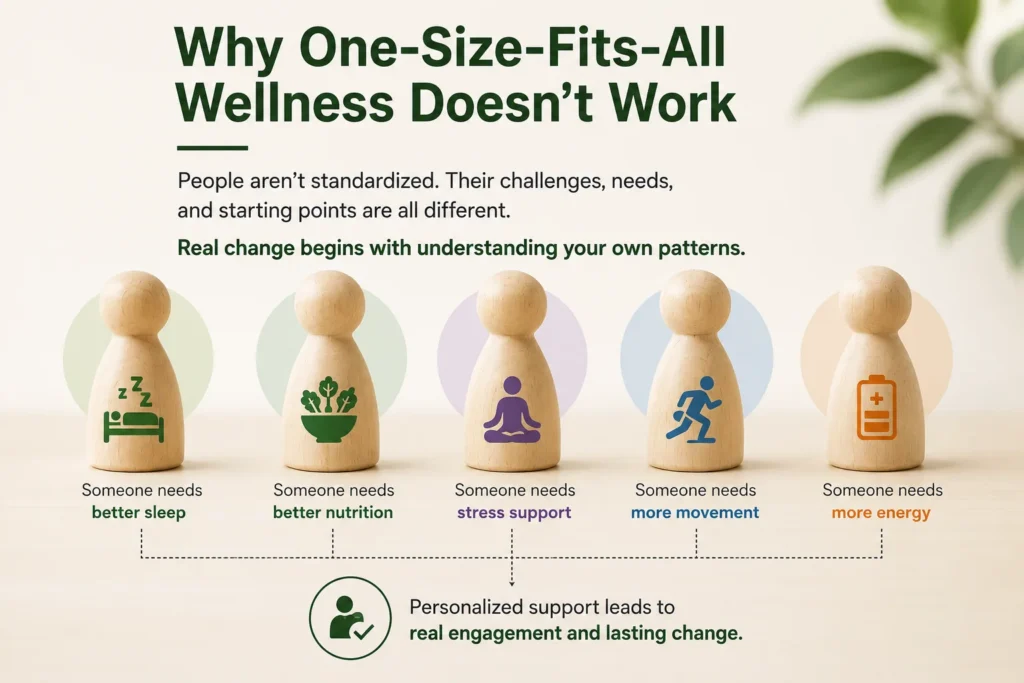
Most wellness programs are built around a single solution for everyone, but people aren’t standardized, and neither are their health challenges. A yoga session might be exactly what one employee needs. Another might be dealing with chronic poor sleep. Someone else needs help with eating habits or building movement into a sedentary workday.
When the intervention doesn’t match the actual issue, employees participate without ever truly engaging.
The future of workplace wellness is personalized, helping people understand their own patterns so they can address the root causes specific to them. That’s where real, lasting change begins.
What Does Effective Workplace Wellness Look Like?

Source: Magnific
Organizations that achieve meaningful outcomes from wellness initiatives tend to move beyond one-time activities and create continuous learning journeys for their people.
Some of the common elements include:
- Assessing employee lifestyle patterns to understand real needs rather than making assumptions
- Addressing foundational pillars such as sleep, nutrition, movement, stress management, and emotional well-being
- Offering personalized support rather than a single solution for everyone
- Creating opportunities for ongoing engagement and habit-building
- Equipping leaders to model healthier behaviours and support a culture of well-being
- Measuring meaningful lifestyle improvements instead of focusing solely on participation metrics
This is the philosophy behind our Corporate Wellness Programs.
While talks, workshops, and webinars play an important role in building awareness, our programs are designed to take the next step. Through assessments, personalized wellness journeys, practical lifestyle interventions, and ongoing engagement, we help individuals and teams build sustainable habits that support long-term health, resilience, energy, and performance.
Because lasting workplace wellness is rarely created through a single event. It is built through consistent action, supported over time.
Leadership Has to Live It, Not Just Approve It
Wellness can’t be delegated entirely to HR. It has to be modeled by leadership, because employees pay far more attention to behavior than to policy.
If leaders normalize overwork, reply to emails at midnight, skip meals, and treat exhaustion as a badge of honor, that becomes the culture, regardless of what the wellness policy says.
But when leaders prioritize recovery, protect their boundaries, make time to move, and visibly value their own well-being, that sends a far more powerful signal than any internal memo. Culture isn’t shaped by what organizations say. It’s shaped by what people see.
The Real ROI of Wellness
When it comes to evaluating wellness programs, Return On Investment (ROI) is a fair question, but we may have been measuring the wrong things. Attendance numbers and participation certificates don’t capture real value. What matters is energy, and energy shows up everywhere:
- In decision-making quality
- In creativity and innovation
- In resilience under pressure
- In collaboration, productivity, and engagement
An employee with stable energy, quality sleep, emotional balance, and consistent daily habits shows up to work fundamentally differently from someone running in survival mode.
The return on wellness is, ultimately, a return on human capacity, and every organization depends on that capacity to grow, innovate, and perform.
The Gap Nobody Is Talking About
The takeaway from the QOLS findings isn’t “add more wellness activities.” It strengthens the foundations that hold everything else up. The organizations that get this right stop treating wellness as an event and start building it into everyday culture.
Healthier workplaces are not built through occasional interventions. They are built through better everyday habits.
That’s the corporate wellness gap nobody’s talking about. And it’s also an opportunity.
If this article resonated with you, perhaps it is time to look beyond wellness events and start addressing the everyday habits that influence energy, resilience, and performance.
Our workplace wellness talks and workshops help organizations support their teams through practical lifestyle interventions focused on nutrition, movement, sleep, stress resilience, and emotional well-being.
Available in live and virtual formats and personalized to your workforce.
Call us at 1800 102 0253 or write to us at [email protected]