No products in the cart.
Pancreatic cancer is one of the most difficult cancers to treat.
Not because medicine hasn’t been tried. Researchers have spent decades working on it.
But this cancer has a way of staying one step ahead, often diagnosed late, spreading quickly, and leaving patients and families with very limited options.
That’s why a new finding presented at ASCO 2026, one of the world’s most important cancer research conferences, is turning heads.
A drug called “daraxonrasib” may have just changed the conversation around metastatic pancreatic cancer treatment.”
Here’s what happened, what it means, and why it matters even if you’re not a scientist.
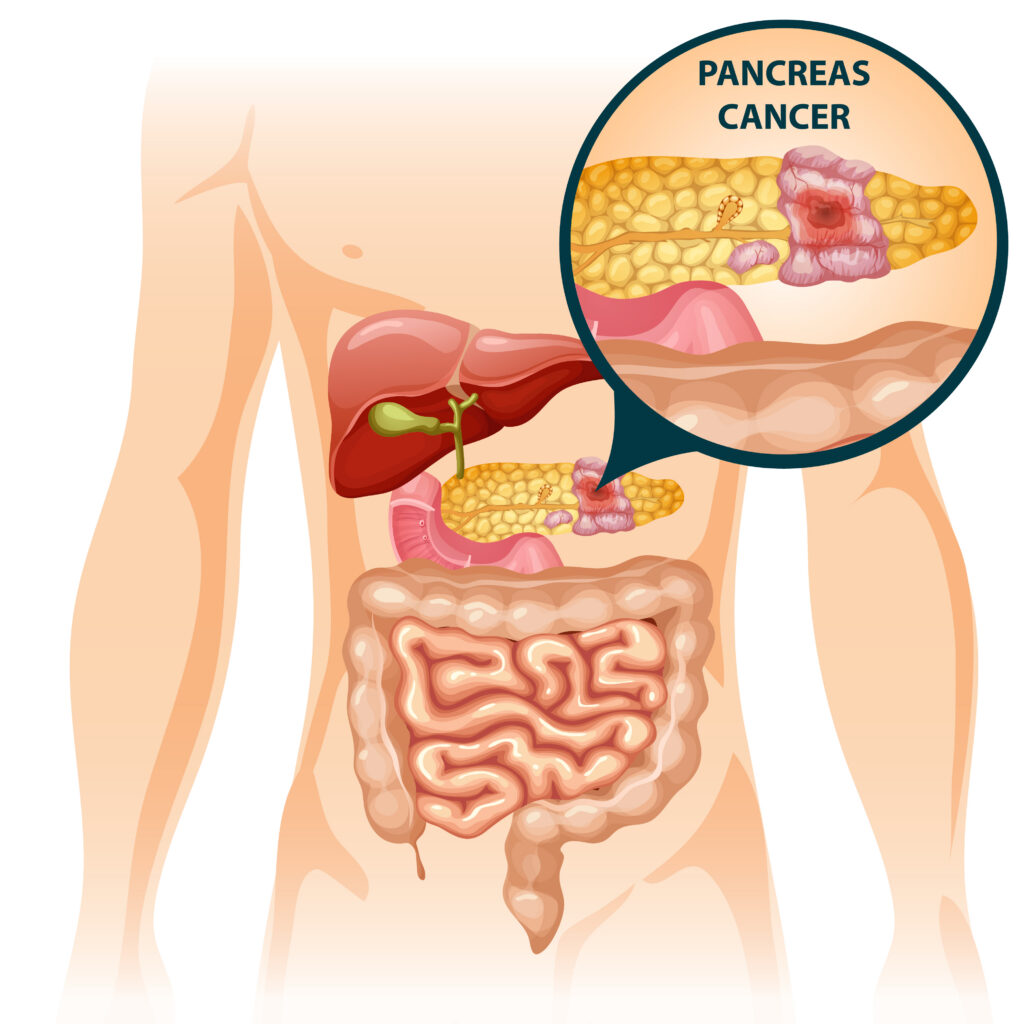
Image Credits: Magnific
First, Why Is Pancreatic Cancer So Hard to Treat?
To understand why this breakthrough matters, it helps to understand why pancreatic cancer has been such a challenge.
A few key reasons:
- Late diagnosis: The pancreas sits deep inside the body. There are no routine screening tests for it. By the time symptoms appear, the cancer has often already spread.
- Aggressive growth: Pancreatic cancer tends to progress faster than many other cancers.
- Limited treatment options: Especially once it becomes metastatic, meaning it has spread to other parts of the body, treatment choices have historically been narrow.
- Drug resistance: Many treatments that work in other cancers simply don’t work as well here.
The overall five-year pancreatic cancer survival rate currently sits at around 13%, but for patients with metastatic disease specifically, that figure drops to just 2 to 3%. (American Cancer Society, Cancer Facts & Figures 2025; January 2025)
That number is not shared to be frightening. It’s shared because it makes what happened next all the more significant.
The RAS Pathway: A Target Scientists Have Been Chasing for Decades
About 90% of pancreatic cancers carry mutations in something called the RAS pathway.
- Think of RAS like a light switch inside a cancer cell. When it’s working normally, it turns on and off as needed.
- When it’s mutated, it gets stuck in the “on” position, telling cancer cells to keep growing, keep dividing, keep spreading.
Scientists identified this problem decades ago. The challenge was figuring out how to turn the switch off.
For a long time, RAS was considered “undruggable,” a frustrating term meaning researchers could see the problem but couldn’t reach it with existing medicines.
- Some early progress came with a related mutation called KRAS G12C, which led to drugs approved for lung cancer.
- But in pancreatic cancer, that specific mutation is rare, appearing in only about 1 to 2% of cases, and the dominant mutations are different and much harder to target.
That’s what makes RAS pathway pancreatic cancer research so difficult, and why any progress here is genuinely newsworthy.
What Happened at ASCO 2026
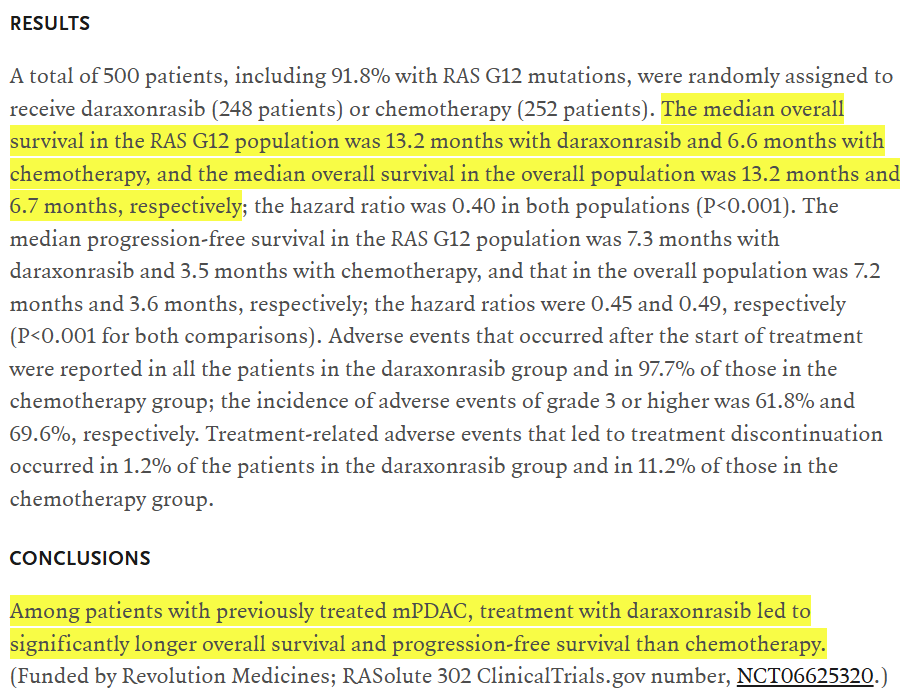
At the ASCO 2026 Annual Meeting in Chicago, researchers presented results from a Phase 3 pancreatic cancer clinical trial called RASolute 302, evaluating daraxonrasib in patients with metastatic pancreatic cancer who had already received at least one round of chemotherapy.
The study was presented by Dr. Brian Wolpin, Director of the Hale Family Center for Pancreatic Cancer Research at Dana-Farber Cancer Institute, and was simultaneously published in The New England Journal of Medicine.
(Source: Dana-Farber Cancer Institute Press Release, May 31, 2026; NEJM, doi: 10.1056/NEJMoa2605555)
This is a group where options are especially limited. Once first-line chemotherapy stops working, there hasn’t been much to offer.
Here’s what the trial found across 500 enrolled patients:
| Outcome | Standard Chemotherapy | Daraxonrasib |
| Median Overall Survival | 6.7 months | 13.2 months |
| Median Progression-Free Survival | 3.6 months | 7.2 months |
| Tumor Response Rate | Lower | Higher |
| Serious Adverse Events | Higher | Fewer |
Median overall survival nearly doubled, with a hazard ratio of 0.40, meaning patients on daraxonrasib had a 60% lower risk of death compared to those on chemotherapy.
In a disease where months matter enormously, this is significant.
What Does “Median Survival” Actually Mean?
It’s worth pausing here because medical statistics can be confusing.
“Median overall survival” doesn’t mean every patient lived exactly that long. It means that half of the patients lived longer than that number and half lived shorter. It’s a statistical midpoint.
What matters is the direction of change.
- Going from 6.7 months to 13.2 months in a population that had already been through chemotherapy is a clinically meaningful shift. It suggests the drug is working in a meaningful number of patients.
The Pancreatic Cancer Action Network called it, in the words of their Chief Scientific and Medical Officer Dr. Anna Berkenblit, “the most significant advance we have ever seen in pancreatic cancer.” (PanCAN, June 2026)

Image Credits: Magnific
Why This Pancreatic Cancer Breakthrough Matters Beyond the Numbers
Beyond survival time, researchers noted something else worth paying attention to: quality of life indicators improved.
Fewer serious adverse events means patients may be spending less time managing severe drug side effects. For someone already navigating a difficult diagnosis, that matters enormously.
- Daraxonrasib is an oral tablet taken once daily, which is also meaningfully different from intravenous chemotherapy in terms of patient experience and convenience. (Revolution Medicines, April 2026)
This is why the daraxonrasib results are generating real interest, not just in oncology circles, but among patients and families who follow pancreatic cancer research closely.
What This Means for Patients Right Now
It’s important to be honest here.
- Daraxonrasib is not yet formally approved by the FDA or other regulatory bodies. However, the FDA did grant permission on May 1, 2026 for Revolution Medicines to initiate an expanded access program, meaning eligible patients may be able to access it before full approval. (Dana-Farber Cancer Institute, May 31, 2026)
- This is not a cure for pancreatic cancer. Survival improved significantly, but the disease remained serious.
- The trial focused on a specific group: patients with previously treated metastatic pancreatic ductal adenocarcinoma (PDAC). Results may differ in other patient populations or at earlier stages.
- More research is ongoing. Future trials are exploring daraxonrasib in combination with chemotherapy and immunotherapy, and in earlier-stage disease settings. (Lustgarten Foundation, February 2026)
That said, Phase 3 clinical trial results are considered some of the strongest evidence in medicine.
This is not a preliminary finding. This is a large-scale, global, randomized controlled study, 500 patients, conducted across multiple countries. And those results held up.
A Note on the Bigger Picture
Pancreatic cancer research has been moving forward steadily, even when it hasn’t made headlines.
Over the past decade, combination chemotherapy regimens like FOLFIRINOX and gemcitabine plus nab-paclitaxel changed first-line treatment significantly. Genetic testing now helps identify patients with BRCA mutations who may respond to PARP inhibitors. Immunotherapy is being actively studied.
Daraxonrasib fits into this larger story of incremental, hard-won progress. And notably, this is the first RAS inhibitor ever evaluated in a large, randomized Phase 3 trial for pancreatic cancer.
None of these advances arrived overnight. Each one came from years of lab research, failed attempts, redesigned trials, and eventually, a finding that held up. That’s how medicine moves forward.
Supporting the Whole Patient, Not Just the Diagnosis
At our practice, we work alongside oncology teams to support patients navigating complex diagnoses like metastatic pancreatic cancer.
We have seen firsthand what this journey looks like. The appointments. The waiting. The conversations with family. The physical toll of treatment. The emotional weight that doesn’t show up in a scan.
Medical innovation matters. And so does everything that happens around it.
Nutrition, mental health, physical rehabilitation, and palliative support are not afterthoughts in cancer care. They are part of what helps patients tolerate treatment, maintain strength, and sustain quality of life during an incredibly difficult time.
The best outcomes tend to come when both pieces are in place.

Image Credits: Magnific
The Last Word
This is not a cure.
But it is the most significant advance seen in this disease in a very long time, and it is real, peer-reviewed, Phase 3 evidence.
For patients, families, and the researchers who have dedicated careers to this work, that matters.
Science moves forward one careful step at a time. And this is one of those steps.
If you found this helpful, share it with someone who follows cancer research or has been touched by a pancreatic cancer diagnosis.
Awareness matters. So does hope, grounded in science.
Disclaimer: The information provided here is for educational and informational purposes only. It is not intended as a substitute for professional medical advice, diagnosis, or treatment. Always consult your healthcare provider before making changes to your nutrition, lifestyle, or healthcare regimen, especially if you have existing medical conditions or are taking prescribed medications.
Looking for support through cancer?
We help you find a way.
Set up a one-on-one consultation with our foundational medicine team or explore our Cancer Care Program with Luke’s Senior Team/Luke’s Team for personalized solutions.
Reach out to us at 1800 102 0253 or write to us at [email protected].