No products in the cart.
If you or someone you love has been living with PCOS, or polycystic ovary syndrome, this is for you.
Because the medical world just made a landmark decision.
After 14 years of global research, surveys across 22,000 people, and input from 56 patient and professional organizations worldwide, PCOS has officially been renamed.
It is now called PMOS: Polyendocrine Metabolic Ovarian Syndrome.
The name change was announced at the European Congress of Endocrinology in Prague and published in The Lancet on May 12, 2026.
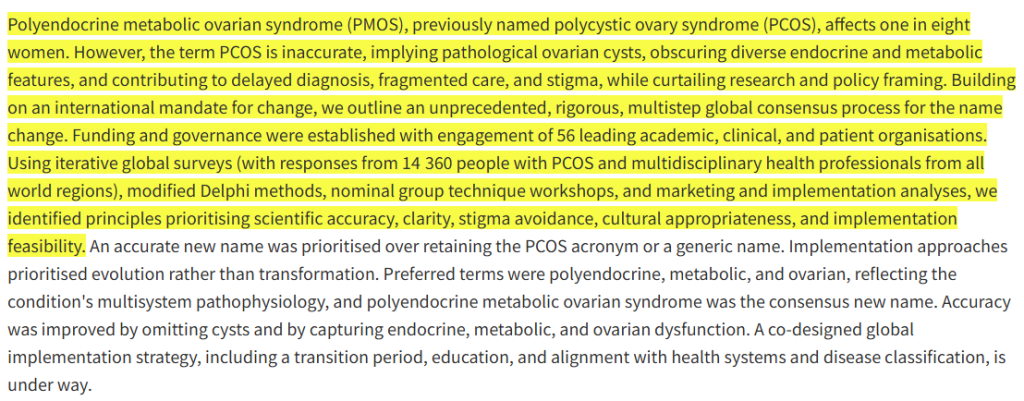
Source: Teede H, Khomami M, Morman R et al. Polyendocrine metabolic ovarian syndrome, the new name for polycystic ovary syndrome: a multistep global consensus process. The Lancet, 2026; 0
This is not just a change in letters. This is a change in understanding. And it matters enormously for every woman living with this condition.
Let us break it all down for you, simply.
First, What Was PCOS? And Why Did the Name Not Work?
PCOS has been one of the most common hormonal conditions affecting women worldwide. It impacts 1 in 8, or more than 170 million women globally.
Symptoms include:
- Irregular or missed periods
- Weight gain
- Acne
- Excess facial or body hair (hirsutism)
- Hair thinning or hair loss
- Difficulty getting pregnant
- Fatigue
- Mood issues, anxiety, and depression
But here is the problem with the old name.
The word “polycystic” means “many cysts.” And the word “ovary” puts the entire spotlight on the ovaries.
- The condition does not actually involve pathological ovarian cysts.
- What appear as “cysts” on some ultrasounds are actually immature follicles, which are a symptom of hormonal dysfunction, not the cause of it.
This caused a cascade of problems.
- Patients would attribute ovarian cysts to PCOS and risk being underdiagnosed for other conditions.
- Doctors would focus on the cystic presentation, and patients could be dismissed if they did not present with cysts, even as they suffered from metabolic and fertility issues linked with the condition.
In short: the name was misleading doctors, misleading patients, and causing real harm.

Image Credits: Magnific
So, What Is PMOS? What Does the New Name Actually Mean?
Let us break down each word:
| Word | What It Means |
| Poly | Multiple, more than one |
| Endocrine | Involving the hormonal/endocrine system |
| Metabolic | Involving metabolism: how your body processes energy |
| Ovarian | The ovaries are still involved |
| Syndrome | A collection of symptoms, not one single disease |
The new name recognizes that the condition is not a primarily gynecological disorder, but a complex, multisystem condition involving endocrine, metabolic, reproductive, dermatological, and psychological health.
Think of it this way:
- PCOS was like calling a river problem a “bridge problem” because the bridge happened to be the most visible part. PMOS tells you the whole river, the source, the currents, the downstream effects.
Why Did Scientists and Doctors Push for This Change?
This was not an overnight decision. It was the result of over a decade of relentless global effort.
A team led by Helena Teede at Monash University in Australia developed surveys which were administered to nearly 15,000 stakeholders in 2025, with about 22,000 people across the globe, including doctors, researchers, patients, and charities, sharing their thoughts on a new name.
What did they want the new name to do?
- Avoid stigma
- Be easy to communicate
- Be scientifically accurate
- Reflect the involvement of the endocrine system
Overall, 86% of patients and 71% of clinicians supported the change, citing stigma, confusion, and fragmented care as key reasons.
According to the researchers, the new terminology is intended to improve diagnostic clarity, reduce stigma, strengthen research consistency, and better align treatment strategies with the underlying biology of the disease.
The Real Root: Why Insulin Resistance Is at the Heart of PMOS
Here is the part that most women with PCOS were never told clearly enough.
This condition is deeply metabolic. And insulin resistance is at its core.
- There is too much insulin in many women with this condition, and that insulin “confuses the ovary to make too much testosterone.”
- High testosterone is what drives most of the visible symptoms women experience.
So when a woman has excess acne, excess hair growth, or irregular cycles, it is often not “just a hormonal problem.” It is the body’s response to a metabolic imbalance that starts with insulin.
- A 2025 study describes a bidirectional relationship between insulin resistance and PMOS symptoms like hyperandrogenism, or excess androgens, and ovulatory dysfunction. PMOS itself also increases the risk of type 2 diabetes.
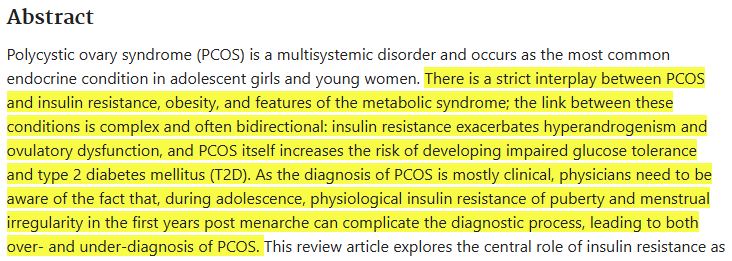
Source: Prosperi S, Chiarelli F. Insulin resistance, metabolic syndrome and polycystic ovaries: an intriguing conundrum. Front Endocrinol (Lausanne). 2025 Oct 1;16:1669716. doi: 10.3389/fendo.2025.1669716. PMID: 41103651; PMCID: PMC12520869.
And this is where it gets important for long-term health.
Insulin resistance is linked to elevated risks of impaired glucose tolerance, gestational diabetes, dyslipidemia, hypertension, and cardiovascular disease.
This is not just a fertility problem. This is a lifelong metabolic condition that needs to be addressed at its root.
What Does PMOS Mean for Diagnosis? Will Anything Change?
Good news: your diagnosis criteria stays the same.
- PMOS is diagnosed when a woman has at least two of the following three features: irregular menstrual periods, high testosterone or related symptoms like excess facial hair, or polycystic ovaries found on an ultrasound.
A blood test for high levels of anti-Mullerian hormone can replace the ultrasound in the diagnosis.
What changes is the lens through which doctors look at you.
- When clinicians hear PCOS, they think “polycystic ovaries” and look for ovarian cysts and menstrual irregularities.
- When they hear “polyendocrine metabolic ovarian syndrome,” the diagnostic lens widens considerably.
This means:
- More attention to metabolic markers like blood sugar and insulin
- Better screening for cardiovascular risk
- Greater acknowledgment of mental health impacts
- Fewer women being dismissed or sent home with just a birth control prescription
The recategorizing will also include updates to clinical guidelines, medical education, and international disease classification systems, ensuring the new terminology is adopted consistently worldwide.
The rollout is planned over 3 years with updates to guidelines used in 195 countries.
The Mental Health Piece: Long Overdue Recognition
PMOS does not just affect the body. It deeply affects the mind.
Symptoms associated with PMOS now include sleep apnea, depression, anxiety, and body dysmorphia.
- Research has shown that women with this condition are significantly more likely to experience anxiety, depression, low self-esteem, and disordered eating.
- Much of this is tied to stigma around weight, acne, and body hair, and a condition whose name itself suggested something that many women did not even have.
A more accurate name means:
- Less stigma around the diagnosis
- Doctors taking mental health symptoms seriously
- Women feeling seen, heard, and understood

AI-generated image
The Foundational Medicine Approach to PMOS
This is where our philosophy becomes incredibly relevant.
The renaming of PCOS to PMOS is, in many ways, a validation of what foundational and lifestyle medicine has been saying for years.
You cannot treat a metabolic condition by only managing its surface symptoms.
The treatment landscape under the PMOS framework places sleep quality, blood-sugar-stabilizing eating patterns, regular movement, and stress management not as optional additions, but as foundational.
Let us look at what foundational medicine recommends for PMOS:
Food as Medicine
- Eat to stabilize blood sugar, not just to lose weight
- Choose anti-inflammatory foods: vegetables, whole grains, legumes, healthy fats
- Reduce refined sugars and ultra-processed foods that spike insulin
- Dietary supplements such as inositol, vitamin D, and omega-3 fatty acids, as well as minerals like zinc, magnesium, selenium, and chromium, and antioxidants like N-acetylcysteine (NAC) help in reducing insulin resistance, improving ovulatory function, and decreasing inflammation
Movement
- Resistance training and strength exercises are particularly effective for improving insulin sensitivity
- Even moderate daily movement, like walking after meals, can make a significant difference
Sleep
- Poor sleep worsens insulin resistance, disrupts hormones, and drives inflammation
- 7 to 9 hours of quality sleep is non-negotiable for PMOS management
Stress Management
- Chronic stress elevates cortisol, which worsens insulin resistance
- Meditation, breathwork, and mindfulness are not soft suggestions. They are clinical tools.
The Mind-Body Connection
- Emotional health, self-compassion, and community support are part of the healing process
- Lifestyle interventions for women with PMOS may include strategies such as setting goals, tracking progress, learning assertiveness, and relapse prevention, to support weight control, a healthy lifestyle, and emotional well-being.
The foundational approach asks: what is driving this condition in this specific woman? Because PMOS is not one-size-fits-all.
- A woman with metabolic-dominant PMOS might spend 3 to 6 months stabilizing glucose before addressing fertility.
- Someone with reproductive-dominant PMOS might prioritize cycle regulation while concurrently building metabolic resilience.
Individualization is everything.
PMOS and the Future: What This Means for Research and Healthcare
The renaming of PCOS to PMOS is not just a symbolic win. It reshapes the entire research and clinical ecosystem.
Recognizing PMOS as a polyendocrine condition acknowledges that infertility is driven by multiple interacting hormonal disturbances, including insulin and neuroendocrine hormones, rather than just an isolated ovarian disorder. This opens doors for treatments that target the underlying metabolic causes, such as managing insulin resistance, to restore spontaneous ovulation and improve pregnancy outcomes.
What we can expect in the years ahead:
- More research into insulin-targeted therapies
- Clinical trials specifically designed for PMOS
- Better cardiovascular screening for women with PMOS
- Improved fertility outcomes through metabolic management
- Reduced diagnostic delays, especially for women who do not present with cysts

AI-generated image
A Note From Team Luke
At Team Luke, we have always believed that the body is not a collection of isolated parts. PMOS is living proof of that.
When we talk about hormonal health, we are talking about sleep, food, movement, stress, emotions, and relationships. Everything is connected.
The renaming of PCOS to PMOS is a powerful step toward a healthcare system that finally treats the whole person, not just the symptom.
If you have been diagnosed with PCOS or PMOS, know this: your body is not broken. It is asking for something.
And when you listen, when you address the root causes, real healing becomes possible.
Disclaimer: This blog is intended for educational and informational purposes only and should not be used as a substitute for professional medical advice, diagnosis, or treatment. Always seek the guidance of your qualified healthcare provider before making any changes to your medications or lifestyle.
Looking for holistic and foundational guidance for PCOS or PMOS?
We help you find a way.
Set up a one-on-one consultation with our foundational medicine team or explore our Hormonal Care Program to optimize your lifestyle goals.
Reach out to us at 1800 102 0253 or write to us at [email protected].