No products in the cart.
You got your blood work done. Your doctor looks at the report and says, “Your testosterone is normal.”
But you feel anything but normal.
Fatigue that won’t go away. Low drive. Brain fog. Muscle that refuses to grow no matter how hard you train. A mood that feels flat.
Sound familiar?
Here’s what most standard blood reports miss, and what Luke has been talking about for years in his foundational approach to health: It’s not just about how much testosterone you have. It’s about how much your body can actually use.
Let’s break this down in the simplest way possible.

Image Credits: Magnific
Testosterone Is Like Money. Seriously.
Think about your finances for a second.
You might have money sitting in a fixed deposit, money locked in a savings account, and maybe a little cash in your pocket.
Your total wealth is all of it combined.
But the only money you can actually spend right now? That’s the cash in your pocket.
Testosterone works the exact same way.
| Type of Money | Testosterone Equivalent | What It Means |
| Total wealth (all accounts) | Total testosterone | Everything your body produces |
| Cash in pocket | Free testosterone | What your body can actually use |
| Money in fixed deposits/lockers | Bound testosterone | Locked to proteins, unavailable |
This simple analogy changes everything about how you read a hormone panel.
Let’s Break Down the Three Forms
1. Total Testosterone = ALL the Money You Own
This is the number your doctor usually looks at. It includes every single form of testosterone floating around in your blood, whether usable or not.
The problem? Having a “good” total number tells you very little about how you actually feel.
2. Free Testosterone = Cash in Your Pocket
This is the gold. Free testosterone is unattached to any protein. It moves freely through your blood and binds directly to your cells to do its job.
Free testosterone is what:
- Builds and maintains muscle
- Keeps your energy up
- Sharpens your mood and mental clarity
- Drives libido and sexual health
- Supports fat burning and recovery
Here’s the sobering reality: only about 1 to 3% of your total testosterone is free. That tiny fraction is doing the heavy lifting for everything you associate with vitality.
3. Bound Testosterone = Locked Money
The remaining 97 to 98% is attached to proteins, primarily:
- SHBG (Sex Hormone Binding Globulin) – binds tightly, testosterone stuck here is completely unusable
- Albumin – binds loosely, some of this testosterone can become available when needed
You technically “have” this testosterone. But your body cannot use it the moment it’s locked.
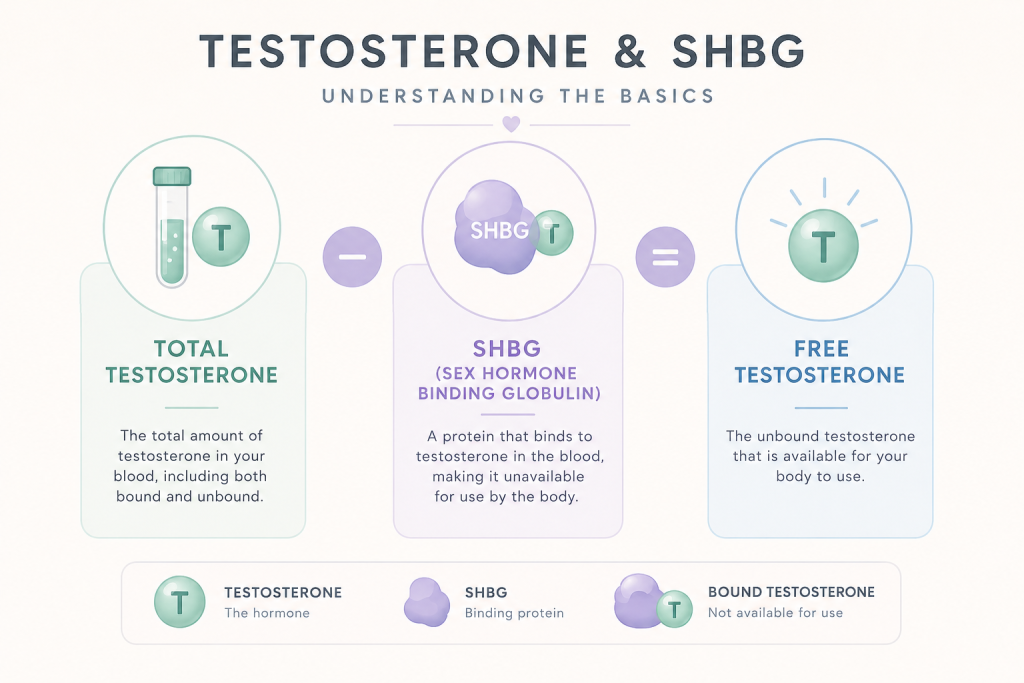
AI-generated image
The SHBG Factor: The Gatekeeper Nobody Talks About
SHBG stands for Sex Hormone Binding Globulin, and it is produced by your liver.
- Think of it as a very possessive protein. When SHBG latches onto testosterone, it holds on tight, and that testosterone goes off the market.
Here’s the important part: the higher your SHBG, the less free testosterone you have, even if your total testosterone looks perfectly fine.
What drives SHBG up?
- Aging (SHBG naturally rises as you get older)
- Chronic stress
- Poor sleep
- Very low-calorie diets
- Excessive cardio
- Liver dysfunction
- Low fat intake
This is why Luke consistently emphasizes that hormonal health is not a single number on a report. It is a reflection of how you are sleeping, eating, moving, and managing stress, every single day.
The 4 Scenarios You Need to Know
Understanding these four situations can completely change how you interpret your own lab work:
Case 1: Total Normal, Free LOW
You have money but it’s all locked up.
Your report looks fine. Your doctor says everything is okay. But you feel exhausted, your libido is low, your workouts aren’t translating into muscle, and your mind is foggy.
This is one of the most underdiagnosed situations in men’s health. The culprit is often high SHBG, quietly binding up most of your testosterone.
Case 2: Total LOW, Free LOW
You simply don’t have enough money at all.
Both numbers are low. The reasons here tend to be:
- Poor sleep quality (even a few nights of disrupted sleep can drop testosterone significantly)
- Obesity and insulin resistance
- Chronic stress keeping cortisol elevated
- Nutritional deficiencies, especially zinc and magnesium
Case 3: Total HIGH, Free LOW
Looks impressive on paper, but misleading.
This one confuses a lot of people, including clinicians. Your total testosterone is elevated, yet you still feel terrible. Very high SHBG is usually the culprit here, trapping testosterone and leaving very little free to work with.
Case 4: Total Normal, Free GOOD
This is the goal.
You have enough, and your body can actually use it. This is what healthy testosterone levels look like in practice, not just on a report.
Why This Matters More Than You Think
A study found that symptoms of testosterone deficiency correlated more strongly with free testosterone levels than with total testosterone. This supports what integrative practitioners have been saying for years: the usable number matters more than the total number.

Source: Lolck, K. V., Alcazar, J., Kamper, R. S., Haddock, B., Hovind, P., Dela, F., & Suetta, C. (2025). Compared to total serum testosterone, calculated free testosterone has a stronger association with lean mass, muscle strength, power, and physical function in older men. Aging clinical and experimental research, 37(1), 203. https://doi.org/10.1007/s40520-025-03107-3

Source: Liu, Z., Liu, J., Shi, X., Wang, L., Yang, Y., Tao, M., & Fu, Q. (2017). Comparing calculated free testosterone with total testosterone for screening and diagnosing late-onset hypogonadism in aged males: A cross-sectional study. Journal of clinical laboratory analysis, 31(5), e22073. https://doi.org/10.1002/jcla.22073
Another important point: testosterone levels are highest in the morning, typically between 7 and 10 AM. If you’re getting blood work done, this timing matters for an accurate picture.
What Kills Free Testosterone (and What You’re Probably Doing)
Most people are unknowingly suppressing their own usable testosterone every single day.
The biggest free testosterone killers:
- Chronic stress (elevated cortisol directly suppresses testosterone production)
- Poor or insufficient sleep (just one week of sleeping 5 hours or less can reduce testosterone by 15%)
- Very low fat diets (testosterone is made from cholesterol; you need healthy fats)
- Extreme calorie restriction
- Excessive endurance cardio
- Sedentary lifestyle
- Nutritional deficiencies in zinc, magnesium, and vitamin D
How to Improve Free Testosterone Naturally
This is where lifestyle as medicine comes in. No quick fixes, no shortcuts. Just the fundamentals done consistently.
Sleep is non-negotiable.
The majority of testosterone production happens during deep sleep. If you are not sleeping 7 to 9 hours of quality sleep, you are actively sabotaging your hormones. Luke has emphasized this repeatedly: sleep is not a luxury. It is a biological requirement for hormone health.
Strength training over excessive cardio.
Resistance training is one of the most evidence-backed ways to raise testosterone and improve testosterone and muscle growth. Compound movements like squats, deadlifts, and presses are particularly effective. Excessive endurance cardio, on the other hand, can raise cortisol and suppress testosterone.
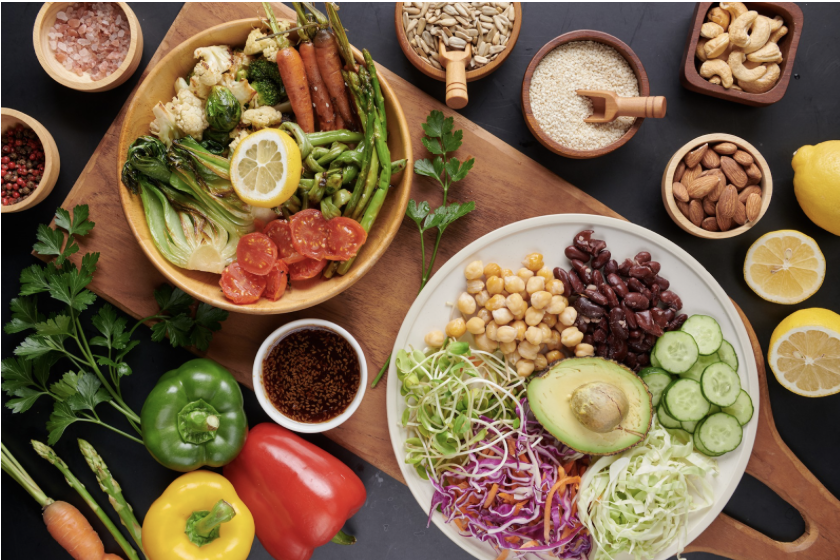
Image Credits: Magnific
Eat enough healthy fats.
Cholesterol is the raw material your body uses to make testosterone. That means avocados, eggs, ghee, nuts, and fatty fish are not your enemies. They are your hormone allies.
Prioritize zinc and magnesium.
- Zinc: found in pumpkin seeds, red meat, shellfish
- Magnesium: found in dark leafy greens, seeds, nuts, and dark chocolate
Both minerals are critical for testosterone production and are commonly depleted in people who are under stress or eating poorly.
Manage insulin levels.
Insulin resistance and obesity are strongly linked to lower testosterone. A diet that keeps blood sugar stable, whole foods, adequate protein, fiber-rich vegetables, and minimal processed sugar, supports healthier hormonal balance overall.
Reduce chronic stress.
This one is uncomfortable because it requires real lifestyle changes. But cortisol and testosterone are in a constant tug of war. When cortisol stays high, testosterone suffers. Meditation, breathwork, nature time, digital detoxes, and genuine rest are not indulgences. They are hormone management.
Want to dive deep into how testosterone affects various aspects of your health and learn actionable strategies to balance your hormones effectively?
Enroll in our online educational course:
Testosterone Boost: A Key to Improving Hormonal Health, Libido, and Fertility
The Most Important Insight from All of This
Luke says it best when it comes to foundational medicine: your lifestyle is your lab report.
A number on a blood test is a snapshot. What creates that number is the quality of your sleep, the food you eat, how you move, how you breathe, and how well you manage your stress.
The shift in thinking here is powerful:
You don’t just want HIGH testosterone.
You want USABLE testosterone.
One Practical Takeaway
If someone tells you “my testosterone is normal but I still feel low,” the next step is always clear:
Check free testosterone AND SHBG together.
Not just total. Not just a single number. The full picture.
This is the kind of nuanced, patient-centered thinking that separates foundational medicine from surface-level diagnosis.
Quick Reference: Free Testosterone vs Total Testosterone
| What You’re Checking | What It Tells You |
| Total testosterone | How much your body produces |
| Free testosterone | How much your body can actually use |
| SHBG | How much is being locked away |
| Albumin-bound testosterone | Loosely bound, partially accessible |

Image Credits: Magnific
The Last Word
Your body is not broken just because a lab report looks “normal.”
Sometimes the numbers are right, but the story they’re telling is incomplete.
Understanding the difference between free testosterone and total testosterone, and the role SHBG plays in between, is one of the most empowering things you can do for your health.
The money metaphor holds. It doesn’t matter how much you own if you can’t access it.
Start with the basics. Sleep more. Stress less. Eat real food. Lift weights. Get the right tests done.
That’s not just advice. That’s the foundation.
Disclaimer: The information provided here is for educational and informational purposes only. It is not intended as a substitute for professional medical advice, diagnosis, or treatment. Always consult your healthcare provider before making changes to your nutrition, lifestyle, or healthcare regimen, especially if you have existing medical conditions or are taking prescribed medications.
Want personalized guidance on hormonal issues?
We help you find a way.
Set up a one-on-one consultation with our foundational medicine team or explore our Hormonal Care Program to optimize your lifestyle goals.
Reach out to us at 1800 102 0253 or write to us at [email protected].