No products in the cart.
Early detection, the foundation-first approach, self-examination, and supplemental screening
When a mammogram report lands in your hands, it often includes a line about breast density. Most women skip past it. But this single detail can change how your cancer risk is assessed and whether your screening is even working for you.
Breast density is not about breast size or firmness. It describes the ratio of fibrous and glandular tissue to fatty tissue inside your breast. Dense tissue and tumors both appear white on a mammogram, which means cancer can hide in plain sight. Radiologists call this the masking effect.
Nearly half of all women who undergo mammography fall into the dense tissue categories. If you are in India and have had a mammogram, there is a good chance you have dense breasts and simply were not told clearly what that means.
The Four Breast Density Categories
Radiologists classify breast density using the BI-RADS (Breast Imaging Reporting and Data System) system. Categories C and D are clinically considered dense.
| BI-RADS | Category | Clinical Description | Screening Implication | Risk Level | Ref. |
| A | Almost entirely fatty | Very little glandular tissue. Excellent imaging contrast. | Standard mammogram, highly reliable. Sensitivity ~93%. | Baseline | [1, 2] |
| B | Scattered fibroglandular density | Mostly fatty with some dense areas. | Mammogram largely reliable. Sensitivity slightly reduced. | Low-Moderate | [1, 2] |
| C | Heterogeneously dense | Many dense areas. Small masses may be obscured. | Masking effect present. Discuss supplemental screening. Sensitivity may drop to ~82%. | Elevated | [2, 3] |
| D | Extremely dense | Almost entirely glandular. Highest masking. | Sensitivity as low as 73%. Supplemental imaging (ultrasound, MRI, CEM) strongly advisable. | High (1.7x) | [2, 3, 4] |
References: [1] ACR BI-RADS Atlas 5th Ed. [2] Lange et al., Am. J. Epidemiology, 2025 (doi:10.1093/aje/kwae245) [3] Melnikow et al., Ann. Intern. Med., 2016 [4] EUSOBI Recommendations 2022
If you have not been told your category, ask your radiologist or doctor at your next visit. You are entitled to this information.
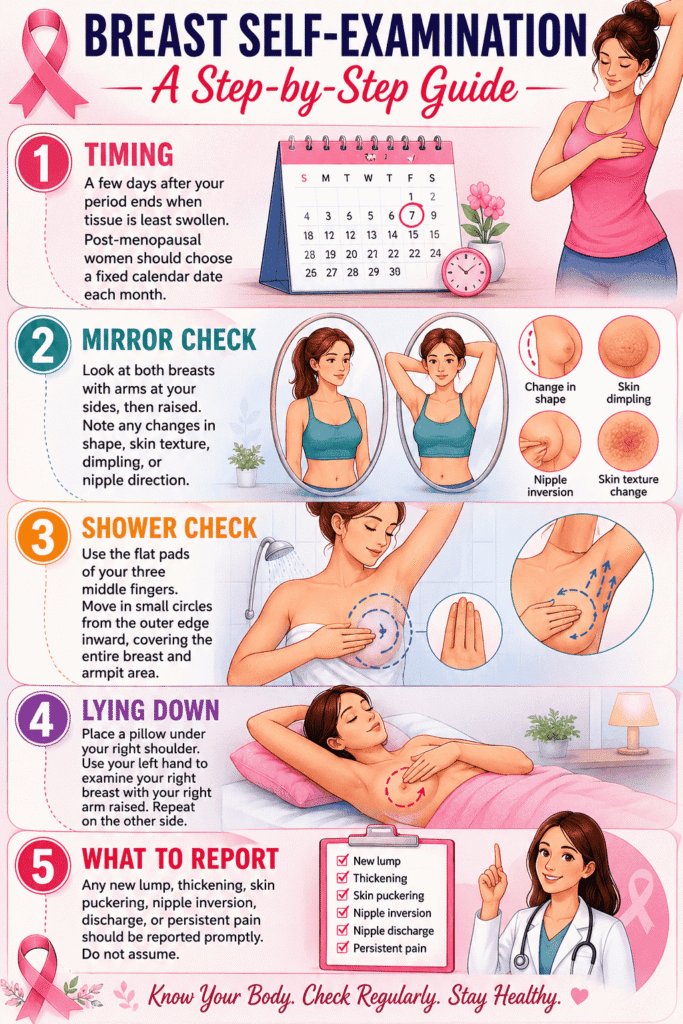
Breast Self-Examination: Building Body Awareness
Self-examination is not a replacement for clinical screening. Its real value is helping you know what is normal for your body so that any change, however subtle, becomes noticeable and can be reported promptly.
Note: Major health bodies do not recommend BSE as a formal screening tool because randomized trials have not shown it reduces breast cancer mortality. The value lies in body familiarity, not clinical detection.
Step-by-Step Technique
- Timing
A few days after your period ends when tissue is least swollen. Post-menopausal women should choose a fixed calendar date each month. - Mirror Check
Look at both breasts with arms at your sides, then raised. Note any changes in shape, skin texture, dimpling, or nipple direction. - Shower Check
Use the flat pads of your three middle fingers. Move in small circles from the outer edge inward, covering the entire breast and armpit area. - Lying Down
Place a pillow under your right shoulder. Use your left hand to examine your right breast with your right arm raised. Repeat on the other side. - What to Report
Any new lump, thickening, skin puckering, nipple inversion, discharge, or persistent pain should be reported promptly. Do not assume.
When Mammography Alone Is Not Enough
If you fall into Category C or D, a standard 2D mammogram may not give you the full picture. Discuss supplemental screening with your doctor.
Breast Ultrasound
Uses sound waves and involves no radiation. Effective at detecting certain cancers mammograms may miss in dense tissue. Best used alongside mammography rather than as a standalone screening tool.
3D Mammography (Digital Breast Tomosynthesis, DBT)
Takes layered X-ray images from multiple angles. Studies show an incremental detection gain of approximately 1.4 to 2.7 additional cancers per 1,000 screens over standard 2D mammography, with a recall rate reduction of 15% to 40%.
Breast MRI
The highest sensitivity of any supplemental screening tool. Recommended for high-risk women, including BRCA1/2 mutation carriers, those with a significant family history, or a personal history of breast cancer.
Contrast-Enhanced Mammography (CEM)
Uses an iodine contrast agent to highlight areas of increased blood flow that may indicate tumor activity. Increasingly available in India and may offer a more accessible alternative to MRI in some settings.
Important: As of 2024, the US Preventive Services Task Force (USPSTF) stated there is insufficient evidence to issue a blanket supplemental screening recommendation based solely on breast density for average-risk women. Decisions should be individualized with your physician.
Six Actions to Take This Week
Not someday. This week. Small actions can make a meaningful difference to your awareness, screening decisions, and overall breast health.
01. Know Your Breast Density Category
If you’ve had a mammogram, contact your radiology center and ask for your BI-RADS breast density category. Understanding whether your breasts are dense is an important part of understanding your screening results and overall risk profile.
02. Discuss Your Results With Your Doctor
Schedule time with your healthcare provider to review your mammogram findings, family history, and personal risk factors. If you have dense breasts, ask whether supplemental screening may be appropriate for you.
03. Strengthen Your Foundations
While breast density itself cannot be changed directly, factors such as nutrition, movement, sleep quality, stress management, and maintaining a healthy body composition contribute to overall health and resilience. Start with one sustainable change this week.
04. Build Body Awareness
Take a few minutes each month to become familiar with what is normal for your body. While self-examination is not a replacement for screening, awareness can help you recognize changes that warrant medical attention.
05. Seek Support When Needed
If you or a loved one is navigating a cancer diagnosis, consider seeking professional support that addresses nutrition, emotional well-being, lifestyle, and quality of life alongside medical care.
06. Share This Information
Breast density remains poorly understood despite affecting millions of women worldwide. Sharing reliable information with a friend, sister, mother, or colleague may encourage someone to have an important conversation with their healthcare provider.
Knowing your breast density is a starting point, not a sentence. Combine that knowledge with the foundation that Foundational Medicine asks you to build, add the right screening tools for your specific situation, and consult your doctor. Informed, proactive healthcare is not about fear. It is about agency.
The Foundation-First Approach
Knowing your density category is step one. What you do with that knowledge, and what kind of internal environment you build every day, is step two.
Cancer Care Is a Whole-Person Journey
What Is Foundational Medicine?
Foundational Medicine is the core philosophy behind all our programs and our most successful outcomes. It is built not on complications, but on a simple truth:
No protocol, treatment, supplement, or plan can work at its full potential if the body’s foundations are weak.
Our Cancer Care Program: What It Offers
Working alongside your oncologist’s care, our Cancer Care Program personalizes nutrition, lifestyle strategies, and mind-body practices to:
- Enhance resilience and manage side effects of treatment
- Reduce inflammation and preserve energy through each phase
- Nurture the body, calm the mind, and strengthen foundations that support quality of life
- Support you through treatment, remission, and beyond
With over a decade of experience across all stages of cancer, this is compassionate, science-backed care that walks with you, honors your journey, and helps you move forward with dignity, clarity, and hope.
A deep dive into breast cancer biology, screening, prevention, genetics, epigenetics, emotional wellbeing, and emerging technologies shaping the future of cancer care.
Breast Cancer Biology: Epigenetics, Screening & Prevention
Need Personalized Support?
If you or a loved one is navigating a cancer diagnosis, our senior team can support you with personalized nutrition, lifestyle, and foundational wellness guidance alongside your medical treatment.
Book a one-on-one consultation with Luke’s Senior Team: Explore the Program
Write to us: [email protected]
Call us: 1800 102 0253
This article is for educational purposes only and does not constitute medical advice. Screening decisions should be made in consultation with a qualified medical professional. All scientific claims are based on peer-reviewed literature and guidelines current as of June 2026.
References
[1] ACR BI-RADS Atlas, 5th Edition
[2] Lange J et al., American Journal of Epidemiology, 2025; doi:10.1093/aje/kwae245
[3] Melnikow J et al., Annals of Internal Medicine, 2016
[4] EUSOBI Supplemental Screening Recommendations, 2022
[5] USPSTF Breast Cancer Screening Guidelines, 2024