No products in the cart.
You land.
The flight was long.
Your eyes feel like sandpaper, your body doesn’t know if it’s 3 AM or 3 PM, and the idea of functioning as a normal human being feels laughably out of reach.
That’s jet lag, the uninvited travel companion that nobody asked for.

Image Credits: Freepik
For frequent international travelers, jet lag isn’t just an inconvenience.
It’s a productivity killer, and for some, a week-long ordeal that turns coming home into its own kind of suffering.
But here’s something most people haven’t been told: jet lag recovery doesn’t have to take a week. With the right routine, you can reset your body clock in as little as 48 hours.
Here, we break down exactly how, starting with what jet lag actually is, why it hits the way it does, and then walk through a practical, proven routine to recover fast.
What Is Jet Lag? Understanding Your Circadian Rhythm
To beat jet lag, you first need to understand what you’re actually fighting.Your body runs on an internal 24-hour clock known as the circadian rhythm.
- This biological system regulates almost everything: when you feel sleepy, when you feel alert, when you’re hungry, when your hormones peak, even when your digestion is most active.
- It is deeply synced to environmental cues, most importantly, light and darkness.
When you travel across multiple time zones, your circadian rhythm doesn’t automatically jump to the new local time. It’s still operating on your departure city’s schedule. So when it’s midnight in Mumbai, your body might think it’s noon in New York, and it’ll act accordingly. That’s jet lag.Common jet lag symptoms include:
- Difficulty falling or staying asleep
- Daytime drowsiness and persistent fatigue
- Brain fog and difficulty concentrating
- Mood disturbances, irritability, low motivation, or anxiety
- Digestive issues and appetite disruption
- A general sense of feeling physically and mentally “off”
The more time zones you cross, the more severe the symptoms tend to be. Eastward travel, like flying from the US back to India, is typically harder on the body than westward travel, because you’re being asked to advance your clock forward, which goes against the body’s natural drift.
Why Jet Lag Hits Harder on Some Routes, And What Luke Did About It
Not all jet lag is created equal. Some routes are simply brutal on the body, and the Mumbai–New York corridor is one of the most demanding in the world.Recently, Luke shared a personal experience. Over his 14 years of traveling between Mumbai and New York, sometimes as many as eight or nine times a year, his jet lag recovery used to stretch to two full weeks.
- Two weeks of disrupted sleep, foggy thinking, and a body completely out of sync with the world around it.
But Luke didn’t accept that as inevitable. He began studying his own patterns, aligning his lifestyle with his circadian biology, and experimenting with a structured reset protocol. The result? He brought that two-week recovery down to one week. Then further. And now, he consistently recovers from the same 14.5-hour transcontinental flight in under 48 hours.That’s not luck. That’s not a younger body or an easier schedule. That’s intentional, informed, and repeatable.The reason the US-to-India route hits so hard comes down to a few compounding factors.
- You’re crossing 10 to 10.5 time zones, which means your body’s internal clock is nearly flipped.
- Add to that the travel fatigue of a long-haul flight, pressurized cabin air, chronic dehydration, disrupted meals, broken sleep in an upright seat, and you land in a significantly depleted state.
- Melatonin production is thrown off, cortisol rhythms are misaligned, and your nervous system is in a low-grade state of stress.
Without a deliberate recovery protocol, your body can take anywhere from five days to two weeks to sort itself out. And most people just wait it out, which is exactly the problem.
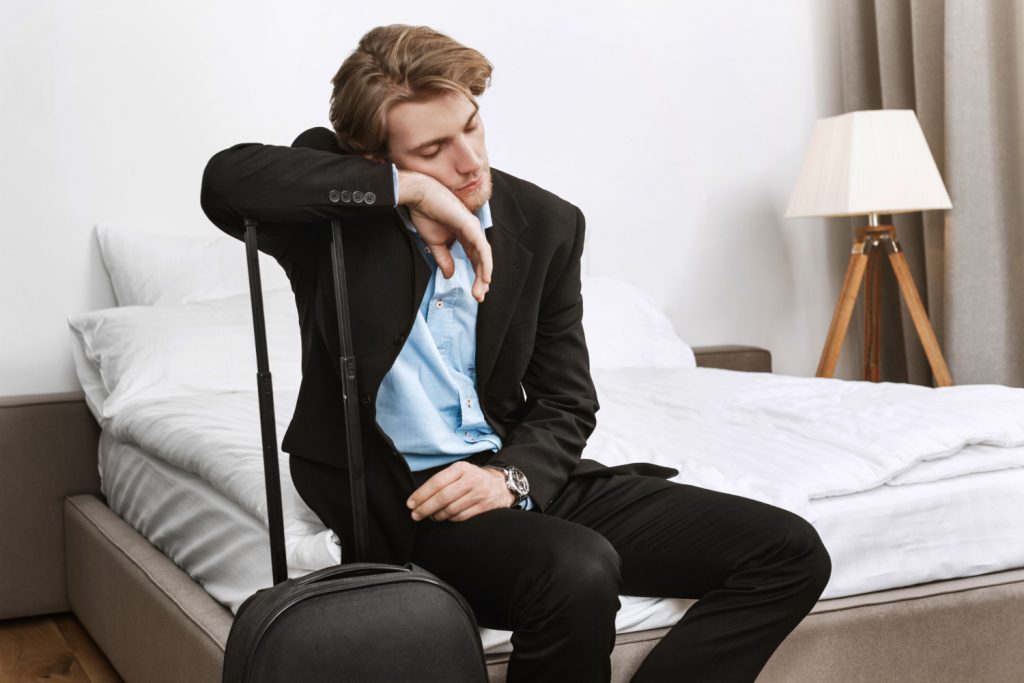
Image Credits: Freepik
The Myth Most Travelers Believe About Jet Lag Recovery
The biggest mistake most travelers make is treating jet lag as something passive, something that just happens to them, and that they simply have to wait out. Power through the days. Survive the sleepless nights. Eventually, the body sorts itself out.That approach works. Eventually. But it’s slow, it’s painful, and according to Luke, it’s completely unnecessary.The truth is that your circadian rhythm responds to intentional inputs.
- Light exposure, meal timing, movement, sleep cues, and specific supplements can all actively signal your body to shift its internal clock faster.
- The difference between a 10-day recovery and a 48-hour one isn’t genetics or willpower, it’s strategy.
As Luke puts it: “It is a myth that you have to have jet lag go on and on. If you align your lifestyle and your rhythms, your body recovers way faster.”
The 48-Hour Jet Lag Reset Routine: What Luke Actually Does
Here’s the protocol Luke followed on his most recent return from New York to Mumbai, aiming to be fully reset within 48 hours. This isn’t theoretical. This is what he did, step by step.Important note: This is Luke’s personal protocol, shared for informational purposes. Always consult a qualified healthcare professional before beginning any new supplement regimen, especially if you have underlying health conditions or are on any medication.
Step 1: Melatonin for Jet Lag: Small Dose, Right Timing
Luke took 1 mg of melatonin at around 6:30 PM on the day he landed, roughly 90 minutes before his target bedtime of 8:00 PM.This is worth paying attention to because the mainstream approach to melatonin is often completely wrong.
- Most over-the-counter melatonin supplements come in 5 mg or 10 mg doses, and many people assume more means better sleep. It doesn’t.
- Low doses of melatonin (0.5 mg to 1 mg) are more effective for circadian shifting than high doses, which can leave you groggy, blunt your natural melatonin production over time, and disrupt the very rhythm you’re trying to fix.
One milligram, timed correctly to your destination’s evening, sends a precise signal to your brain: it’s night here now. That’s the goal.Before you think of consuming melatonin, read this:
https://www.lukecoutinho.com/blogs/melatonin-sleep-side-effects/
Step 2: L-Theanine + Magnesium Glycinate: The Sleep Support Stack
Alongside melatonin, Luke took two supporting supplements in the evening:L-Theanine (200 mg), an amino acid found naturally in green tea.
- It promotes a state of calm without sedation, takes the edge off the low-grade nervous system activation that travel brings, and supports deeper, more restorative sleep. No hangover, no dependency.
Magnesium Glycinate is one of the most bioavailable and gentle forms of magnesium.
- This mineral plays a direct role in muscle relaxation, nervous system regulation, and sleep onset.
- Long-haul flights are dehydrating in ways that deplete key minerals, and magnesium is one of the first to drop.
- Replenishing it in the evening supports the kind of deep, uninterrupted sleep that accelerates circadian recovery.
Together, these three form a gentle, effective, non-habit-forming evening stack that Luke has refined over years of travel.
Step 3: Early Dinner, Balanced and Light
Meal timing is a powerful and often overlooked circadian cue.
- Your digestive system runs on its own biological clock, and eating late at night in your new time zone sends confusing signals to your body, essentially telling it that it’s still daytime wherever you just came from.
Luke had dinner at 6:00 PM, a full 2 to 2.5 hours before his 8:00 PM bedtime.
- His recommendation is ideally 2.5 to 3 hours between your last meal and sleep.
- The meal itself was balanced: good quality protein, some complex carbohydrates, healthy fats, not too heavy, not too light.
- No large, rich, or processed meals that spike blood sugar and keep digestion working overtime through the night.
Eating early and eating well does two things simultaneously: it aligns your gut’s circadian rhythm with your target time zone, and it ensures your body isn’t in full digestive mode when it should be winding down.
Step 4: Sleep Without an Alarm: Let the Body Wake Naturally
Luke was in bed by 8:00 PM, and importantly, set no alarm.
- He woke up naturally the next morning at around 9:00 AM, giving his body approximately 12.5 hours of sleep.
This is counterintuitive to a lot of people who worry that sleeping too long will make jet lag worse.
- But in the immediate aftermath of a 14.5-hour long-haul flight, your body is sleep-deprived and physiologically depleted.
- Allowing it to sleep as long as it needs to, without a jarring alarm interrupting the final stages of REM sleep, supports the hormonal and neurological repair that circadian resynchronization depends on.
The key is that this is a one-time deep sleep window. The rest of the protocol ensures you don’t repeat it indefinitely and accidentally entrench your old time zone.
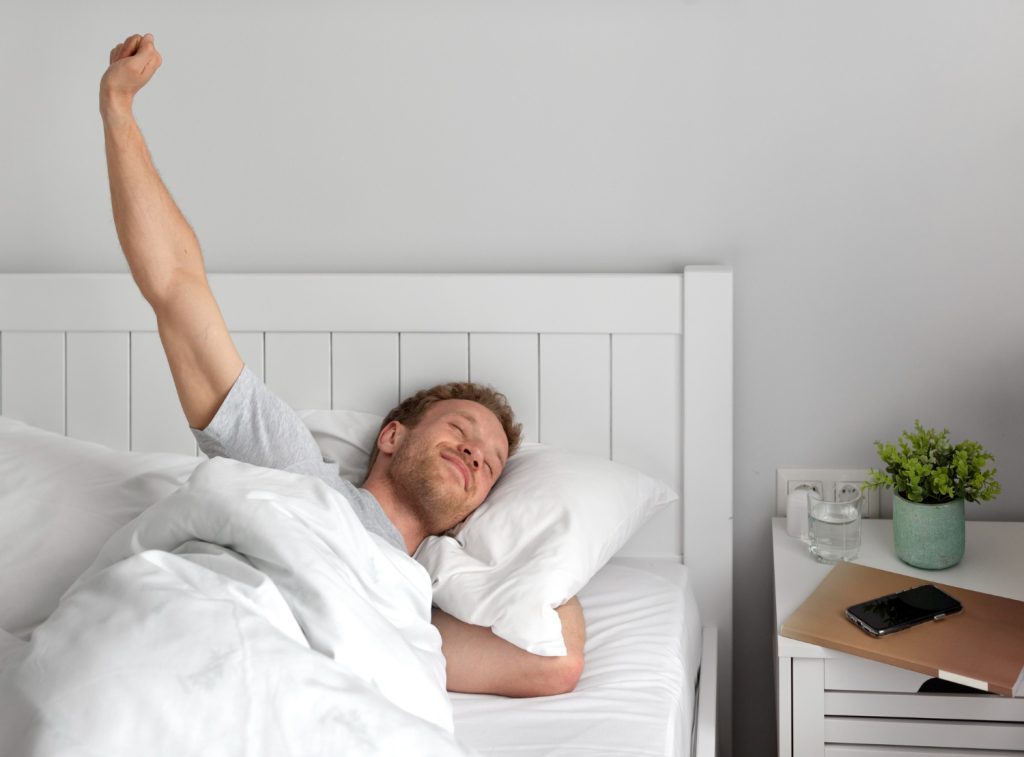
Image Credits: Freepik
Step 5: Morning Sunlight: The Most Powerful Circadian Reset Tool
The moment Luke woke up, he opened the windows and stepped outside for 20 minutes of natural morning sunlight on his body and eyes, followed by a 20-minute walk.This is the single most effective natural intervention for jet lag recovery, and it’s completely free.
- Morning sunlight triggers a cascade of biological signals: it suppresses residual melatonin, triggers an appropriate cortisol rise, boosts serotonin, and most critically, it anchors your circadian rhythm to your new local time zone.
- Your brain’s suprachiasmatic nucleus, the master clock in your hypothalamus, is directly responsive to light hitting your retina. No sunglasses during this window.
- Outdoor light, even on a mildly overcast day, is exponentially more powerful than indoor lighting.
The 20-minute walk layered on top amplifies this further. Light movement in the morning boosts mood, activates the body gently, and reinforces wakefulness without exhausting an already tired system.
Step 6: Coffee, But Done by Mid-Morning
Luke had his coffee after breakfast, with consumption wrapped up by 10:30 AM on Day 1. On Day 2, he extended that slightly to 11:00 AM.This matters more than most people realize.
- Caffeine has a half-life of approximately 5 to 6 hours in the body, meaning a coffee at 3:00 PM still has meaningful stimulant activity at 9:00 PM.
- When you’re trying to fall asleep at 8:00 PM to anchor a new circadian rhythm, even a small amount of residual caffeine can delay sleep onset and reduce sleep quality.
Keep coffee to the morning, and cut it off by late morning at the latest.
Step 7: Blue Light Blocking Glasses After Sunset
As evening approached, Luke put on his blue light-blocking glasses the moment the sun set, and kept them on.
- Artificial light from phones, laptops, TVs, and LED lighting emits blue-spectrum wavelengths that mimic daylight.
- When your eyes register blue light in the evening, your brain suppresses melatonin production and delays sleep readiness.
- For someone trying to reset their circadian rhythm to a new time zone, this is deeply counterproductive.
Blue light-blocking glasses act as an artificial darkness signal.
- They tell your biology that night has arrived, allowing melatonin to rise naturally and your body to begin its wind-down process on local time.
Combined with the melatonin supplement taken at 6:30 PM, this creates a powerful, layered evening cue.
Step 8: No Afternoon Naps, Non-Negotiable
This is the hardest part. The afternoon after a long-haul flight, the pull toward sleep is almost gravitational. But Luke is firm on this: no afternoon naps.Here’s the science behind it.
- Sleep is driven partly by a process called homeostatic sleep pressure.
- The longer you’re awake, the more adenosine builds up in the brain, and the stronger your drive to sleep becomes.
- An afternoon nap, even a short one, relieves enough of that pressure to keep you alert into the late evening, which keeps you anchored in your old time zone’s rhythm.
Push through the afternoon. Get outside. Stay engaged. Let the sleep pressure build so that when 8:00 PM arrives, your body is genuinely ready to sleep deeply and stay asleep.
Step 9: Day 2: Reinforcing the Reset
Day 2 is about locking in what Day 1 started.
- Luke’s plan was identical: wake naturally without an alarm, get 20 minutes of morning sunlight and a walk, coffee wrapped up by 11:00 AM, supplement stack again at 6:00 PM, early balanced dinner, blue blockers on at sunset, and in bed by 8:00 PM.
Two consistent days of aligned light exposure, sleep timing, meal timing, and supplementation are enough to send a clear, repeated signal to the circadian system, and the body responds. By the morning of Day 3, Luke expected to wake feeling fully reset and ready to return to his normal schedule.
Your Body Can Reset Faster Than You Think
Jet lag is not something you have to simply endure. It is a biological misalignment, and like any misalignment, it can be corrected quickly and intentionally when you give your body the right signals at the right times.Luke’s 14-year journey from a two-week recovery to a 48-hour one is proof that the body is far more adaptable than we give it credit for. The protocol isn’t complicated or expensive. It asks for discipline over two days.The reason most people suffer through extended jet lag is not that their bodies are incapable of recovering faster; it’s that their behaviors are actively working against recovery. Whether you’re a frequent flyer on the Mumbai–New York run or someone bracing for their first major long-haul crossing, your circadian rhythm is not your enemy. It’s a system that responds to clear inputs. Give it those inputs consistently, and it will reset faster than you ever thought possible.Align your rhythms. Put in the 48 hours. And get back to living fully.Disclaimer: This blog is intended for educational and informational purposes only and should not be used as a substitute for professional medical advice, diagnosis, or treatment. Always seek the guidance of your qualified healthcare provider before making any changes to your medications or lifestyle.
Also Watch This Video:
Looking for holistic and foundational guidance for jet lag?
We help you find a way.
Set up a one-on-one consultation with our foundational medicine and lifestyle experts or explore our Wellness Programs to optimize your lifestyle goals.
Reach out to us at 1800 102 0253 or write to us at [email protected].