No products in the cart.
Let’s be honest.
You’ve been told your whole life: “Sleep at the same time every night.”
And when life gets in the way, when work runs late, the kids won’t settle, travel wrecks your schedule, or stress just keeps you wired, you feel like you’re failing.
You’re not.

Image Credits: Magnific
This is about freeing you from the guilt of “imperfect” sleep timing and giving you something far more powerful: a way to sleep better in real life, not ideal life.
First, Let’s Address the Elephant in the Room
Sleep consistency matters. We’re not going to pretend it doesn’t.
Research shows a strong association between irregular bedtimes and poor sleep quality.
And as Luke has always said, sleep is one of the four foundational pillars of health. Mess with it, and everything else suffers: energy, mood, immunity, metabolism, and even your hormones.
But here’s what nobody tells you:
Your body responds more to signals than it does to a perfect clock.
And that changes everything.
What Is Your Body Actually Listening To?
Inside your brain sits a tiny region called the suprachiasmatic nucleus (SCN), your body’s master internal clock.
It drives what we call the circadian rhythm, a 24-hour biological cycle that governs when you feel sleepy, when you feel alert, when hunger kicks in, when cortisol peaks, and when melatonin is released.
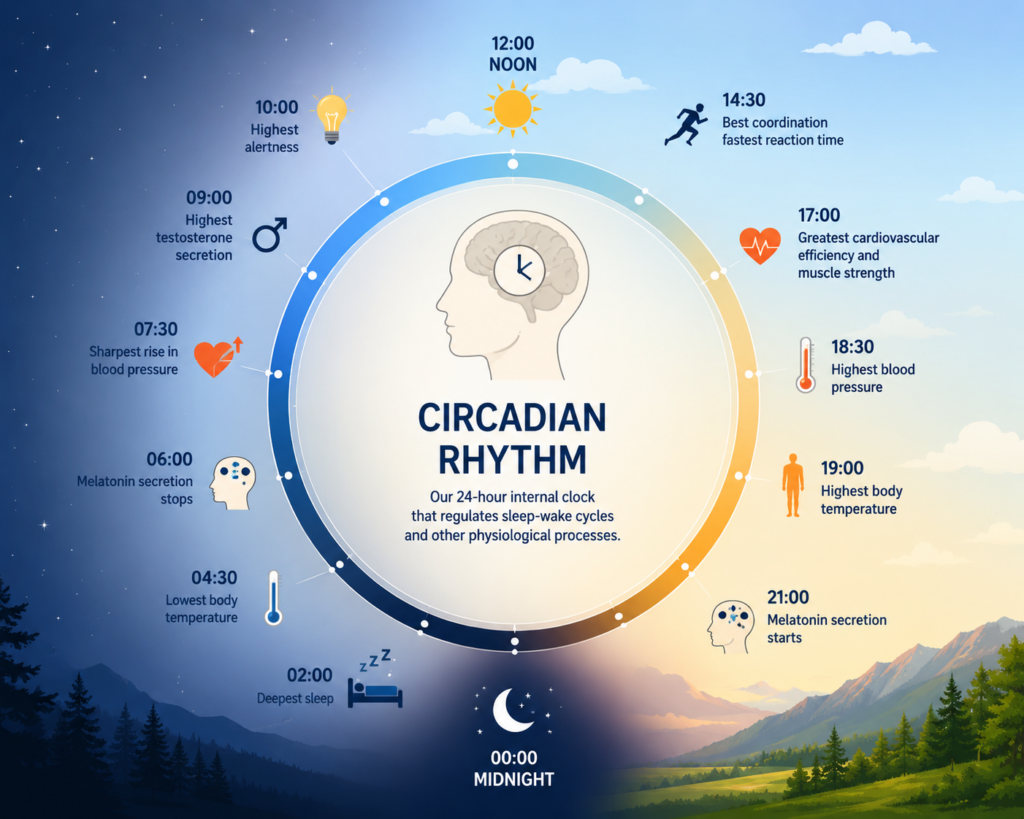
AI-generated image
This clock doesn’t just watch a wristwatch. It reads cues from your environment.
| Signal | What It Tells Your Body |
| Morning sunlight | “Wake up. Start the day. Set the clock.” |
| Darkness at night | “Wind down. Release melatonin. Prepare for bed.” |
| Food timing | “Here’s when to activate digestion and metabolism.” |
| Body temperature drop | “It’s time to sleep.” |
| Nervous system state | “Are we safe enough to rest, or still on alert?” |
These signals are called zeitgebers (German for “time givers”). They are nature’s way of synchronizing your internal rhythm with the world around you.
The problem isn’t that your schedule shifts. The problem is when your body stops receiving these signals clearly.
Why “Sleep at the Same Time Every Night” Is Good Advice But Not the Only Advice
Consistency helps because it trains your brain to expect sleep at a certain hour, which makes melatonin release more predictable. Luke has shared this insight often: “Keep fixed sleep and wake times, at least five days a week.”
But what happens the other two days? Or during a stressful week? Or when you’re traveling across time zones?
You don’t throw the whole system out. You anchor it.
Think of your sleep like a boat. The anchor keeps it from drifting too far even when the tide shifts.
Your anchors aren’t a rigid bedtime. They are non-negotiable daily habits that keep your circadian rhythm relatively stable, no matter what else changes.
The Two Anchors That Work Even When Life Doesn’t
Anchor 1: Get Natural Light When You Wake Up
This is the single most underrated sleep tool in existence.
When morning light hits your eyes, it sends a direct signal to your SCN: the day has started. This:
- Suppresses the remaining melatonin from the night before
- Triggers a healthy cortisol spike (the kind that gives you energy, not the stress kind)
- Starts a 14 to 16-hour countdown to your next window
- Even 5 to 15 minutes outside, without sunglasses, does the job. On cloudy days, it still works because ambient outdoor light is far brighter than indoor light.
Here’s the interesting part: People who get morning sunlight exposure fall asleep faster at night and report better rest, even if their bedtime isn’t perfectly consistent. Your morning sets your night.
This is how you reset your cycle naturally, without medication, without a rigid schedule, and without guilt.
- No expensive gadgets needed
- Works even after a bad night
- Takes under 15 minutes

Image Credits: Magnific
Anchor 2: Calm Your Nervous System Before Bed
This is where most people completely miss the mark.
We spend our evenings doing everything that keeps the nervous system in high alert mode: scrolling through news and social media, watching intense shows, checking work emails, replying to messages, worrying about tomorrow.
And then we wonder why sleep doesn’t come.
As Luke often explains, your nervous system operates in two modes:
- Sympathetic mode: Fight or flight. Alert. Activated. This is NOT sleep mode.
- Parasympathetic mode: Rest and digest. Calm. Safe. THIS is where sleep lives.
You can’t force sleep. But you can create the conditions for it.
What a calming pre-sleep wind-down looks like:
- Dim your lights 60 to 90 minutes before bed
- Stop screens or use blue-light blocking settings
- Try 4-7-8 breathing or left nostril breathing (Chandra Bhedana), which Luke frequently recommends to shift the nervous system into a calmer state
- Do light stretching or Yoga Nidra
- Journal, pray, or practice gratitude
- Keep your bedroom cool (ideally between 16 to 20 degrees Celsius)
The goal isn’t a perfect bedtime. The goal is a calm body when you eventually do lie down.
A wired, alert body at midnight will sleep worse than a calm body at 1 AM.

Image Credits: Magnific
What Happens When You Skip Both Anchors
Let’s say your schedule is all over the place AND you’re not getting morning light AND you’re on your phone until you pass out.
Here’s what your body experiences:
- Melatonin release becomes unpredictable
- Cortisol stays elevated into the evening, making it harder to fall asleep
- Sleep architecture suffers: less deep sleep, less REM, more fragmented nights
- Recovery is poor: growth hormone (which spikes during deep sleep) doesn’t do its job
- You wake up groggy, reaching for coffee, and the whole cycle repeats
This is not a willpower problem. It’s a biology problem.
And the fix is surprisingly simple.
A Quick Cheat Sheet
| Situation | What to Do |
| Traveling or jet-lagged | Get sunlight at the local morning time ASAP |
| Worked late, slept at 1 AM | Still wake at your regular time, get light exposure |
| Stressed and wired at night | Breathing + dim lights 60 mins before bed |
| Shift work or irregular hours | Anchor your wake time, control your wind-down signals |
| Can’t sleep, lying in bed anxious | Get up briefly, do slow breathing, return when sleepy |
A Note on Foundational Medicine
At Team Luke, we approach health from the inside out. Sleep is not just about rest. It is deeply woven into every system in your body.
Poor sleep disrupts:
- Hunger hormones like ghrelin and leptin (hello, weight gain and cravings)
- Inflammatory pathways
- Blood sugar regulation
- Immune defense
- Emotional regulation and mental resilience
When we help our clients rebuild sleep, we don’t start with supplements or trackers. We start with the basics that move the needle: light, calm, consistency where possible, and compassion for the days it isn’t.
As Luke has always said, the body has a remarkable ability to heal when you stop fighting it and start working with it.
The Mindset Shift That Changes Everything
Most people don’t have a sleep problem.
They have a guilt problem.
They lie awake not just because their cortisol is high, but because they’re mentally beating themselves up for not sleeping. That anxiety becomes its own barrier to rest.
So here’s the reframe:
Consistency is a goal. Not a reason to feel like you’re failing.
You don’t need a perfect schedule to have better sleep. You need two reliable anchors, a calmer nervous system, and a little bit of self-compassion.
Some nights will be harder than others. That’s real life. What matters is what you do the next morning.
Get the light. Keep the signal going. Wind down tonight. Repeat.

Image Credits: Magnific
The Last Word
Start here:
- Morning: Get 5 to 15 minutes of natural light right after waking up, every day
- Evening: Begin dimming your environment and your nervous system 60 to 90 minutes before bedtime
- Bedtime: Aim for consistency where you can, but don’t punish yourself when life happens
- Night: If you can’t control the clock, control the signals your body receives
Your body is not broken.
It’s just waiting for the right cues.
Disclaimer: The information provided here is for educational and informational purposes only. It is not intended as a substitute for professional medical advice, diagnosis, or treatment. Always consult your healthcare provider before making changes to your lifestyle or healthcare regimen, especially if you have existing medical conditions or are taking prescribed medications.
Looking for support to manage your circadian rhythm?
We help you find a way.
Set up a one-on-one consultation with our foundational medicine team or explore our Wellness Programs to optimize your lifestyle goals.
Reach out to us at 1800 102 0253 or write to us at [email protected].