No products in the cart.
Imagine this.
It is May. The heat has peaked, schools have shut, and every second WhatsApp group is buzzing with travel plans. Hill stations, beaches, international trips, packed itineraries, matching outfits, reels waiting to be made.
You wait for this all year.
And yet, you return… exhausted.
Your sleep is off. Your digestion feels heavy. You need a “holiday after the holiday.”
If this sounds familiar, you are not alone. This is what researchers and psychologists increasingly call the vacation paradox.
We plan holidays to rest but often return more depleted than before.
Let’s unpack why this happens and what a truly restorative holiday actually looks like.
The myth of “earned rest”
Many of us carry an invisible belief:
“I will rest once I have earned it.”
So what happens?
We overwork before the trip to “clear everything.”
We overpack the trip to “make the most of it.”
We return to an overload of pending work.
Rest becomes conditional, not natural.
Psychologically, this is linked to what behavioral scientists call ‘effort justification.’ The more effort we put in, the more we feel the outcome must be maximized. So your 4-day holiday becomes a 20-item checklist.
Instead of slowing down, you perform rest.
Overplanning is not relaxation
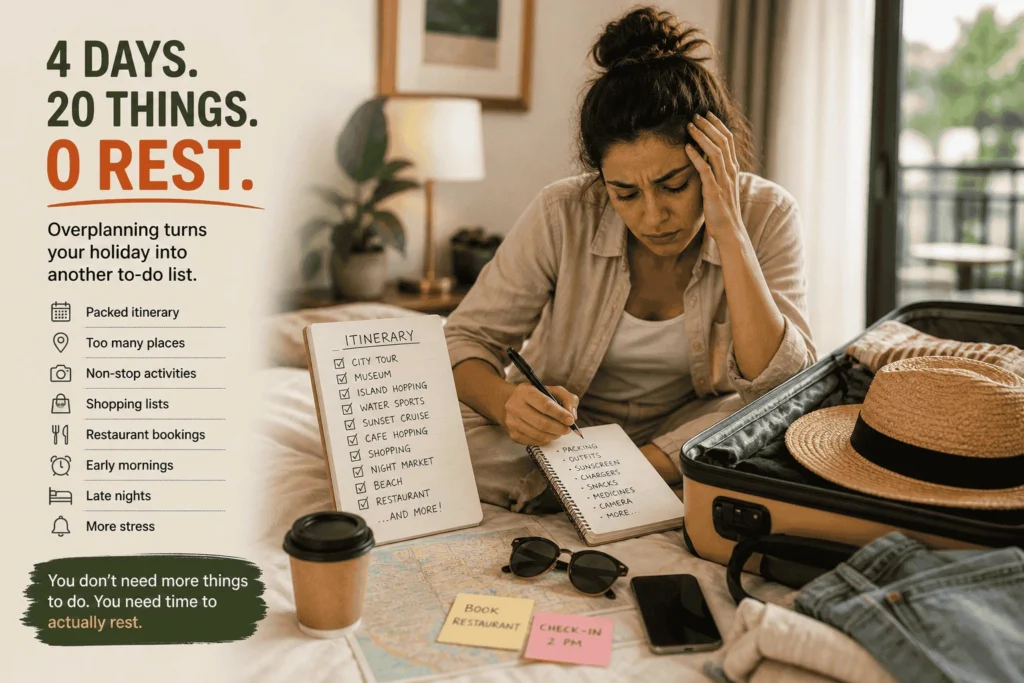
Source: AI
Let’s make this real.
Day 1: Travel + sightseeing + dinner reservation
Day 2: Sunrise point + local market + activity + photoshoot
Day 3: Adventure sport + café hopping + shopping
Day 4: “Chill day” that still has 5 things planned
Your body does not read this as rest. It reads this as stimulation.
Research shows that constant novelty, decision-making, and time pressure keep cortisol levels elevated, even during leisure time. Your nervous system remains in a mild “on” state instead of shifting into repair mode. (McEwen, 2007; Koolhaas et al., 2011).
This is why you feel wired but tired.
Sleep debt tourism is real
Most holidays start with poor sleep.
Late-night packing
Early morning flights
Irregular meal timings
Different beds and environments
Increased screen exposure
A 2018 study in the Journal of Sleep Research found that even small disruptions in sleep timing can affect circadian rhythm and next-day cognitive function.
Now add alcohol, heavy food, and inconsistent routines.
You are not catching up on rest. You are accumulating sleep debt in a new location.
The body needs different inputs than the mind
Your mind wants novelty. Your body wants rhythm.
This mismatch is at the heart of the vacation paradox.
The mind says:
“Let’s explore, do more, and try everything.”
The body quietly needs the following:
Regular meals
Consistent sleep
Gentle movement
Low stimulation
Time without decisions
When the mind dominates the holiday, the body pays the price.
What does a restorative holiday actually look like?
Let’s shift the lens.
A restorative holiday is not about doing less for the sake of it. It is about doing what allows your nervous system to downshift. (Sonnentag & Fritz, 2007; McEwen, 2007)
Here is what that looks like in practice.
1. Plan less than you think you need
Instead of filling every day, choose one anchor activity per day.
For example:
- Morning nature walk
- Afternoon rest
- Evening light exploration
Leave gaps. Boredom is not a problem. It is a gateway to recovery. (Sonnentag & Fritz, 2007)
2. Protect your sleep like you protect your itinerary
Simple, practical shifts:
- Keep a consistent sleep and wake window within 60 to 90 minutes
- Avoid heavy meals late at night
- Limit screens at least 30 minutes before sleep
- If travelling across time zones, get sunlight exposure early in the day
Think of sleep as the foundation of your holiday, not an afterthought. (Åkerstedt et al., 2018)
3. Eat for energy, not just indulgence
Yes, enjoy your food. But also notice how you feel after.
A simple rule:
One indulgent meal, one balanced meal.
Hydration matters more than you think, especially in summer travel.
Your gut is deeply connected to your energy levels. When digestion is off, everything feels heavier.
4. Build in “nothing time”
This is uncomfortable for many people.
Sitting without a plan. No phone. No agenda.
But this is where your nervous system resets.
Even 20 to 30 minutes a day of intentional stillness can shift your entire holiday experience. (Kühnel & Sonnentag, 2011)
5. Move gently, not aggressively
You do not need a holiday workout plan.
But your body does need movement.
Walking, swimming, stretching, light yoga.
Movement supports circulation, digestion, and sleep. It signals safety to your body.
6. Watch your “performance mode”
Are you trying to capture every moment?
Or actually live it?
Constant documenting, posting, and comparing keeps your brain in evaluation mode.
Try this:
Create a few “no photo” pockets in your day. Be present without proof.
A different way to define a “good holiday”
Instead of asking:
“How much did I do?”
Ask:
“How did I feel?”
- Did I wake up without an alarm at least once?
- Did I feel light after meals?
- Did I have moments of real stillness?
- Did my mind slow down?
If the answer is yes, you rested.
Bringing it back to May holidays
For many families, especially in India, May means travel with children, packed schedules, and high expectations.
Try this small shift:
Instead of designing a “perfect trip,” design a sustainable rhythm.
Children do not need more activities. They need relaxed parents.
A slower holiday often becomes a more memorable one.
The real takeaway
You do not need another holiday.
You need a different relationship with rest.
Rest is not something you earn after exhaustion.
It is something you build into your life, including your holidays.
So the next time you plan a trip, ask yourself:
Am I planning to escape my life for a few days?
Or am I creating a space where my body can finally breathe?
That one question can change everything.
If your holidays leave you more tired than restored, it may not be a time-off problem. It may be a recovery problem.
And that is something most of us were never taught.
You don’t have to figure this out alone.
You can speak to our team or explore our Wellness Programs to build a lifestyle that supports better rest, steady energy, and long-term health.
📞 1800 102 0253
📧 [email protected]
Disclaimer:
This article is intended for educational purposes only and is not a substitute for personalised medical or lifestyle advice. Individual needs may vary based on health conditions, medications, and lifestyle factors. Please consult your healthcare professional before making significant changes to your routine, especially if you have an existing medical condition.
References
- De Bloom, J., Geurts, S. A. E., & Kompier, M. A. J. (2013). Effects of vacation from work on health and well-being. Journal of Happiness Studies, 14(2), 613–633.
- Nawijn, J., Marchand, M. A., Veenhoven, R., & Vingerhoets, A. J. (2010). Vacationers happier, but most not happier after a holiday. Applied Research in Quality of Life, 5(1), 35–47.
- Kühnel, J., & Sonnentag, S. (2011). How long do you benefit from vacation? Journal of Organizational Behavior, 32(1), 125–143.
- Åkerstedt, T. et al. (2018). Sleep timing and its effects on performance and alertness. Journal of Sleep Research, 27(4).