No products in the cart.
We can message anyone, anytime. A voice note in two seconds. A reaction to a story. A meme that says, “Thinking of you.” We can keep up with someone’s life without speaking to them for months. And yet, so many people are quietly starving for something basic: being seen, understood, and safe enough to be real.
This is the strange part of modern connection. Out of sight becomes out of mind. And somewhere inside, we all sense it. That’s why we feel lonely and still can’t put the phone down.
This is why we need to redefine loneliness. Loneliness isn’t only about sitting alone. Loneliness is sitting with people and still feeling alone. It’s being in a relationship, being in a family, being in a crowd, and still feeling socially disconnected.
And here’s the line that wakes people up: you’re smoking 15 cigarettes a day, but you’re not a smoker. Not to scare you. To bring this loneliness epidemic into the light, so we can stop normalizing it and start rebuilding real connections, one honest conversation at a time.
What Loneliness Actually Means (And What It’s Not)
We need to clear up something important, because most people are not ‘bad at relationships.’ They’re just confusing three different experiences and then blaming themselves for the wrong one.
Loneliness is a quality gap. You can be surrounded by people, have plans every weekend, and still feel emotionally unseen. We hear this often: “I have people around me, but I can’t talk to anyone.”
Social isolation is a quantity gap. Fewer calls. Fewer check-ins. Less human contact built into your week. This is the person who moved cities, works remotely, or is an older adult whose children live far away. Sometimes they feel lonely, sometimes they don’t, but the structure of connection is missing.
And then there’s solitude, which most people don’t even realize they need. Solitude is chosen. It’s the hour you take for a walk, prayer, journaling, or just quiet, and you come back feeling like yourself again. Solitude restores you. Loneliness drains you.
Here’s a simple test. Think of that one friend you can call and drop the act. You don’t have to be “fine.” You can be honest. You hang up feeling lighter. Now compare it to being in a room full of people, laughing at the right moments, replying to messages, and still feeling like you’re behind glass. That’s loneliness.
Loneliness isn’t a personality flaw. It’s a signal. And when the symptoms of loneliness start showing up in your sleep, energy, mood, and behavior, it’s not you being weak. It’s your system asking for real connections, not more performance.
The Science: Why It’s Being Compared to Smoking
When we say, “loneliness is like smoking 15 cigarettes a day,” it can sound dramatic. But this comparison didn’t come from social media. It came from public health.
The U.S. Surgeon General’s advisory on social connection highlighted something most people don’t expect: lacking social connection can increase the risk of premature death as much as smoking up to 15 cigarettes a day. It also reported that loneliness and social isolation are linked with a higher risk of premature death (often cited as 26% for loneliness and 29% for social isolation). And it connects poor social connections with increased risk for disease, including heart disease and stroke (commonly cited around 29% higher heart disease risk and 32% higher stroke risk).

Source: Our Epidemic of Loneliness and Isolation, 2023, The U.S. Surgeon General’s Advisory on the Healing Effects of Social Connection and Community
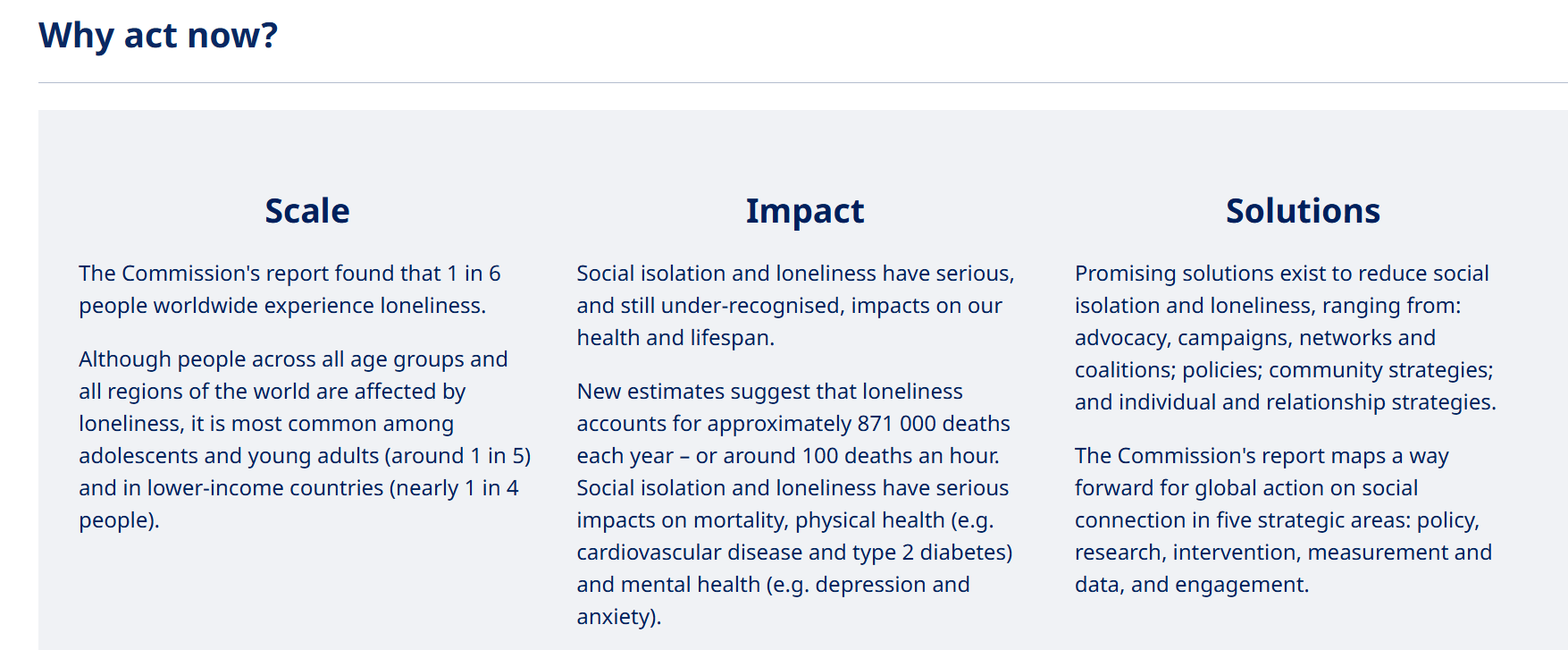
Now, let’s zoom out. This isn’t a niche issue affecting a few people. The WHO Commission on Social Connection reports that about 1 in 6 people worldwide experience loneliness, and it’s most common among adolescents and young adults, roughly 1 in 5.
The effects of loneliness on health are not just emotional; they’re biological. And the link between loneliness and mental health is equally real, because the body can’t separate emotional safety from physical survival.
The Body Treats Disconnection Like a Threat State
One of the most important things we’ve learned over the years is this: feeling safe is a core human need. And when that sense of safety is missing, even quietly, the body doesn’t treat it like a small emotional issue. It treats it like a threat.
That’s why loneliness can feel confusing. People will say, “Nothing is technically wrong. Life is fine.” And yet their system feels on edge, tired, heavy, and reactive. Because when the nervous system doesn’t feel emotionally safe or socially supported, it starts to dysregulate.
Here’s what that often looks like in the body, in simple terms:
- Chronic loneliness (feeling emotionally disconnected for long periods)
- A heightened stress response (more time in fight-or-flight, higher cortisol output)
- A higher internal inflammation load (the body is bracing, not repairing)
- Sleep disruption and chronic fatigue patterns (you’re exhausted, but you don’t rest deeply, no matter how many hours of sleep you get)
And this is where many people recognize themselves.
You’re eating ‘right’, but you still feel drained. You want to work out, you know movement will help, but you feel too lethargic to even begin. You sit in front of the television. You doomscroll. You feel tired after doing very little, because your body is spending energy just staying alert.
These are not character flaws. These are side effects of loneliness when it becomes chronic and a spiral. The body doesn’t separate emotional disconnection from survival. It interprets it as instability.
We also see another layer people don’t talk about enough: loneliness and pain. When you feel unsupported or unsafe, your ability to cope with discomfort reduces. The same ache can feel louder. Recovery can feel slower. Even small symptoms can feel more overwhelming, because you’re carrying them alone.
This is why our first step is awareness. Once you see the pattern, you can start regulating the system, restoring safety, and rebuilding connection in ways that feel real and sustainable.

AI-generated Image
How Loneliness Shows Up Day-to-Day (Symptoms You Can Actually Recognize)
Symptoms of loneliness don’t always look dramatic. Most of the time, they look like your body and mind quietly switching into survival mode. You may still be doing “all the right things” on paper, but inside, something feels off.
Physical
- Constant fatigue, even after rest
- Low energy throughout the day
- Low motivation to move
- Disrupted or lighter sleep
- Feeling drained for no clear reason
Mental and emotional
- Feeling disconnected even around people
- Sadness in a crowd
- Feeling unseen, unheard, or misunderstood
- Overthinking conversations after they end
- Pretending to be okay because explaining feels exhausting
Behavioral
- Doomscrolling to fill the silence
- Withdrawing from plans you once enjoyed
- Irritability, snapping, getting triggered easily
- Avoiding calls, replying late, ‘disappearing.’
- Losing interest in things that used to feel good
None of this makes you weak. It makes you human. And it’s also why we take it seriously.
If this feels familiar for weeks, it’s time to respond, not judge.
If these patterns feel familiar most days for weeks, that’s not a character flaw. That’s your system asking for connection, safety, and support.
Why We’re Lonelier Now (Even With Infinite Access)
This is the strange part of modern life: we have infinite access to people, and yet many of us feel more emotionally cut off than ever. We’ve replaced check-ins with updates.
Social media gives us contact without closeness. It keeps us informed, but not necessarily held.
When we were younger, we had fewer interactions, but they carried more value. That one phone call mattered. That one letter from a friend felt like the highlight of your week. Meeting someone took planning, effort, and commitment. And that effort is exactly what builds trust and intimacy.
Today, convenience has reduced the “work” of connection. No planning. No awkwardness. No vulnerability. Just scroll, react, move on.
Over time, that gap can feed the loneliness epidemic. And for some people, loneliness can overlap with low mood. We end up feeling lonely, and depression starts to look like the same cloud: low energy, low hope, low interest, and a nervous system stuck in threat.
This is not about blaming technology. It’s about noticing what it replaced, and deciding what we want to bring back.
The Touch Deficit and the Loss of ‘It Takes a Village’ Mindset
A message can update you. A meme can distract you. But neither can replace the nervous-system safety we get from real presence.
And this is where the next layer of the loneliness story begins: touch deficit, and the quiet disappearance of the village.
The Touch Deficit: What We’re Missing Without Realizing It
Humans are wired for safe, appropriate touch. Not forced. Not performative. Not boundary-crossing. We mean the kind of touch that gently tells the body, you’re not alone, you’re safe here.
It can be simple:
- A hug that lasts an extra second
- A hand on the shoulder when someone’s struggling
- Cuddles with your child at bedtime
- Holding your partner’s hand without multitasking
- Sitting beside a friend in silence, not needing to explain everything
Safe touch is not a luxury. It’s a biological signal. It lowers the stress response and helps the body shift into repair. That’s why touch-based support, from comforting presence to therapies like massage, has been linked in research to measurable benefits in stress regulation, mood, and overall well-being. We don’t need to oversell it. We just need to respect it.
And when people say, “I don’t know why I feel so on edge,” sometimes it’s not because something terrible happened. Sometimes it’s because their body has gone too long without the simplest human cues of safety.
The Village Deficit: When Belonging Stops Being Built-in
Now add the second layer. When we lose community structure, we don’t just lose social plans. We lose built-in support.
Across many traditional communities, belonging was woven into daily life. There were roles, rhythms, and repeated points of contact that made connection almost unavoidable in the best way.
Think about what used to exist naturally:
- Neighbors who checked in without an agenda
- Elders who were included, not sidelined
- Shared meals, shared celebrations, shared responsibilities
- Community groups, faith spaces, and local rituals
- Familiar faces you’d see regularly, without planning weeks in advance
In that structure, loneliness still existed, but there were more “safety nets” of human contact. There were more chances to be noticed. More moments of touch, laughter, and shared life.
Today, individualism, speed, relocation, nuclear living, and screen-first routines have thinned those structures out. We can live in a building for years and not know the person next door. We can be in a family and still feel emotionally unsupported. We can be surrounded by people and still feel alone, because the connection is not felt.
This is why loneliness doesn’t improve just by being ‘busy’ or ‘social.’ It improves when we rebuild what the nervous system recognises as real: safety, repetition, and belonging.
Even when we understand this, even when we want to reconnect, many of us still don’t. Not because we’re stubborn, but because something inside has learned that closeness comes with a cost.
When the nervous system has a history of hurt, it doesn’t ‘snap out of it.’ It protects.
Root Causes We See Often
Chronic loneliness rarely starts as “I don’t have people.” It often starts as “I don’t feel safe with people.” And once the body learns that closeness equals hurt, it chooses distance as protection.
We see a few roots show up often:
- Bullying scars that taught someone to stay quiet, stay agreeable, stay guarded
- Betrayal or criticism that made vulnerability feel risky
- Abusive dynamics where a person was controlled, shamed, or made to feel small
- Failure stories that quietly become identity: “I’m the one who messes up,” “I’m not enough,” “I don’t belong.”
Grief is another big one. Losing a loved one or a pet can collapse a person’s sense of meaning, and connection starts to feel pointless because everything reminds them of what’s gone.
We also see substance use deepen loneliness. When dopamine is repeatedly hijacked, real life can feel dull, and people withdraw even further, not because they don’t care, but because nothing feels worth the effort.
And on the question, can loneliness cause depression? Chronic loneliness can increase vulnerability to low mood and depression, especially when it becomes a long-term pattern. That’s why the way out is rarely ‘try harder.’ It’s rebuilding safety, slowly, in small steps.
The Way Out: Small, Brave, Real Connection
The way out of loneliness is rarely a big personality change. It’s usually one small act of honesty, repeated until your nervous system starts trusting connection again. And one of the fastest ways to feel connected again, without overthinking it, is simple: be useful to someone. Service creates meaning. Meaning creates belonging.
This matters because loneliness and mental health often overlap, and the effects of loneliness on health are real enough that we shouldn’t ignore the signal.
A) Identify (1 minute of honesty)
Before we ‘fix’ anything, let’s find clarity.
- What are we feeling, really? (Lonely, unseen, disconnected, numb?)
- What do we need? (To be heard? Reassurance? Presence?)
- Who is one safe person? (Not perfect. Just safe enough.)
Then we name it, without drama: “I feel lonely.”
B) Reach out (Scripts that don’t blame)
Keep it short. No emotional essays. One degree of vulnerability.
Partner
- “I feel lonely. I’m not blaming you. I just want to feel understood. Can we talk for 10 minutes tonight?”
Parent or Child
- “Can we talk for 10 minutes without advice? I just want you to hear me.”
Friend
- “No pressure, but I miss real conversation. Can we catch up properly this week, even for a short walk?”
C) Serve (Connection grows when we stop living only inside our heads)
When we feel lonely, we often wait for someone to notice us. Service flips the equation. It puts us back into humanity.
Start small and local:
- In your own family: Who seems stressed, quiet, or overwhelmed? Offer a kind ear, not solutions.
- In your circle: Check in on the friend who always checks on everyone else.
- With elders: Visit, call, sit, listen. Many seniors are lonely and won’t say it.
- With the sick or struggling: A short visit, a message, a meal, help with an errand.
- Volunteering: Choose one cause you can show up for consistently, even once a week.
Faith can help here too, not as preaching, but as practice: community, service, humility, and showing up for others.
D) Build a connection ladder (So it doesn’t depend on motivation)
Instead of more people, we build more consistency.
- Step 1 (today): One message to one person
- Step 2 (this week): One 15–20 minute call or walk, scheduled
- Step 3 (this month): One recurring touchpoint (volunteering, class, support circle, faith/community space) where we show up regularly
And when it feels deeper, heavier, or long-standing, please don’t carry it alone. Our Emotional Wellness Coaches are trained to help you gently rebuild safety, communication, and nervous system regulation in a way that fits real life.
CTA: Book a consult with our Emotional Wellness Experts and let’s take the next step together.
Final Word: Returning to Human Values
If we’re honest, the answer to loneliness isn’t just more social plans. It’s a return to human values we’ve quietly drifted from.
Across most faiths and traditions, the message is surprisingly consistent: serve, be compassionate, be present, take care of your neighbour, don’t let someone suffer alone. You don’t have to follow any one path to understand this. When we return to those values, we return to ourselves.
We don’t need more followers. We need more real-life friendships.
So keep it simple. Choose one person this week. Have one honest conversation. Create one small ritual you can repeat, a walk, a shared meal, a bedtime check-in, a short call where you don’t pretend you’re fine.
And if you’re reading this quietly thinking, “This is me,” know this: it’s okay to be lonely. It’s not okay to do nothing about it.
If you’re struggling with any emotional or mental health issue, don’t wait.
Schedule a consultation with our emotional wellness counselors or life coaches or call us at 1800 102 0253.
Ready for a personalized approach to your health?
Explore our Wellness Programs to optimize your health goals.
Disclaimer: This blog is for educational and informational purposes only and is not a substitute for professional medical advice, diagnosis, or treatment. Always seek the advice of your physician or qualified healthcare provider with any questions you may have regarding a medical condition.