No products in the cart.
You go for a routine health check-up. The CBC (Complete Blood Count) report looks fairly normal, until one value catches your eye: ESR (Erythrocyte Sedimentation Rate). It’s highlighted in bold, showing high ESR levels.
You pause for a moment, what does high ESR mean if you aren’t experiencing any symptoms? You type it into Google and suddenly find yourself spiraling through endless articles suggesting infections, inflammation, and even more serious concerns. The confusion deepens. Should you worry? Or should you brush it off as something minor, like ESR during periods, which some say is common?
This is where most people get stuck, in that grey zone of uncertainty. ESR is one of those blood parameters that doctors often order, but very few explain in detail. And yet, its significance lies not in the number itself, but in what it reflects about your internal environment.
So, first, let’s understand what ESR is.
What is ESR?
Let’s break this down step by step. The red blood cells that flow through your veins are also called erythrocytes. Beyond carrying oxygen, they can reveal a lot about what’s happening inside your body, especially when measured through a test called the Erythrocyte Sedimentation Rate, or ESR.
In simple terms, ESR measures how quickly these red blood cells settle at the bottom of a tall, thin test tube filled with your blood. Under normal conditions, erythrocytes settle slowly. But when there’s inflammation in the body, certain proteins, like fibrinogen (blood-clotting proteins) and immunoglobulins (antibodies), increase in the blood. These proteins cause red cells to stick together in stacks, called rouleaux, which sink faster.

Source: Erythrocyte Sedimentation Rate – ESR. (n.d.). Mcgill.Ca. Retrieved September 15, 2025, from https://www.medicine.mcgill.ca/physio/vlab/bloodlab/ESR.htm
The result?
High ESR levels.
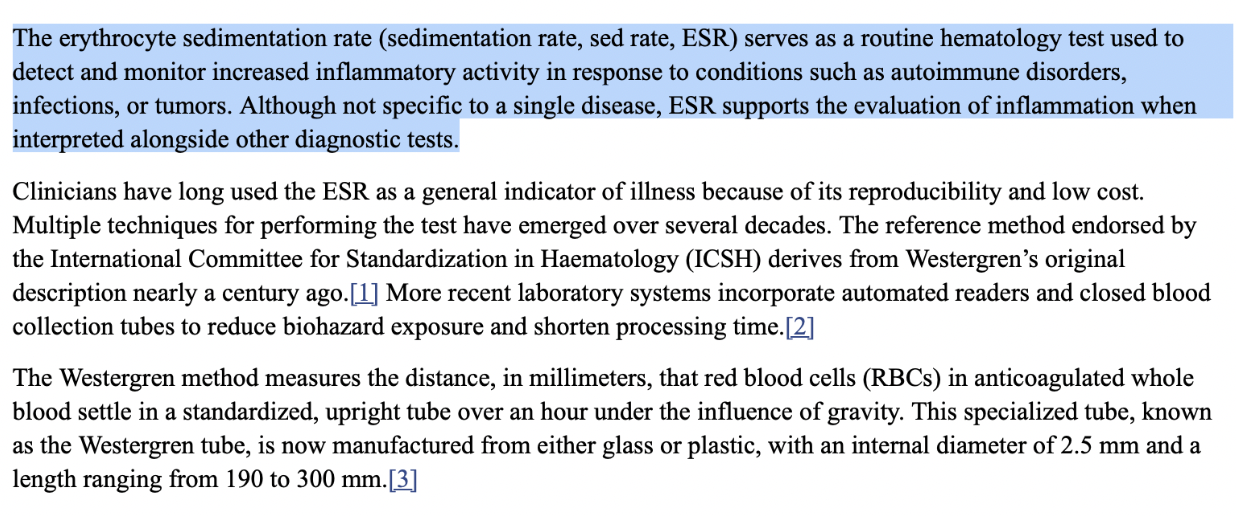
Source: Tishkowski K, Zubair M. Erythrocyte Sedimentation Rate. [Updated 2025 Jul 7]. In: StatPearls [Internet]. Treasure Island (FL): StatPearls Publishing; 2025 Jan-. Available from: https://www.ncbi.nlm.nih.gov/books/NBK557485/
| Did you know? The test itself has a fascinating history. The principle of blood sedimentation was first noted in the 18th century by surgeon John Hunter, but it was physicians like Edmund Biernacki, Robert Fahraeus, and Alf Westergren in the late 19th and early 20th centuries who refined the method into what we use today. In fact, the Westergren method is still considered the global gold standard, endorsed by the International Council for Standardization in Haematology (ICSH) because of its reproducibility and reliability. |
Red blood cells normally repel each other due to a natural negative charge on their surface, called the zeta potential. But when inflammation increases proteins in the blood, this charge is reduced, allowing cells to clump together and sink more quickly. That’s exactly what the ESR test picks up, the speed of sedimentation reflecting the presence of systemic inflammation.
So, while ESR remains one of the oldest and simplest laboratory markers in medicine, it continues to be a valuable tool. Its low cost, ease of testing, and ability to flag hidden inflammation make it widely used in clinical practice, from routine check-ups to monitoring chronic illnesses.
Image Credits: Freepik
ESR is not a disease and not even a diagnosis; it is only a marker. Think of it as your body’s smoke alarm. The alarm doesn’t tell you whether it’s a kitchen fire or just burnt toast; it only tells you something is going on that needs a closer look.
That’s why when people ask, “what does high ESR mean?”, the answer is—it means your body is mounting some kind of response, but it does not, by itself, tell you the cause.
Normal ESR and When It Naturally Rises
To understand what high ESR means, it helps to first know what’s considered normal. ESR values are not the same for everyone; they vary with age, sex, and even life stages.
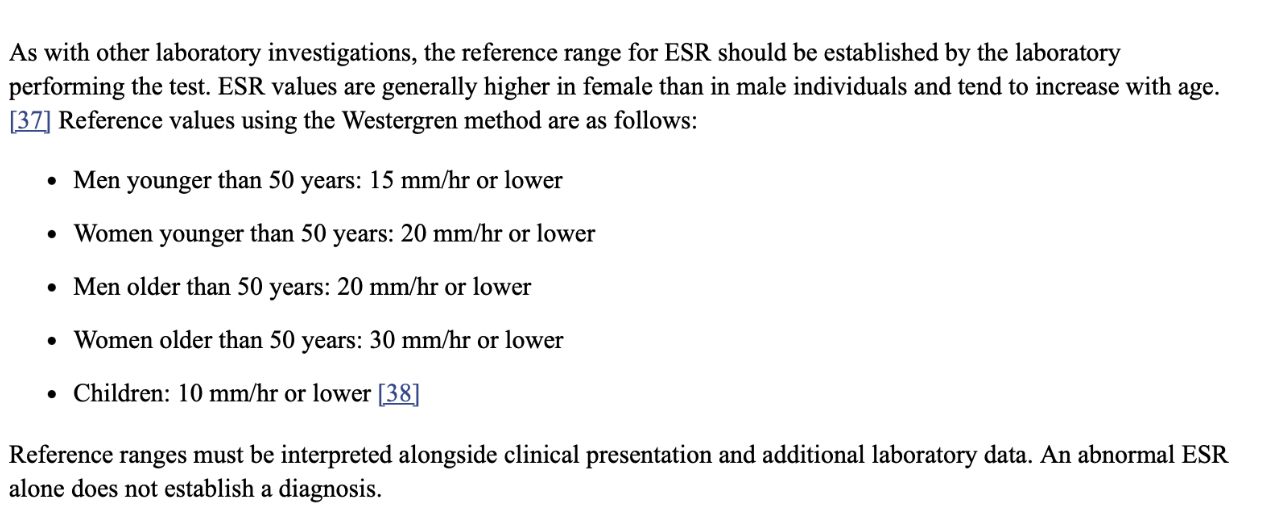
Source: Tishkowski K, Zubair M. Erythrocyte Sedimentation Rate. [Updated 2025 Jul 7]. In: StatPearls [Internet]. Treasure Island (FL): StatPearls Publishing; 2025 Jan-. Available from: https://www.ncbi.nlm.nih.gov/books/NBK557485/
Sometimes high ESR levels do not indicate disease at all; they can be a natural response to physiological changes. For instance, ESR during periods is known to rise temporarily.
This happens due to hormonal fluctuations, particularly changes in estrogen and progesterone, which influence proteins like fibrinogen in the blood. Elevated fibrinogen promotes red blood cells to clump and settle faster, resulting in a higher ESR. That’s why many doctors recommend doing the test at least 10 days after menstruation begins, unless it’s medically urgent, to avoid misinterpretation.
Pregnancy is another natural state where ESR may climb. During gestation, plasma proteins increase, and the body undergoes significant immune and hormonal adjustments. ESR can rise significantly as pregnancy progresses, particularly in the second and third trimesters, without signaling any disease. Similarly, menopause and aging can lead to mildly higher ESR values. This is partly due to changes in hormone balance and the gradual increase in inflammatory markers that naturally accompany aging.
So, before panicking about causes of high ESR, it’s crucial to remember that numbers must always be seen in context. Sometimes, it’s simply the body’s way of reflecting natural hormonal and physiological rhythms rather than hidden illness.
How Do You Find Out About High ESR?
Unlike blood sugar or blood pressure, high ESR levels don’t usually make themselves obvious. In fact, ESR on its own produces no direct symptoms; you only discover it through a simple blood test. That’s why many people are caught off guard when they see the value highlighted in their report and wonder, what does high ESR mean if I feel fine?
ESR is less about symptoms and more about signals. When it is elevated, any discomfort you notice usually stems from the underlying condition driving the rise. For example, in autoimmune conditions like rheumatoid arthritis or lupus, you may experience persistent joint pain and stiffness, and research confirms ESR often correlates with disease activity in these disorders.
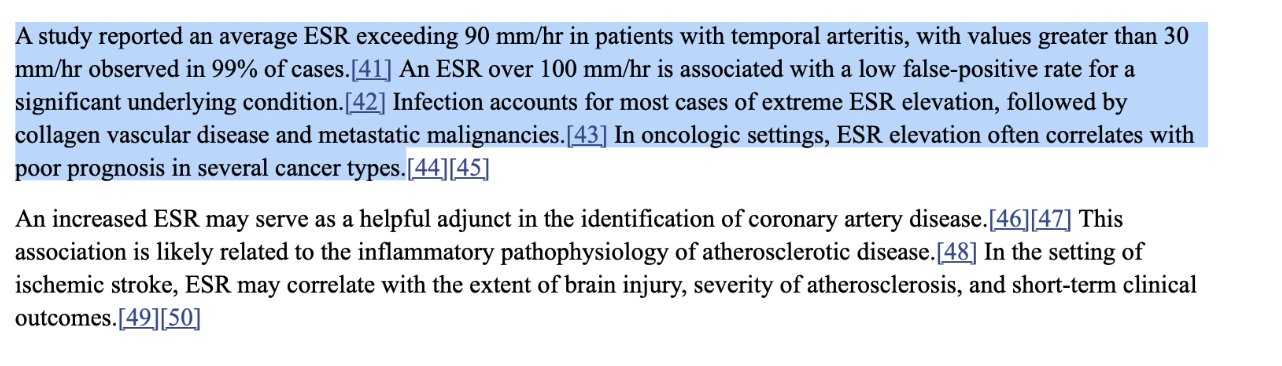
Source: Tishkowski K, Zubair M. Erythrocyte Sedimentation Rate. [Updated 2025 Jul 7]. In: StatPearls [Internet]. Treasure Island (FL): StatPearls Publishing; 2025 Jan-. Available from: https://www.ncbi.nlm.nih.gov/books/NBK557485/
What Does High ESR Mean? Tracing the Underlying Causes
Here are some of the most commonly recognized contributors:
- Autoimmune Disorders: Conditions such as rheumatoid arthritis, systemic lupus erythematosus (SLE), and vasculitis are well-known drivers of high ESR levels. These diseases trigger chronic immune activation, increasing acute-phase proteins like fibrinogen and immunoglobulins that make red blood cells settle faster. In fact, ESR has historically been used to monitor disease activity in rheumatoid arthritis and lupus.
2. Chronic Infections: Persistent infections often push ESR higher, especially when the immune system is engaged over weeks or months. Tuberculosis is a classic example, where elevated ESR frequently accompanies active disease. Even seemingly minor or hidden infections, such as urinary tract infections or gum infections, can trigger a sustained rise.

Image Credits: Freepik
3. Cancers: Though less common, some malignancies can present with unexplained high ESR levels. Blood-related cancers such as lymphoma and multiple myeloma are particularly associated with this marker, largely because abnormal proteins in circulation enhance red cell aggregation. In such cases, ESR often rises significantly and persistently, making it an important clue when paired with other findings.
4. Chronic Diseases: Systemic illnesses like chronic kidney disease, liver disease, and poorly managed diabetes can also elevate ESR. These conditions alter blood protein composition, contributing to inflammation. The rise here is usually moderate but persistent, reflecting a body under long-term physiological stress.
5. Anemia: Iron deficiency, particularly in women, is another reason for raised ESR. With fewer red blood cells and changes in their shape, sedimentation happens more rapidly. This is why an anemic patient might show high ESR levels even without infection or autoimmune activity.
6. Lifestyle Factors: Your daily habits matter more than you think. Research shows that smoking, excessive alcohol intake, obesity, and sedentary behavior are all linked to higher ESR values, owing to their role in driving low-grade systemic inflammation.

Source: Alende-Castro, V., Alonso-Sampedro, M., Vazquez-Temprano, N., Tuñez, C., Rey, D., García-Iglesias, C., Sopeña, B., Gude, F., & Gonzalez-Quintela, A. (2019). Factors influencing erythrocyte sedimentation rate in adults: New evidence for an old test. Medicine, 98(34), e16816. https://doi.org/10.1097/MD.0000000000016816
7. Emotional Trauma and Unresolved Stress: Unresolved trauma can elevate inflammatory pathways, reflected as subtle but persistent changes in ESR and related markers. Chronic stress has been associated with elevated inflammatory markers, ESR included, through prolonged activation of the hypothalamic–pituitary–adrenal (HPA) axis. This is a reminder that healing is not only about the body, it’s also about the mind and emotions.

Source: Mbiydzenyuy, N. E., & Qulu, L. A. (2024). Stress, hypothalamic-pituitary-adrenal axis, hypothalamic-pituitary-gonadal axis, and aggression. Metabolic brain disease, 39(8), 1613–1636. https://doi.org/10.1007/s11011-024-01393-w
When Should You Visit a Doctor?
A mildly elevated value, especially if you feel well, may not be alarming on its own. In such cases, doctors often recommend a ‘wait and watch’ approach, repeating the test after a few weeks or correlating it with other investigations before deciding on next steps.
But there are times when causes of high ESR signal something more serious, and ignoring it would be unwise. Medical guidance becomes crucial if elevated ESR is accompanied by certain red-flag symptoms. For instance:
- Persistent fever or unexplained night sweats
- Unintended weight loss
- Severe joint or muscle pain
- Ongoing fatigue despite adequate rest
- Chronic cough, breathlessness, or recurring infections
The golden rule is this: don’t panic, but don’t ignore either.
What NOT To Do if You Have High ESR
When faced with high ESR levels, it’s natural to feel anxious and start overthinking. But here’s what you should avoid:
- Don’t panic or assume the worst.
High ESR is a non-specific marker. It can rise in many conditions, from infections to autoimmune disorders, anemia, or even temporary changes like ESR during periods. It does not point to a single disease. - Don’t self-medicate with anti-inflammatories.
Popping painkillers or steroids to ‘bring the number down’ only masks symptoms and may delay the right diagnosis. The focus should be on finding the cause, not just lowering the value - Don’t repeat tests unnecessarily.
ESR values naturally fluctuate due to stress, minor infections, or even physical activity. Repeated testing without medical guidance creates more worry than clarity. Retesting is useful only when symptoms persist or treatment monitoring demands it. - Don’t ignore the lifestyle connection.
Chronic stress, poor food habits, lack of sleep, smoking, and obesity all contribute to low-grade inflammation, which can keep ESR elevated.
Why Just Taking Anti-Inflammatories Isn’t the Answer
When blood reports show high ESR levels, the quick fix many people reach for is anti-inflammatory medication. While these pills may temporarily reduce pain or bring down inflammation markers, they do not address the real causes of high ESR, be it chronic infection, autoimmune activity, or silent metabolic stress.
Indiscriminate use of anti-inflammatories can even mask serious conditions and delay accurate diagnosis. The right approach is not to chase numbers but to ask: “What does high ESR mean in my context?”
That’s where a doctor’s evaluation, lifestyle assessment, and targeted investigations truly matter.
Do We See Low ESR Too?
After discussing high ESR levels and the many possible causes of high ESR, you may wonder: what does high ESR mean if the opposite also exists?
Interestingly, while clinicians often focus on elevated values, ESR can sometimes be unusually low but this is very rare. For example, sickle cell disease alters the normal flexibility of red blood cells, preventing them from settling easily, which lowers the sedimentation rate. Even severe dehydration can lead to lower readings because of changes in plasma volume and concentration of proteins that normally influence sedimentation.
How to Support Your Body if You Have High ESR
With high ESR levels, the focus should not be on chasing the number but on addressing the cause. Chronic inflammation is both a driver and a consequence of many illnesses, and lowering it requires a blend of medical guidance and sustainable lifestyle choices:
- Medical Guidance Comes First: The most important step is to work with your doctor to understand the causes of high ESR in your unique case. ESR is a marker, not a diagnosis, and ruling out conditions like infections, autoimmune disorders, or anemia is essential before focusing on lifestyle corrections.
- Heal the Gut, Heal the Inflammation: The gut is the command center of immunity. Dysbiosis and poor gut barrier function can amplify low-grade inflammation. Food rich in fiber, prebiotics, and probiotics, think whole grains, fermented foods, and fresh vegetables, helps restore balance. Cutting back on ultra-processed foods and refined sugars is equally important.
- Choose Anti-Inflammatory Nutrition: What you eat daily shapes how your immune system behaves. Omega-3 fatty acids from flaxseeds, walnuts, or fatty fish help downregulate inflammatory pathways. Spices like turmeric and ginger, along with antioxidant-rich foods such as berries, green tea, and leafy greens, reduce oxidative stress and lower inflammation.
- Manage Stress Before It Manages You: Chronic emotional stress is increasingly recognized as a contributor to systemic inflammation. Elevated cortisol and sympathetic overdrive to persistent immune activation. Mind-body practices like meditation, journaling, yoga, and breathwork help bring the nervous system back into balance, which in turn helps the body regulate inflammation.

Image Credits: Freepik
5. Prioritize Rest and Recovery: Sleep is not passive; it’s the body’s nightly repair cycle. Evidence shows that 7–8 hours of restorative sleep supports immune regulation and lowers inflammatory markers. Consistent sleep hygiene, like dark rooms, fixed timings, and digital detox before bed, can make a significant difference.
6. Move, But Don’t Overtrain: Gentle, consistent movement is one of the most effective ways to lower inflammation. Walking, yoga, tai chi, and light strength training reduce pro-inflammatory cytokines while improving circulation. Overtraining, however, can have the opposite effect, so balance is key.

Source: Alende-Castro, V., Alonso-Sampedro, M., Vazquez-Temprano, N., Tuñez, C., Rey, D., García-Iglesias, C., Sopeña, B., Gude, F., & Gonzalez-Quintela, A. (2019). Factors influencing erythrocyte sedimentation rate in adults: New evidence for an old test. Medicine, 98(34), e16816. https://doi.org/10.1097/MD.0000000000016816
7. Quit Smoking, Moderate Alcohol
Both smoking and excess alcohol are well-documented drivers of systemic inflammation. Quitting smoking and reducing alcohol intake can significantly improve ESR and other inflammatory biomarkers.
Myths Around ESR
Whenever people see high ESR levels on their blood report, fears and misconceptions quickly take over. But much of what circulates online or in casual conversations is misleading.
Let’s set the record straight with science.
Myth 1: High ESR always means cancer.
Fact: False. While malignancies can sometimes elevate ESR, the most common causes of high ESR are far less alarming, such as chronic infections, iron-deficiency anemia, or autoimmune conditions like rheumatoid arthritis.
Myth 2: “You can lower ESR just by taking medicine.”
Fact: Not true. Medications may temporarily reduce inflammation, but they do not address what’s driving the elevation. Resolving the underlying trigger, be it gut dysbiosis, an infection, or chronic stress, is what truly brings ESR back into balance.
Myth 3: “Normal ESR means no inflammation.”
Fact: False. Some conditions, such as early-stage infections or mild autoimmune flares, may not show immediate changes in ESR. Clinical reviews point out that ESR often rises slowly and may miss subtle or early inflammatory activity. That’s why doctors also rely on other markers like C-reactive protein (CRP) alongside ESR.
Final Word: Decoding ESR With Wisdom
When we ask, what does high ESR mean, the answer is never one-size-fits-all. High ESR levels don’t define your health, but they do demand attention.
They can point to infections, autoimmune imbalances, nutritional gaps, or sometimes simply natural variations like ESR during periods. Instead of fearing the number or chasing quick fixes, view it as a guiding marker. The real progress comes when we investigate the causes of high ESR, address the root drivers of inflammation, and create an internal environment where balance is restored.
Your body is always communicating; ESR is just one of its many voices. The key lies in listening deeply, responding wisely, and working with, not against, your biology.
If this resonated with you, also read:
View this post on Instagram
Disclaimer: This blog is intended for educational and informational purposes only. It is NOT a substitute for professional medical advice, diagnosis, or treatment. If you have high ESR levels or are concerned about your health, please consult a qualified healthcare professional for personalized evaluation and care. Never disregard or delay seeking medical advice because of information you have read here.
Noticing high ESR levels in your blood report can feel concerning, but you don’t have to face it alone.
Our team is here to help you understand the possible causes of high ESR and provide guidance through personalized nutrition, lifestyle strategies, and expert medical advice.
Reach out to us at 1800 102 0253 or email [email protected] to explore a thoughtful approach to your health.