No products in the cart.
It is not in your head, it is not just stress, and it is definitely not something you have to accept. Here is what is really happening and what you can do about it.
Palak is 38. She has managed her period for over two decades without much strain. But in the last year and a half, the week before her period has become something she quietly dreads. Mood swings that feel out of proportion. Bloating is so severe she avoids fitted clothes. Fatigue that no amount of sleep fixes. She tries to push through. Her doctor says everything is “normal.” But nothing about this feels normal to her, and she is right to question it.
If you are in your mid-to-late thirties and your premenstrual syndrome (PMS) has shifted from manageable to genuinely disruptive; you are not imagining things. Something real is changing in your body, and it starts well before perimenopause officially begins. The good news is that nutrition and lifestyle can have a significant stabilizing effect, not as a quick fix, but as a genuine recalibration of the systems driving your symptoms.
What is actually changing after 35
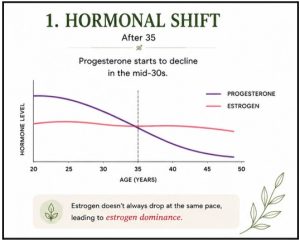
Starting in the mid-thirties, progesterone levels begin a gradual decline. Estrogen, however, does not always decline at the same pace. This creates a state called estrogen dominance, where the ratio of estrogen to progesterone is skewed. It is not necessarily that estrogen is sky-high; it is that progesterone is no longer there to balance it. The result is heavier, more unpredictable periods, increased water retention, worse mood volatility, and heightened breast tenderness before menstruation.
Source: AI
At the same time, insulin sensitivity begins to shift in this age window. The body becomes slightly less efficient at managing blood sugar, which is critically relevant to PMS because blood sugar instability amplifies every hormonal symptom you already have. Irritability feels sharper. Fatigue becomes an inability to function. Cravings spike, especially for sugar and simple carbohydrates. What you eat in the two weeks before your period is no longer irrelevant background noise. It is actively shaping how that week feels.
Then there is the depletion factor. Years of monthly cycles, combined with dietary gaps, stress, and gut health changes that accumulate with age, leave many women in their late thirties quietly low in three key micronutrients: magnesium, vitamin B6, and omega-3 fatty acids. Each one plays a direct role in hormone metabolism and mood regulation. When they are depleted, PMS does not just appear. It escalates.
“The body is not failing. It is adapting to a new hormonal terrain. Your job is to give it the raw materials it needs to adapt well.”
The three micronutrients that matter most
Nutrient | Why it matters | Food sources |
| Magnesium | Regulates the nervous system, reduces cortisol spikes, and helps muscles relax, including the uterus. Deficiency is directly linked to cramps, anxiety, and poor sleep in the premenstrual phase. | Pumpkin seeds, dark leafy greens, dark chocolate (70%+), almonds, black beans |
| Vitamin B6 | Critical for the production of serotonin and dopamine. Without enough B6, your brain cannot manufacture the neurotransmitters that buffer mood and reduce the emotional sharpness of PMS. | Chickpeas, salmon, chicken, bananas, sunflower seeds, sweet potato |
| Omega-3 | Reduces prostaglandin production, which directly drives menstrual pain and inflammation. Also supports brain health and reduces the depressive undertone many women notice pre-menstrually. | Fatty fish (sardines, mackerel, salmon), flaxseeds, walnuts, chia seeds |
These are not optional additions to a healthy diet. For many women over 35 dealing with worsening PMS, they are the nutritional floor. Getting enough of them from real food consistently, not in a single meal or a week-long attempt, is what begins to change the pattern.
Blood sugar is not a side issue
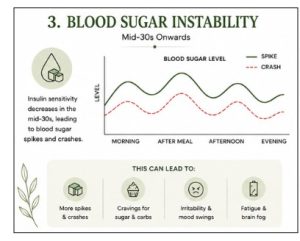 In the luteal phase, which is the second half of your cycle after ovulation, your body becomes more insulin resistant by default. It is a physiological reality, not a personal failure. This means the same meal that felt fine earlier in your cycle may cause a more pronounced blood sugar spike and crash in the ten days before your period. Those crashes feel like irritability, sudden hunger, brain fog, and emotional reactivity that seems disproportionate to the situation.
Stabilizing blood sugar in the luteal phase is one of the most underutilized tools for PMS management. This does not mean going low-carb or restricting food. It means pairing carbohydrates with protein and fat at every meal, eating at regular intervals instead of skipping meals, reducing refined sugar and processed foods specifically in this window, and not treating coffee on an empty stomach as a morning ritual. These are not dramatic changes. But applied consistently in the second half of your cycle, they create a measurable difference in how you feel.
Your body is not becoming difficult.
It is asking for different support than it needed at 25.
Nutrition that actually supports PMS after 35
Nutrition as a stabilizer means building a consistent daily foundation, not adding supplement stacks and calling it done. It means eating enough. Women in their thirties under-eat protein chronically, and protein is the structural backbone of hormone production. It means including adequate fiber to support estrogen clearance through the gut, since excess estrogen is eliminated via the digestive tract, and constipation or poor gut motility literally recirculates it. It means hydration, not as a cliché, but because dehydration worsens bloating, headaches, and fatigue that are already amplified premenstrually.
It also means being honest about what is depleting you. Alcohol in the luteal phase worsens estrogen dominance. Chronic under-sleeping raises cortisol, which competes with progesterone at the receptor level. Extreme caloric restriction signals stress to the body and suppresses progesterone production. If you are doing any of these consistently, no supplement will compensate adequately.
PRACTICAL STARTING POINTS
- Track your cycle and identify your luteal phase. Start your nutritional adjustments on day 15, not just the week of your period.
- Add a portion of good-quality protein to every meal, especially breakfast. This is non-negotiable for blood sugar stability.
- Eat magnesium-rich foods daily: a handful of pumpkin seeds, a serving of dark leafy greens, or a small square of dark chocolate.
- Include fatty fish at least twice a week in the luteal phase, or consider a quality omega-3 supplement if fish is not part of your diet.
- Eliminate alcohol and significantly reduce refined sugar in the ten days before your period for at least two full cycles before evaluating results.
- Prioritize seven to eight hours of quality sleep in this window. Sleep deprivation is hormonal disruption, not just tiredness.
- Do not skip meals, especially during the luteal phase. Eat every three to four hours even if hunger cues feel muted.
This takes cycles, not days
One of the most important reframes is time. Hormone patterns do not shift in a week. The body recalibrates across cycles. Most women who apply these changes consistently report a noticeable difference within two to three months, with meaningful improvement by months four to six. That is not slow. That is biology. The mistake is expecting a fast result, not seeing one in three weeks, and abandoning the approach entirely.
You are also not trying to eliminate PMS entirely. Some premenstrual sensitivity is normal physiology. The goal is to bring it back to a level that does not disrupt your work, your relationships, or your sense of self. That is achievable for most women through consistent, targeted nutritional and lifestyle support.
Ready to address the root of your hormonal imbalance?
You do not have to figure this out alone. Sometimes the right guidance, nutrition strategy, and lifestyle support can make all the difference across cycles.
Start with a one-on-one consultation with our foundational medicine team or explore our Hormonal Care Program designed to support women through PMS, perimenopausal changes, energy fluctuations, and hormone-related symptoms with a more integrative approach.
📞 Call us at 1800 102 0253
📧 Write to us at [email protected]
Disclaimer:
This article is intended for educational and informational purposes only. It is not a substitute for professional medical advice, diagnosis, or treatment. Always consult your physician, gynecologist, or a qualified healthcare provider before making changes to your diet, supplement regimen, or lifestyle, particularly if you have a diagnosed health condition or are on medication. Individual results vary. The information presented here reflects integrative nutrition principles and should be used as a complement to, not a replacement for, conventional medical care.