No products in the cart.
Most of us don’t feel unhappy. We just don’t feel settled.
Even on good days, the mind keeps reaching forward. Another goal. Another plan. Another distraction. Another reason why this moment isn’t quite enough yet.
You finish what you were chasing and instead of relief, there’s a quiet discomfort. Not dissatisfaction, more like restlessness. A feeling that something is missing, even when nothing really is.

Image Credits: Freepik
We’re told to be grateful. To want more. To push harder. To upgrade constantly. So we do. And somehow, the more we have access to, the harder it becomes to sit still with it.
This isn’t because we’re broken, ungrateful, or incapable of contentment. It’s because the brain was never designed for constant stimulation. It was designed for effort, pauses, and meaning. Modern life removes the pauses but keeps the wanting.
This is not about rejecting ambition or pleasure. It’s about understanding why enough feels uncomfortable, how dopamine quietly drives that discomfort, and why learning to slow down isn’t a moral choice, it’s a neurological one.
Here’s what you’ll explore:
- Why the brain is wired to keep wanting more, even after getting what it asked for
- What dopamine detox actually means (and what it doesn’t)
- How constant stimulation keeps the mind restless and unsettled
- The real consumerism effects on mental health, beyond shopping and screens
- A grounded, psychology-backed dopamine detox routine for daily life
- How gratitude creates mental clarity instead of forced positivity
- Why simplicity is the new luxury in an overstimulated world
- What the neuroscience of happiness reveals about lasting contentment
Why “Enough” Rarely Feels Enough
You hit the goal.You buy the thing.You finally get the break, the raise, the praise, the perfect meal.
And for a moment, it feels good.
Then the mind quietly asks, What’s next?
Consumerism trains us to believe that fulfillment lives just one purchase or one achievement away. Over time, this loop takes a toll. The consumerism effects on mental health show up as restlessness, comparison, and a constant feeling of insufficiency, even when life looks “good” on paper.
It’s responding exactly as it’s wired to.
At a neurological level, the brain is designed to seek, not settle.
Dopamine, the chemical linked to motivation and anticipation, is released not when we get what we want, but when we chase it. This is the foundation of the neuroscience of happiness, and also why contentment feels so elusive. When stimulation becomes constant, the brain keeps raising the bar, making “enough” feel like a moving target.
Understanding this is the first step toward learning how to calm your mind and focus and eventually, experience a deeper sense of contentment.
What’s Dopamine Detox And What It Really Means
The term dopamine detox has been overused and misunderstood. It often sounds like dopamine is the enemy, something to eliminate or suppress. That’s not how the brain works.
So let’s be clear about what dopamine detox is and what it is not.
Dopamine is essential. It drives motivation, curiosity, learning, and movement. Without dopamine, we wouldn’t get out of bed. A dopamine detox does not mean cutting out pleasure, joy, or ambition. You cannot “remove” dopamine from the brain, and trying to avoid it entirely would be neither possible nor healthy.
What a dopamine detox actually refers to is restoring balance.
When the brain is constantly flooded with high stimulation, endless scrolling, binge content, frequent snacking, constant notifications, dopamine spikes become frequent and effortless. Over time, the brain adapts by reducing sensitivity. This is why ordinary experiences start to feel dull, and why we crave stronger, faster rewards.
A realistic dopamine detox routine focuses on reducing excess stimulation, not pleasure. It’s about spacing rewards, reintroducing effort before gratification, and allowing the nervous system to recalibrate. When stimulation decreases, dopamine sensitivity gradually improves, making simple experiences feel satisfying again.
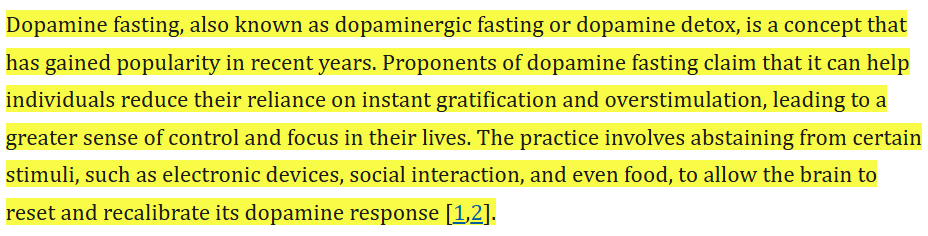
Source: Desai D, Patel J, et al. A Literature Review on Holistic Well-Being and Dopamine Fasting: An Integrated Approach. Cureus. 2024 Jun 4;16(6):e61643. doi: 10.7759/cureus.61643. PMID: 38966464; PMCID: PMC11223451.
In essence, dopamine detox is less about deprivation and more about giving the brain room to reset.
The Dopamine Loop: Why Wanting Never Ends
As we discussed earlier, dopamine isn’t released when we achieve a reward, but when we anticipate it. Chasing goals, scrolling endlessly, or thinking about the next purchase all raise dopamine, until it drops once the reward arrives. That’s why satisfaction is short-lived.
In a high-stimulation world, the brain stays stuck in anticipation, constantly raising its expectations and making contentment harder to access. Consumer culture fuels this loop by promising “more” and “better,” leading to restlessness, poor focus, and emotional fatigue.
Breaking the loop doesn’t mean giving up ambition, it means reducing excess stimulation so the mind can settle. When stimulation slows, wanting softens, and contentment becomes possible again.
Are you a dopamine junkie? Watch THIS!
Consumerism Effects on Mental Health
Once you understand the dopamine loop, modern consumer culture starts to make a lot more sense.
We are not just consuming products anymore. We are consuming stimulation constantly. Ads, notifications, content, sales, trends, upgrades. Each one promises relief, excitement, or improvement. Each one triggers dopamine. And each one leaves the brain wanting the next hit.
Over time, the consumerism effects on mental health show up in subtle but powerful ways:
- A constant sense of restlessness, even during downtime
- Difficulty focusing on one task or one thought
- Emotional flatness unless something exciting is happening
- Comparison fatigue and chronic dissatisfaction
Neuroscience shows that too many low-effort rewards weaken the brain’s reward system. When gratification is instant and frequent, the brain stops responding strongly to everyday pleasures. This is why abundance often feels empty.
The problem isn’t desire, it’s overstimulation.
When wanting becomes the default mental state, contentment feels unfamiliar. This is where intentional regulation, not restriction, becomes essential.
Learn more about how instant gratification hijacks your life and ways to reclaim it.
A Simple Dopamine Detox Routine for Everyday Life
A dopamine detox routine doesn’t mean cutting out joy or ambition. Psychology shows that the brain regulates itself best when stimulation is intentional, spaced, and effort-based.
Here’s what a realistic dopamine detox can look like:
Reduce passive stimulation first
Limit mindless scrolling, background noise, and constant multitasking. This lowers unnecessary dopamine spikes.
Reintroduce effort before reward
Walk before entertainment. Complete a task before checking your phone. Effort strengthens dopamine sensitivity.

Image Credits: Freepik
Create gaps between impulses and action
Pausing before responding retrains the brain’s reward anticipation loop.
Choose fewer, richer inputs
One conversation, one meal, one task at a time supports mental clarity.
Protect sleep and natural rhythms
dysregulates dopamine and increases craving behavior.
This approach is supported by the neuroscience of happiness, which shows that stability, presence, and predictability calm the nervous system. Over time, this makes it easier to calm your mind and focus, and reduces the constant pull of wanting.
A dopamine detox isn’t about living with less pleasure. It’s about finally allowing the brain to feel satisfied again.
Final Note: The Quiet Power of Enough
At some point, the question stops being How do I get more? and becomes Why does more never feel like enough?
When the brain is constantly chasing stimulation, contentment feels unfamiliar. Not because life is lacking, but because attention is always pulled forward. Gratitude works differently. It doesn’t add anything new. It simply redirects attention to what’s already here.
From a neurological perspective, gratitude and mental clarity are closely linked. Gratitude shifts the brain away from anticipation and into presence. Instead of activating the dopamine-driven seeking loop, it strengthens neural pathways associated with emotional regulation, safety, and satisfaction. Over time, this calms the nervous system and softens the constant urge for more.
This isn’t about forced positivity or pretending everything is perfect. It’s about noticing what’s stable, supportive, and sufficient even in imperfect moments. That act alone begins to retrain the brain.
In a world built on excess, simplicity becomes a skill. And in an overstimulated mind, feeling content becomes rare. That’s why simplicity is the new luxury.
Enough is not a mindset you adopt overnight.
It’s a state your brain learns to return to when you stop chasing, slow down, and finally allow yourself to arrive.
Frequently Asked Questions
1. What’s dopamine detox and why has it become so popular?
What’s dopamine detox really about is not removing dopamine, but restoring balance. Dopamine is a natural brain chemical linked to motivation and anticipation. The idea of dopamine detox has gained attention because modern life overloads the brain with constant stimulation. Reducing excess inputs helps the brain become more responsive to everyday pleasures again.
2. Is a dopamine detox safe, or does it deprive the brain?
A dopamine detox is not about deprivation or eliminating joy. Neuroscience shows the brain functions best when stimulation is intentional rather than constant. A well-designed dopamine detox supports emotional regulation, focus, and mental clarity instead of restricting healthy pleasure.
3. What does a realistic dopamine detox routine look like?
A sustainable dopamine detox routine focuses on spacing stimulation rather than removing it. This can include reducing mindless scrolling, avoiding multitasking, and reintroducing effort before reward. Psychology research shows that these habits help reset dopamine sensitivity without disrupting daily life.
4. How are consumerism effects on mental health connected to dopamine?
The consumerism effects on mental health are closely tied to dopamine-driven reward loops. Constant exposure to novelty, advertisements, and comparison keeps the brain in a state of anticipation, leading to restlessness, reduced focus, and dissatisfaction. Dopamine detox strategies help break this cycle by lowering unnecessary stimulation.
5. How does dopamine detox relate to the neuroscience of happiness?
The neuroscience of happiness shows that long-term wellbeing comes from emotional stability and presence, not constant pleasure. Dopamine detox supports this by calming reward-seeking circuits and allowing the brain to experience contentment, focus, and satisfaction from simpler experiences rather than constant novelty.
6. Can dopamine detox help with anxiety and mental overload?
Yes, a dopamine detox can help reduce mental overload by lowering constant reward-seeking signals in the brain. When stimulation decreases, the nervous system shifts toward regulation, which often reduces anxiety, restlessness, and emotional fatigue linked to overstimulation.
7. How long should a dopamine detox routine last to see benefits?
A dopamine detox routine doesn’t need a fixed duration. Neuroscience suggests benefits begin when stimulation patterns change consistently over time. Even small daily adjustments, like fewer digital interruptions or more intentional breaks, can improve focus and emotional balance.
8. What’s dopamine detox not supposed to do?
What dopamine detox is not meant to do is eliminate pleasure, ambition, or enjoyment. It’s not about living without comfort or reward. Instead, it helps the brain relearn how to respond to stimulation in healthier, more sustainable ways.
9. Why do consumer habits affect emotional wellbeing so deeply?
The consumerism effects on mental health stem from constant exposure to novelty and comparison. This keeps the brain in a perpetual state of wanting, which weakens satisfaction and attention. Over time, this can lead to chronic dissatisfaction even when basic needs are met.
10. Does dopamine detox improve long-term happiness or just focus?
According to the neuroscience of happiness, dopamine detox supports more than focus. By calming reward-seeking circuits, it allows the brain to experience steadier emotions, presence, and contentment, key contributors to long-term wellbeing rather than short-lived pleasure.
Disclaimer: This article is for education and general guidance only. It is not a substitute for personal medical advice, diagnosis, or treatment. If you are currently living with a medical or mental health condition, use these practices as supportive tools alongside your doctor’s advice, not in place of it. Always make an informed choice. Keep your healthcare provider in the loop before trying anything new. If you ever experience very low moods, seek immediate help from a trusted professional.
If “enough” has been feeling hard to reach lately, your brain may just need better support.
A single conversation can bring clarity, direction, and a calmer way forward.
Schedule a consultation with our life coaches or call us at 1800 102 0253 or explore our Wellness Programs to optimize your health goals.