No products in the cart.
There’s a popular argument going around right now.
“Our grandparents ate white bread and sugar, and they were fine.”
“They didn’t count protein.”
“They didn’t take supplements.”
“And they were healthier than we were.”
So the conclusion most people jump to?
“We should go back to how they lived.”
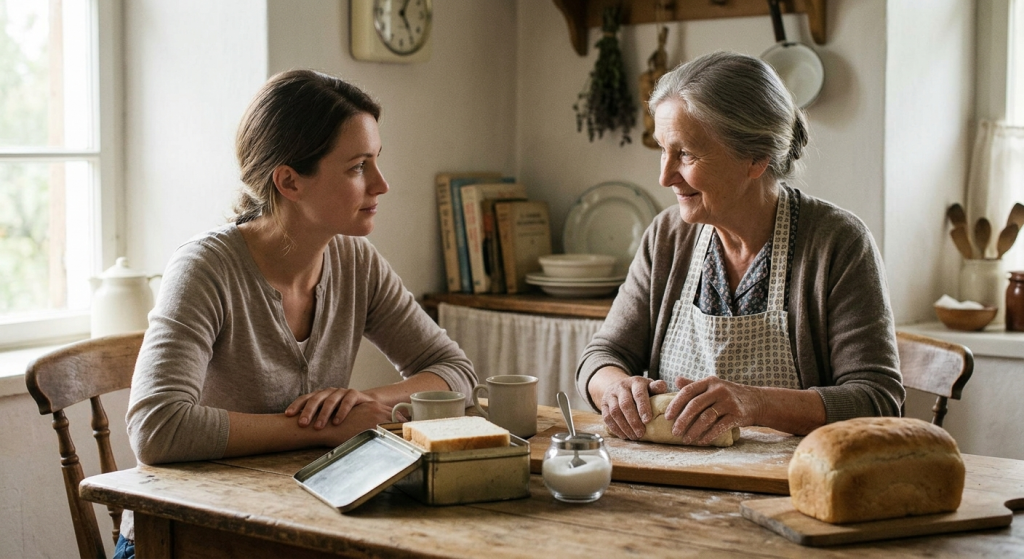
AI-generated image
It sounds intelligent. It sounds like a rejection of overcomplicated modern health culture. And honestly, part of it is right.
But only part of it.
Because this argument does something very dangerous, it takes one variable, food, and uses it to explain an entire outcome. And in health, that rarely works.
Why This Thinking Is Incomplete
When we say our grandparents were healthier, we’re usually talking about things like:
- Lower rates of obesity
- Less Type 2 diabetes
- Less anxiety and depression
- Better sleep
- More energy into old age
- Fewer lifestyle diseases overall
And that’s true. The data broadly supports it.
But here’s the question nobody asks: why were they healthier?
Was it just the white bread? Or was it everything else around that white bread?
- Because our grandparents didn’t just eat differently.
- They lived differently.
- Their entire biology was operating in a different environment.
And if you ignore that environment and just copy the food, you’re solving the wrong problem.
Their Life Was the Medicine
This is something we have spoken about for years: lifestyle is medicine. Not a supplement. Not a superfood. The whole lifestyle.
Let’s break down what our grandparents’ lives actually looked like through a health lens.
1. Their Nervous System Was in a Completely Different State
This one doesn’t get talked about enough.
Our grandparents lived with chronic stress, too. They had wars, poverty, loss, and hard labor. But the nature of their stress was different.
Their stress had a beginning and an end. You stress, you act, and it resolves. That’s how the human stress response was designed to work.
What we have today is different. We have chronic low-grade stress with no off switch.
- Emails at 11 pm
- News cycles designed to keep you anxious
- Social media comparison running 24/7
- Financial pressure that never fully goes away
- Decision fatigue from having too many choices
When your nervous system is stuck in a sympathetic state, a fight-or-flight loop, here’s what happens biologically:
- Cortisol stays elevated
- Digestion slows down or becomes erratic
- Nutrient absorption drops
- Immunity gets suppressed
- Sleep quality suffers
- Hormones go out of balance
- Inflammation becomes chronic
And here’s the critical part: no amount of good food can fully override a broken nervous system.
- You can eat the cleanest diet in the world. If your cortisol is chronically high, your body will still struggle to absorb nutrients properly, manage blood sugar effectively, or maintain hormonal balance.
Our grandparents didn’t manage stress consciously.
- They just lived in a world where the nervous system got to rest more naturally.
- Less stimulation. More silence. More real human connection.
- More time outdoors. Earlier bedtimes aligned with the sun.
That’s not nostalgia. That’s biology.

Image Credits: Freepik
2. They Moved Constantly, Without Thinking About It
Nobody in 1955 was scheduling a “movement block” into their calendar.
They just moved. All day. Because life required it.
- Walking to the market
- Farming, cooking, and cleaning by hand
- Sitting on the floor and getting up repeatedly
- No elevators, no delivery apps, no drive-throughs
This kind of incidental daily movement, what researchers now call NEAT (Non-Exercise Activity Thermogenesis), is one of the most powerful factors in metabolic health. And it’s almost completely missing from modern life.
Click here to know more about NEAT.
We’ve replaced all of it with 45 minutes at the gym. And then we sit for the remaining 15+ hours of our day.
The research on this is alarming.
- Sitting for long periods is independently associated with increased risk of cardiovascular disease, poor metabolic health, and early mortality, even in people who exercise regularly.
Our grandparents weren’t athletic. But they were always moving. That’s a fundamentally different thing.
3. Their Food Was Actually Different Food
This is where the “they ate white bread and were fine” argument completely breaks down.
The white bread they ate and the white bread on your shelf today are not the same product. They share a name. That’s about it.
White Bread: Then vs Now
| White Bread Then | White Bread Now |
| Milled from local wheat with more of the bran and germ intact | Highly refined, ultra-processed flour with the germ and bran stripped out |
| No bleaching agents, dough conditioners, or added emulsifiers | Often contains additives like potassium bromate, azodicarbonamide, DATEM, and emulsifiers |
| Slowly fermented in many cases, improving digestibility and lowering glycemic impact | Made for long shelf life and designed to stay soft for weeks |
| Eaten in moderate portions as part of complete meals | Consumed multiple times a day in large portions |
| Typically paired with simple, whole-food meals | Often topped or paired with ultra-processed spreads, fillings, and sauces |
Sugar: Then vs Now
| Sugar Then | Sugar Now |
| Mostly came from seasonal fruits, jaggery, or small amounts of natural sweeteners | Added to countless packaged foods, drinks, sauces, breads, yogurts, and snacks |
| Naturally packaged with fiber, water, and micronutrients that slowed absorption | Stripped of fiber and rapidly absorbed into the bloodstream |
| Consumed occasionally as a treat | Consumed multiple times daily, often unknowingly |
| Intake was limited by seasonal availability and homemade preparation | Mass-produced, cheap, hyper-accessible, and available everywhere |
| Sweet foods were simple and minimally processed | Engineered to hit the “bliss point” and encourage overeating |
Your grandparents didn’t just eat less sugar. They lived in a world where the food supply wasn’t engineered to make overconsumption nearly impossible to avoid.
4. Their Gut Health Was Naturally Supported
The gut microbiome is one of the most exciting areas of modern science. And when you look at how our grandparents lived, they were unknowingly doing almost everything right.
- Eating seasonally and locally meant rotating foods naturally, which feeds diverse bacterial strains
- Fermented foods, whether it was homemade curd, kanji, pickles, or fermented grains, were part of daily eating in most Indian households
- Eating with their hands actually introduced beneficial environmental microbes
- Time outdoors and contact with soil exposed them to bacterial diversity that builds immune resilience
- No over-sanitization meant the immune system was being trained constantly
Today, we have a gut crisis.
- Declining microbiome diversity is linked to rising rates of autoimmune conditions, mental health issues, metabolic disorders, skin problems, and chronic inflammation.
Gut health impacts immunity, mental health, and how you absorb every nutrient you eat.
You can take every supplement in the world. If your gut is compromised, you’re not absorbing much of it.
5. They Ate Aligned With Nature’s Clock
Nobody told our grandparents about the circadian rhythm. But they lived by it completely.
- They woke up with or before sunrise
- They ate their largest meal when the sun was at its highest and digestion was strongest
- They ate light at night
- They slept when it got dark
This is not ancient folklore. This is now validated by an entire field of research called chronobiology.
- Your body has a master clock governed by light. Every organ, including your gut, liver, pancreas, and brain, has its own internal clock.
- And these clocks regulate when your body is primed to digest food, process glucose, repair tissue, and cleanse.
When you eat late at night, your pancreatic clock is winding down. Insulin sensitivity drops. The same meal eaten at 7 pm hits your metabolism very differently from the same meal eaten at 10 pm.
Our grandparents weren’t optimizing their circadian rhythm.
- They just didn’t have electricity, devices, or 24-hour food access to disrupt it.
- We’ve disrupted ours completely, and then we’re confused about why our metabolic health is suffering.
Want to realign your body with nature and restore your circadian rhythm?
Enroll in our online educational course to learn practical, science-backed strategies for better sleep, energy, metabolism, and overall health.
Circadian Rhythm: A New Way Of Living Beyond Medicine
Every Generation Adds a Layer
Here’s the honest truth about how health knowledge evolves:
| Generation | What They Had |
| Our grandparents | Intuitive wisdom, cleaner environment, simpler living |
| Our parents | Transition period, exposure to processed food, beginning of lifestyle disease |
| Us | Access to science, more complexity, more choice, more chronic disease |
Our grandparents had things we’ve lost. We have things they never had access to.
The intelligent move is not to pick a side. It’s to integrate.

Image Credits: Freepik
What we know today that they didn’t:
- Adequate protein intake, not excessive, not insufficient, is essential for muscle maintenance, hormonal health, immune function, and healthy aging. Most traditional Indian diets, for all their wisdom, were often low in quality protein.
- Gut microbiome diversity directly impacts immunity, mental health, metabolic function, and even food cravings
- Chronic low-grade inflammation is the root driver of most lifestyle diseases, and ultra-processed foods are one of the most consistent triggers
- Stress is not just a mental experience. It is a biological event with measurable effects on every system in your body
- Sleep is when repair happens. Chronic sleep deprivation disrupts hormones, raises inflammatory markers, and impairs the body’s ability to regulate blood sugar
This is not hype. This is peer-reviewed science. Ignoring it in the name of tradition is not wisdom. It’s just avoidance.
The Real Mistake People Make
Thinking it’s either/or.
- Either: “Old ways are always right. Modern health advice is just a conspiracy to sell you supplements.”
- Or: “Old ways are outdated. Science has all the answers.”
- Both of these are lazy thinking.
The real intelligence is in the integration. Taking what worked and still works. Upgrading what needs upgrading. And adapting all of it to the reality of the life you’re actually living.
You are not your grandparent.
- You’re sitting more.
- You’re sleeping less and worse.
- You’re eating in a food environment that is specifically engineered to override your body’s natural satiety signals.
- You’re under a type and frequency of stress that no previous generation experienced.
- You’re exposed to more environmental toxins. Your gut microbiome is more depleted.
That’s not a moral failing. That’s just the reality of modern life.
And the solution to that reality is not to pretend it doesn’t exist.
What Integration Actually Looks Like in Practice
Borrow from their wisdom:
- Eat simple, real food as the foundation
- Prioritize local and seasonal eating; it’s cheaper, fresher, and better for your gut microbiome
- Eat with people when you can. Digestion improves in a calm, connected social setting
- Respect your body’s daily rhythm. Eat earlier, sleep earlier, move throughout the day
- Cook more. The act of cooking itself connects you to your food in a way that changes how you eat it
Apply what science now tells us:
- Get adequate protein at every meal. For most adults, this means being more intentional than most Indian diets traditionally were
- Reduce ultra-processed foods. Not because of calories, but because of what they do to your gut, your hormones, and your hunger signals
- Manage your nervous system actively. Breathing practices, walks without your phone, and genuine rest. These are not luxuries. They are physiological requirements.
- Move throughout the day, not just in a gym session
- Protect your sleep like you protect your most important meetings

Image Credits: Freepik
The Last Word
Your grandparents were healthier. That’s true.
But it wasn’t just the white bread.
It was the walk to the market to buy it. The fact that it was made with fewer additives. The afternoon nap after the meal. The early dinner before sunset. The nights without artificial light. The community they ate with. The nervous system that actually got to rest.
You can’t cherry-pick one piece of that picture and ignore the rest.
What you can do is take the principles that made their lifestyle healthy and apply them intelligently to the world you actually live in.
Drop what’s clearly not working, which is the ultra-processed food, the endless sitting, the chronic stress, and the disrupted sleep.
Health has never been tradition versus science. It’s always been evolution.
Your grandparents did the best they could with what they had and what they knew.
Now it’s your turn to do the same.
Disclaimer: This blog is intended for educational and informational purposes only and should not be used as a substitute for professional medical advice, diagnosis, or treatment. Always seek the guidance of your qualified healthcare provider before making any changes to your medications or lifestyle.
Looking for support in your health transformation? You don’t have to figure it out alone.
We help you find a way.
Set up a one-on-one consultation with our foundational medicine experts or explore our Wellness Programs to optimize your lifestyle goals.
Reach out to us at 1800 102 0253 or write to us at [email protected].