No products in the cart.
Science is finally catching up to what ancient Indian wisdom has always known, your skin is a reflection of what you consume, not just what you apply.
Long before we had ‘hydrating serums’ and ‘barrier repair creams,’ Indian homes had something far simpler and far more intuitive.
A glass of kokum sherbet. A matka infused with vetiver roots. Aam panna on hot afternoons.
These weren’t just summer comforts. They were functional foods—doing what modern nutraceuticals now charge a premium for. Cooling the body from within. Reducing inflammation at the cellular level. Protecting the skin barrier before it broke.
But here’s the thing: we stopped trusting them. We replaced the matka with air conditioning. The kokum sherbet with packaged ‘electrolyte drinks.’ The aam panna with vitamin C tablets.
Today, modern dermatology is beginning to validate what traditional wisdom always knew: your skin is not separate from what you consume. And some of the most powerful skin foods aren’t exotic imports—they’re seasonal, local, and deeply Indian.
Your grandmother was practicing functional nutrition. She just didn’t call it that.
What Indian summers actually do to your skin
Indian summers are not mild. Heat, UV exposure, dehydration, and oxidative stress all rise simultaneously, and your skin absorbs the consequences.
Here’s what’s happening beneath the surface:
– Transepidermal water loss (TEWL) increases your skin loses moisture faster than you can replenish it topically
– UV-induced free radicals damage collagen and elastin fibers, accelerating visible aging
– Melanin production spikes as a defense response, causing pigmentation and uneven tone
– The gut-skin axis gets disrupted by heat—affecting digestion, absorption, and the microbiome balance that regulates skin inflammation
Most people respond externally: more sunscreen, more moisturizer, more serum. All of that helps. But it’s incomplete—because skin resilience starts from within. And this is where these traditional summer foods quietly do their most important work.
FOOD #1
Kokum: The anti-inflammatory shield your skin didn’t know it needed
Kokum (Garcinia indica) grows in abundance along the Konkan coast and has been used in coastal Indian cooking for centuries, in curries, chutneys, and summer drinks. But its benefits go far beyond flavor.
The key compound here is garcinol, a polyisoprenylated benzophenone found almost exclusively in kokum. And garcinol is remarkable.
Research shows it has significant anti-inflammatory properties — it inhibits COX-2 and NF-κB pathways, which are the same inflammatory pathways that many modern anti-inflammatory drugs target. It’s also a potent antioxidant, with studies suggesting it can neutralize UV-induced oxidative stress before it causes downstream damage to skin cells.
For skin specifically, this means:
– Reduced redness and reactive inflammation particularly important for people prone to heat boils, rosacea-like flares, or general skin sensitivity in summer
– Oxidative stress is one of the primary accelerators of collagen breakdown, and garcinol’s antioxidant capacity helps interrupt that process
– Photoprotection from within, not a replacement for sunscreen, but a meaningful internal layer of defense
Your grandmother knew none of this science. But she gave kokum sherbet to prevent ‘body heat,’ to calm skin eruptions, and to support digestion. All of those outcomes are now scientifically explicable. She was targeting the same inflammatory pathways that researchers are studying today.
↳ Inflammation is at the root of most skin concerns. Kokum works quietly at that level—not on the surface.
How to use it
One glass of unsweetened or minimally sweetened kokum sherbet mid-morning is sufficient. Add a pinch of black salt and cumin—both support digestive fire, which indirectly supports skin clarity. Always choose homemade or low-sugar versions; excess sugar is pro-inflammatory and cancels out the benefits entirely.
FOOD #2
Vetiver (Khus) – When calming the nervous system clears the skin
Vetiver is a grass whose roots have been used in India for millennia, not just as a fragrance, but as a cooling agent added to drinking water, woven into mats and curtains, and consumed as khus sherbet during peak summer.
Its active compounds — vetiverol, khusimol, and a complex array of sesquiterpenes — are known for their cooling, calming, and mild anti-inflammatory effects. But what makes vetiver particularly interesting from a skin perspective is its relationship with the nervous system.
Here’s something most skincare conversations miss: stress and heat are often the hidden drivers of summer skin problems. High temperatures spike cortisol. Cortisol increases sebum production, disrupts the skin barrier, and amplifies inflammatory responses. For someone prone to acne, eczema, or general reactivity, a prolonged period of heat stress is often enough to trigger a visible flare.
Vetiver works on this upstream. Its sesquiterpenes have documented calming effects on the nervous system — reducing the cortisol response, supporting better sleep quality in heat, and helping the body regulate its temperature more efficiently.
Emerging research also points to vetiver’s antioxidant activity and its role in improving microcirculation — better blood flow to the skin means better nutrient delivery and more efficient cellular repair.
↳ Sometimes a skin problem isn’t a skin problem. It’s a stress-plus-heat problem. Vetiver addresses both at once.
How to use it
Add vetiver roots to a clay pot (matka) of water and let them infuse overnight. Drink this throughout the day. If you prefer a drink, choose naturally flavored khus sherbets, and read the label. Most commercial versions are synthetic dyes with no actual vetiver. Look for real root extract or make your own.
FOOD #3
Raw Mango (Aam Panna) – The original electrolyte drink with a skin bonus
Raw mango is harvested before the summer peak, and the traditional drink made from it—aam panna—is one of the most functionally intelligent foods in the Indian kitchen. It was given to prevent heatstroke, restore energy after physical exertion, and support digestion when heat suppresses appetite. Every one of those uses is backed by science.
Here’s the nutritional profile that matters:
– Vitamin C: Raw mango is exceptionally rich in it, and vitamin C is non-negotiable for collagen synthesis. Without adequate Vitamin C, your body cannot produce functional collagen, regardless of how many collagen supplements you take externally
– Polyphenols: Mangiferin, a compound with documented antioxidant and anti-inflammatory activity that protects against UV-induced DNA damage
– Natural electrolytes: sodium, potassium, and magnesium in a bioavailable form that supports cellular hydration far more effectively than many commercial electrolyte powders
– Malic acid: Supports liver detoxification, and since the liver is one of the primary organs involved in hormone regulation and skin clarity, this matters more than most people realize
The skin connection is direct: better hydration means a more intact skin barrier. Adequate vitamin C means improved collagen synthesis and reduced pigmentation. Electrolyte balance means cells are functioning efficiently — which shows up as less dullness, better texture, and faster recovery from sun exposure.
↳ Hydration is not just water. It’s minerals, antioxidants, and cellular balance—and aam panna delivers all three together.
How to use it
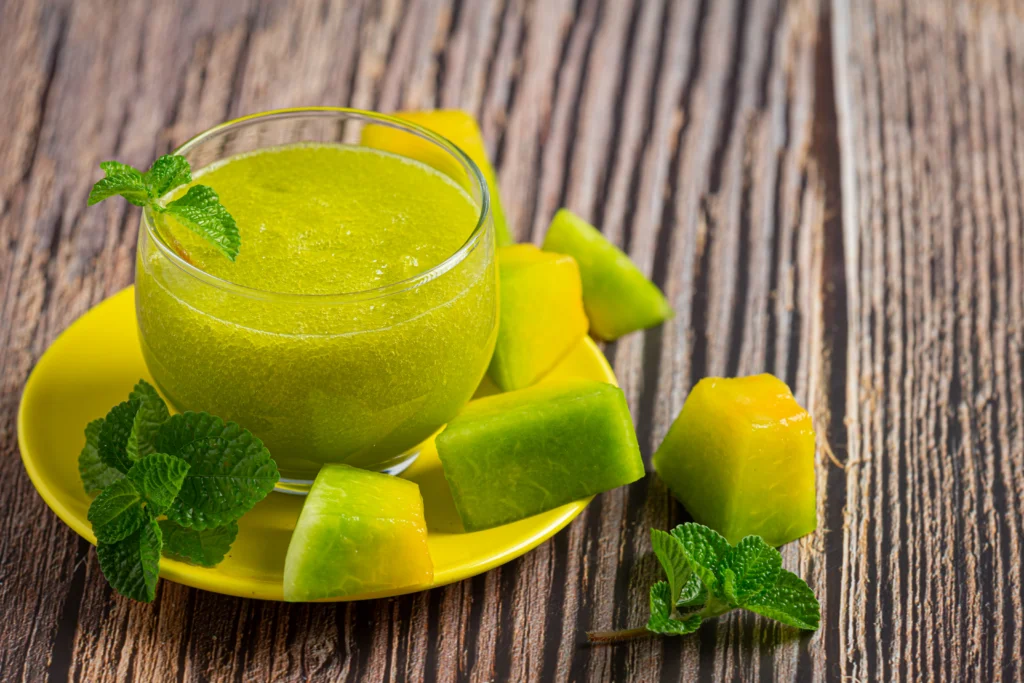
Homemade aam panna with mint, cumin, black salt, and a small amount of jaggery is ideal. The jaggery provides trace minerals; the cumin and black salt support digestion. Avoid packaged versions—the sugar content in most commercial variants directly counteracts the anti-inflammatory benefits of the mango.
THE BIGGER PICTURE
Seasonal eating is the oldest form of personalized medicine
This is not about adding three drinks to your routine. It’s about understanding a deeper principle that ancient science encoded thousands of years ago and that modern systems biology is now rediscovering: nature gives your body what it needs, exactly when it needs it.
Summer brings kokum, vetiver, and raw mango—all anti-inflammatory, cooling, and hydrating by nature. Winter brings warming spices, root vegetables, and immunity-supportive foods. When you align your consumption with this seasonal rhythm, something shifts:
– Inflammation reduces gradually, not dramatically overnight, but consistently over weeks
– Digestion improves and since the gut-skin axis is real, your skin reflects that improvement
– Your body’s stress response becomes better regulated—and skin reactivity decreases with it
The practical application is simple. Rotate between kokum sherbet, vetiver water, and aam panna through the week. Keep them homemade. Avoid excess sugar. Pair them with a diet that emphasizes seasonal produce, adequate protein, and healthy fats. Prioritize sleep because no drink can compensate for chronic sleep deprivation.
You don’t need to choose between Ancient Science and dermatology. The real power lies in integrating both.
FINAL THOUGHT
Your grandmother didn’t count antioxidants. She just understood balance.
Your grandmother didn’t know the word ‘garcinol.’ She didn’t measure polyphenols or read studies on transepidermal water loss.
But she understood seasonality, prevention, and the quiet intelligence of the body. She knew that what you put inside shapes what shows up outside. She knew that summer called for specific foods, not because of tradition for its own sake, but because the body responds differently to different seasons and needs different support.
Modern science is now building the evidence base for everything she practiced intuitively. You don’t need to wait for a clinical trial to act on that. These foods are available now, inexpensive, deeply rooted in the food culture you already belong to, and safe for almost everyone.
Start this summer with three simple drinks. Your skin and your whole body will notice the difference.
Disclaimer: This content is for educational purposes only and does not replace professional medical advice. For specific skin or health concerns, please consult a qualified healthcare professional. Individual results will vary based on your unique health profile and context.
Want to build a seasonal eating plan that actually works for your skin and body?
Kokum, vetiver, and raw mango are a beautiful starting point, but they’re not the full picture.
What truly matters is how you eat through the season, what you combine these foods with, and how your body responds to it all. And that’s different for everyone.
If you feel confused, stuck, or unsure where to begin, we’re here to guide you.
You can speak to our team or explore our Wellness Programs to build a lifestyle that supports your skin, your health, and your long-term well-being.
📞 1800 102 0253
📧 [email protected]
[uicore-block id=”218799″