No products in the cart.
Pre-Diabetes: Not a Disease – A Message
Across India, in cities and towns, in corporate offices and family kitchens, a quiet metabolic shift is underway. Millions of Indians are living with elevated blood sugar that hasn’t yet crossed the diabetes threshold – a state called prediabetes. Most don’t know it. And for those who do, confusion, denial, or panic tends to replace action.
But here is what the science unambiguously confirms: prediabetes is one of the most reversible metabolic conditions we know of. It is not a verdict. It is a message from your body and the message is both a warning and an invitation.
Key Definition: Prediabetes is defined as blood glucose levels above normal but below the threshold for a diabetes diagnosis - typically a fasting blood glucose of 100–125 mg/dL, an HbA1c of 5.7–6.4%, or a 2-hour post-glucose value of 140–199 mg/dL.The Age Shift: It’s Getting Younger
Perhaps the most alarming trend is the decline in age of onset. Traditionally considered a condition of the elderly, prediabetes and diabetes are increasingly affecting Indians in their 20s, 30s, and early 40s. The 36–40 age group now shows one of the highest prediabetes prevalence rates (18.8%).
Indian professionals in IT, finance, and services sectors are reporting blood sugar abnormalities in their 30s – a generation earlier than their parents’ cohort. The convergence of genetic susceptibility, career stress, sedentary jobs, and processed food consumption has accelerated this timeline dramatically.
How Prediabetes Is Impacting Indians
- The Asymptomatic Danger Zone
One of the most dangerous aspects of prediabetes is how unremarkable it feels. Most people have no obvious symptoms. Yet under the surface, the metabolic machinery is degrading. Blood vessels are stiffening. Inflammation is rising. Insulin-producing beta cells in the pancreas are under progressive stress.
When symptoms do appear, they are often dismissed as “normal” fatigue or lifestyle tiredness:
- Persistent fatigue, especially after meals
- Sugar cravings and difficulty feeling full
- Weight that won’t shift, particularly around the abdomen
- Brain fog and difficulty concentrating
- Mood swings and irritability
- Tingling or numbness in hands and feet
- Slow wound healing
- Increased thirst and urination
- The Downstream Consequences
Prediabetes is not a “safe” zone. Without intervention, 15–30% of people with prediabetes develop full type 2 diabetes within 3–5 years. But the damage begins well before diabetes is formally diagnosed:
ORGAN / SYSTEM | RISK IN PREDIABETES STAGE |
Heart & Blood Vessels | Elevated cardiovascular risk even before diabetes diagnosis; arterial stiffening begins in prediabetes |
Kidneys | Early signs of nephropathy (kidney stress) can appear at prediabetes stage |
Eyes | Early retinal changes reported in some prediabetic patients |
Brain & Cognition | Reduced insulin sensitivity in the brain affects memory, focus, and mood regulation |
Nerves | Peripheral neuropathy (tingling, numbness) can begin before diabetes is confirmed |
| Liver | Non-alcoholic fatty liver disease (NAFLD) strongly associated with insulin resistance |
Why Is Prediabetes Rising in India?
India’s prediabetes crisis is not a single-cause story. It is a perfect metabolic storm, the collision of genetic vulnerability, dietary transition, physical inactivity, psychological stress, and disrupted sleep, all accelerating simultaneously.
Genetic Predisposition: The Asian Indian Phenotype
Indian genetics play a significant but frequently misunderstood role. South Asians develop insulin resistance at lower BMIs than Western counterparts, sometimes with a BMI as low as 23–24. This means the typical Western benchmark for “healthy weight” doesn’t protect Indian bodies the same way.
Research has identified four sub-groups of type 2 diabetes in India, two of which are unique to the country. Indians also tend to develop diabetes a decade earlier than Europeans. Critically, only about one-third of Indian diabetics have a BMI above 25 meaning millions develop blood sugar problems without being conventionally “obese.”
The Dietary Transition: From Dal-Roti to Ultra-Processed
Traditional Indian diets, rich in pulses, vegetables, whole grains, and fermented foods, provided natural protection against metabolic disease. That protection is rapidly eroding.
- Urban Indians now consume significantly more refined carbohydrates, sugary beverages, and processed snacks.
- White rice and refined wheat (maida) dominate diets, causing rapid post-meal glucose spikes.
- Sugary chai with biscuits multiple times a day is a culturally embedded glucose challenge.
- Portion sizes have grown; meal timing has become erratic.
Physical Inactivity: The Sitting Disease
India’s rapid economic development has come with a massive shift to sedentary work. The WHO recommends a minimum of 150 minutes of moderate physical activity per week. Most urban Indian professionals fall well short of this.
- Desk-based IT, finance, and service sector jobs involve 8–12 hours of continuous sitting.
- Long daily commutes (often 2–4 hours in metro cities) reduce available time for movement.
- Even 30 minutes of continuous sitting reduces muscle glucose uptake measurably.
Those in high-physical-demand occupations (manual labour, farming) have consistently lower diabetes prevalence than white-collar workers
Stress: The Invisible Metabolic Disruptor
This is the factor that receives the least attention in clinical settings and arguably deserves the most.
India has some of the longest average working hours globally. IT professionals, startup employees, and finance workers routinely work 10–12 hours daily. Research confirms that employees working such hours have nearly double the diabetes risk compared to those working 6–8 hours.
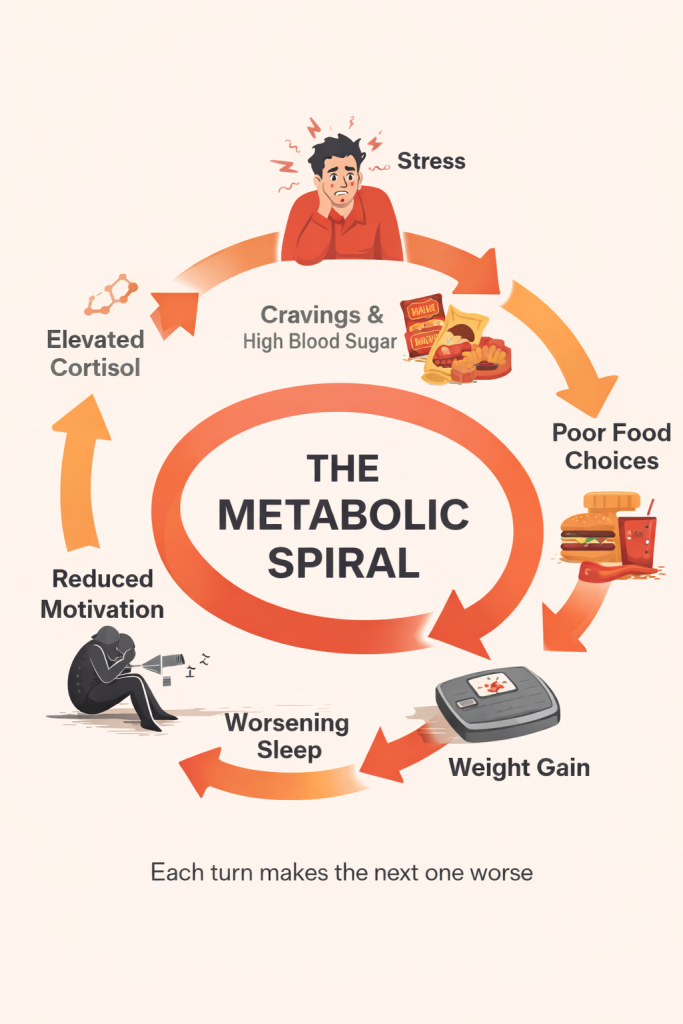
This image depicts the metabolic spiral, not a lack of discipline, but a cycle where stress, cravings, poor choices, and low energy keep feeding into each other.
Sleep Disruption: The Overlooked Risk Factor
Sleep and blood sugar are intimately connected and India has a serious sleep debt.
- Late-night eating disrupts circadian insulin sensitivity, the body’ s glucose-handling machinery is calibrated for daytime activity.
- Sleep deprivation reduces insulin sensitivity within a single night.
- Shift workers (a large population in India’s 24-hour economy) face particularly high metabolic risk due to circadian disruption.
- Scrolling on phones late at night delays melatonin release and disrupts metabolic rhythm.
The 6 Evidence-Based Foundational Habits That Make the Difference
These are not wellness fads. Each of the following habits has meaningful research backing its benefit in prediabetes and blood sugar management.
Habit 1: The Post-Meal Walk
A 10-minute brisk walk after each major meal activates muscle glucose uptake independently of insulin. This is particularly impactful after your highest-carbohydrate meal. Even gentle walking (not running) measurably blunts post-meal glucose spikes in CGM (Continuous Glucose Monitoring) studies.
Habit 2: Fenugreek (Methi)
Soak 1–2 teaspoons of fenugreek seeds overnight and consume the water (and/or seeds) on an empty stomach. Galactomannan, a soluble fibre in fenugreek, slows glucose absorption at the gut level and has demonstrated HbA1c-reducing effects in multiple Indian studies. This is one kitchen remedy with genuine evidence behind it.
Habit 3: Apple Cider Vinegar (ACV)
1 teaspoon of raw, unfiltered ACV with mother culture in a glass of water before a carbohydrate-heavy meal can reduce the glucose spike from that meal. The mechanism: acetic acid inhibits alpha-amylase and alpha-glucosidase, enzymes that break down starch into glucose. Not a magic bullet — but a valid, low-cost adjunct. Caution: Not suitable for those with gastric issues, low potassium, or on certain medications without medical advice.
Habit 4: Food Order — Fibre First, Carbs Last
Follow our meal flow. Start every meal with vegetables or salad (fibre). Then eat your protein (dal, paneer, eggs, fish, chicken). Finish with your carbohydrates (rice, roti). This single sequencing habit, validated in peer-reviewed research, can reduce post-meal glucose peaks by up to 73% compared to eating carbohydrates first.
Habit 5: Stress Management Is Not Optional
Meditation, yoga, diaphragmatic breathing, time in nature, journaling, digital detox, and adequate social connection are not “extras” — they are metabolic medicine. Chronic stress directly raises blood sugar through cortisol, independent of what you eat or how much you exercise. Five to ten minutes of deep breathing or mindfulness daily has measurable effects on cortisol and insulin sensitivity.
Habit 6: Respecting Circadian Rhythm — Eat Earlier, Sleep More
Avoid eating after 7:30–8 PM. The body’s insulin sensitivity peaks in the morning and falls through the day, reaching its lowest point at night. A late dinner is metabolically far more damaging than the same meal eaten at lunchtime. Prioritise 7–8 hours of quality sleep — even one night of poor sleep reduces insulin sensitivity by up to 25%.
The Core Principle: These habits work because of consistency, not perfection. A 10-minute walk after 5 out of 7 dinners is infinitely better than a perfect 60-minute gym session once a month. Sustainable small changes compound into profound metabolic improvements over months.
India is facing a rapidly growing prediabetes epidemic, affecting over 136 million people across age groups and geographies. Without timely action, many will progress to type 2 diabetes and its associated complications. Yet, the science is clear — prediabetes is highly responsive to lifestyle changes, making it one of the few conditions that can be effectively managed and even reversed with the right approach. This is not a message of fear, but of informed action: if you’ve been diagnosed with prediabetes, your body is not failing — it is signaling, and you still have the power to respond.
Disclaimer: This information is intended for educational purposes only and should not be considered medical advice. Always consult a qualified physician, endocrinologist, or healthcare professional before making any changes to your diet, lifestyle, or treatment plan.
Ready to Take Charge of Your Health?
Build a sustainable foundation through food, sleep, movement, emotional balance, and expert support.
Start your journey with our Wellness Program that builds the foundation your body needs.
Need personalized help to achieve your wellness goals?
Book a one-on-one consultation with Team Luke to create a plan tailored to your unique journey.
📞 Call us at 1800 102 0253
📧 Or write to us at [email protected]