No products in the cart.
Be honest.
How many times have you walked into the bathroom with your phone… just for “two minutes”… and walked out 20 minutes later?
For many, this is not occasional anymore. Toilet scrolling is a routine.
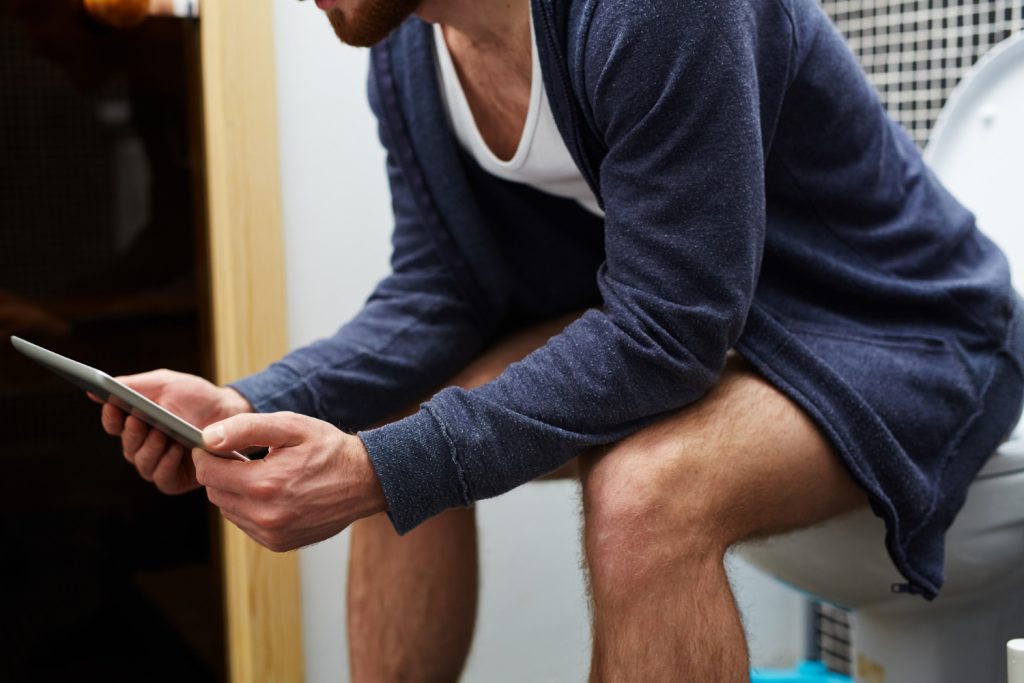
Image Credits: Freepik
A scroll here, a reel there, a quick reply, and suddenly your bathroom break turns into screen time.
What feels harmless is quietly shaping your toilet hygiene habits, your gut health, and even your brain.
This is not about shaming you.
It is about showing you what is really happening inside your body and on your phone when you carry it into one of the most bacteria-heavy environments in your home.
From mobile phone contamination to hemorrhoids from sitting too long, from disrupted bowel signals to addictive habit loops, this “small habit” has bigger consequences than you think.
Let’s break it down.
The Numbers Don’t Lie: How Common Is This?
Before we get into what’s happening to your body part, let’s look at how many of us are doing this.
| Statistic | Data |
| Adults who use their phone in the bathroom | 87% |
| Millennials engaged in regular doom-scrolling | 46% |
| Gen Z engaged in regular doom-scrolling | 53% |
| Average Gen Z daily social media screen time | 6+ hours |
The average person checks their phone 96 times a day. And for Gen Z and millennials, the bathroom has become one of those 96 check-in moments, sometimes the longest one.
Your Phone Is a Petri Dish
Let’s start with the most visceral part of this conversation: phone hygiene bacteria.
How Dirty Is Your Phone, Really?
A study found that 67.54% of participants admitted to carrying their mobile phones into toilets, and bacteria from the Enterobacteriaceae family was present on 90.54% of mobile phone samples tested in the case group.

Source: Rozario SR, Rahman H, Fakhruddin ANM, Rabbani KA. Prevalence of Multidrug-Resistant Bacteria on Mobile Phone Surface. J Microsc Ultrastruct. 2019 Nov 29;8(1):14-19. doi: 10.4103/JMAU.JMAU_7_19. PMID: 32166059; PMCID: PMC7045620.
Another community-based study found that out of 192 mobile phones swabbed and cultured, 91.7% showed bacterial contamination, with Coagulase negative Staphylococcus being the most prevalent at 69.3%, followed by Klebsiella and Pseudomonas.
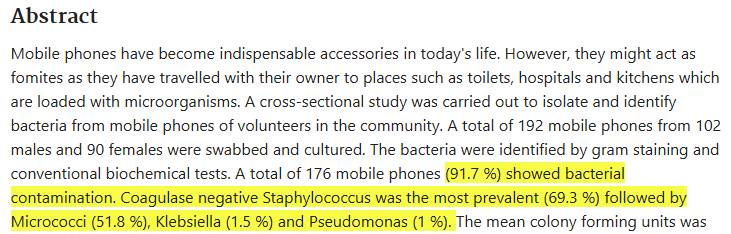
Source: Bhoonderowa A, Gookool S, Biranjia-Hurdoyal SD. The importance of mobile phones in the possible transmission of bacterial infections in the community. J Community Health. 2014 Oct;39(5):965-7. doi: 10.1007/s10900-014-9838-6. PMID: 24522388.
And here’s where it gets personal.
Researchers from the London School of Hygiene & Tropical Medicine and Queen Mary, University of London, analyzing 780 swab samples from mobile phones and the hands that used them, found that 16% of both hands and phones were contaminated with E. coli, fecal-origin bacteria.
The likely reason: people do not wash their hands thoroughly after using the restroom.
So you’re essentially re-contaminating your clean hands every time you pick the phone back up after washing.
Your Phone vs. A Public Toilet Seat
This comparison has been doing the rounds, and the research backs it up.

Image Credits: Freepik
Laboratory testing across multiple studies has uncovered that smartphones harbor roughly 20 times more bacteria than a public toilet seat.
- E. coli, also known as fecal coliform bacteria, is one of the most predominant bacteria found on mobile phones.
- Its presence on your phone means there is a strong likelihood that some amount of fecal matter is also present.
- Staphylococcus aureus was present in around 12.8% of cultures, and while harmless in most cases, it is known to cause health issues ranging from mild skin infections to pneumonia when it enters the body
The Toilet Flush Makes It Worse
Every time you flush with the lid up, which most of us do, you create what’s known as a toilet plume, an aerosol spray of micro-droplets containing fecal bacteria that can travel up to 1.5 meters.
Your phone, sitting face-up right there, is catching all of it.
Research confirms that contaminated mobile phones are one of the main routes by which pathogenic bacteria cause infections, and it is estimated that approximately 80,000 to 180,000 infections could be avoided every year, especially with adequate hand hygiene and increased intensity of smartphone cleaning.

Source: Kayed K, Khoder G, Farhat J, Ghemrawi R. Mobile Phones: Reservoirs of Resistant Bacteria during the COVID-19 Pandemic in Abu Dhabi, United Arab Emirates. Microorganisms. 2023 Feb 18;11(2):523. doi: 10.3390/microorganisms11020523. PMID: 36838487; PMCID: PMC9962086.
| Quick Fact: A study (Kõljalg et al., University of Tartu) found a high median bacterial count of 10.5 CFU/cm² on students’ mobile phones, with potentially pathogenic microbes including Staphylococcus aureus, Pseudomonas spp., and Bacillus cereus among the dominant species found. |
What Is Happening to Your Body When You Sit Too Long
Now let’s talk about the mechanical damage that your scrolling session is doing to your insides. Because it’s not just about bacteria on mobile phones, it’s about what the toilet position + extra time + distraction combination does to your anorectal anatomy.
Piles Causes: The Prolonged Sitting Connection
Hemorrhoids, or piles, are swollen veins in the lower rectum and anus. They are uncomfortable, sometimes painful, and increasingly common in younger adults.
- Spending too much time on the toilet places extreme pressure on your rectum and anus.
- On a toilet seat, your rectum is lower than the rest of your buttocks.
- As a result, gravity pushes down on the veins and blood pools in them.
- When sitting, the muscles of the buttocks region spread out, which causes rectal and anal veins to stretch.
- These veins have less elasticity, making them more fragile and likely to swell.
- Slower circulation to the pelvic region when sitting can cause blood to pool, filling the already-stretched veins with blood and leading to swelling and inflammation.
A few clinical observations even suggest that extended sitting habits can worsen anorectal conditions significantly.
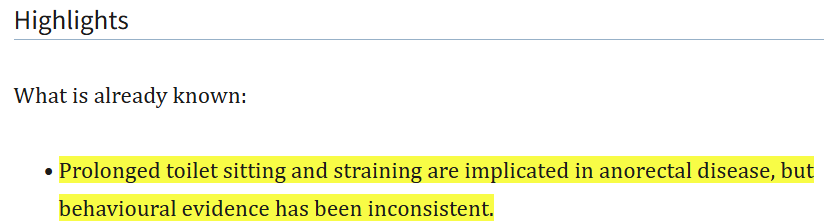
Source: Yazkan C, Şahin S, Yavuz B, Mammadov A, Özcan Ö, Dere Ö. Toilet behaviors and lifestyle factors in anorectal diseases: a cross-sectional analysis. Front Surg. 2025 Nov 18;12:1683286. doi: 10.3389/fsurg.2025.1683286. PMID: 41340992; PMCID: PMC12669168.
Moreover, hemorrhoids could be significantly associated with long sitting time, because this practice contributes to the weakening and then dilatation of the hemorrhoidal cushions.
The Anorectal Angle: What Your Posture Is Doing on the Toilet
When you hunch over your phone on the toilet, you change the natural alignment of your lower body.
- When you’re hunched over your phone, you’re changing the angle at which the rectum meets the anus.
- An abnormal anorectal angle increases the pressure on blood vessels in the rectum. If this pressure is maintained for a long period of time, it could increase the risk of symptomatic hemorrhoids.
- People who reported using their phones on the toilet also spent more time there, with 35% of those people spending more than five minutes on the toilet.
Doctors recommend a bowel movement should ideally take no longer than 3 to 5 minutes. Phone users? Often 15 to 30.
The Viral Case That Should Have Made Everyone Put Their Phones Down
The Man Who Lost His Rectum for 30 Minutes of Scrolling
This is not a myth or a meme. This happened.
A man in China, sat on a toilet playing games on his mobile phone while trying to defecate for 30 minutes, until his rectum fell out. Just after midnight, the unfortunate young man was rushed to a hospital in Guangzhou with a lump about 16 centimeters in diameter hanging from his anus. Doctors quickly determined that it was the man’s rectum.
Doctors explained that sitting or squatting on a toilet causes pressure in the abdomen to build up, which can force the rectum to detach and protrude if the pelvic muscles are not strong enough to support one’s body weight.
It was the long-term habit of sitting on the toilet for long periods that created great pressure on the abdomen, eventually resulting in rectal prolapse that progressively got worse.
His surgeons successfully operated, and he recovered. But the lesson stands.

Image Credits: Freepik
Your Brain on the Toilet Scroll
This is where the habit loop becomes really important to understand.
The Dopamine Habit Loop Explained
The neurobiological basis of scrolling involves small doses of dopamine released with each scrolling motion, coupled with variable reward schedules, which can lead to tolerance development.
- This mechanism mirrors the reward uncertainty that makes many behavioral patterns compelling and potentially habit-forming.
In simple terms: your brain gets a tiny hit of dopamine every time you swipe to something new. It doesn’t matter whether the content is good. The unpredictability of whether the next thing will be good is what keeps you going. This is the same mechanism behind slot machines.
- Adolescents and young adults are often victims of an unrelenting dopamine cycle created in a loop of desire induced by endless social media feeds, seeking and anticipating rewards in the way of photo tagging, likes, and comments, the latter being the triggers that continue to reinstate the desire behavior.
- The overactivation of the dopamine system can further increase the risk of addictive behaviors, leading to reduced reward sensitivity, a hallmark of addiction.
Now take that dopamine loop and place it inside a toilet, which is already a cue-rich environment (sitting down = opening phone), and you have a deeply conditioned habit that fires automatically, without any conscious decision.
The Habit Loop in This Context:
| Stage | What Happens |
| Cue | Sitting on the toilet |
| Craving | Boredom + urge to check something |
| Response | Picking up the phone and scrolling |
| Reward | Dopamine hit from new content |
Repeat this every day, and the neural pathway becomes a motorway. Your brain stops registering it as a choice.
How This Disrupts Your Gut Health and Bowel Habits
Your gut has its own nervous system, the enteric nervous system, often called the “second brain.” It responds to stress, distraction, and mental load.
- When you are scrolling on social media, you are activating your sympathetic nervous system (the fight-or-flight pathway), even mildly.
- This is the opposite of what your gut needs to complete a healthy, relaxed bowel movement.
Healthy defecation requires:
- Parasympathetic nervous system activation (rest and digest)
- Relaxed pelvic floor muscles
- Undistracted, pressure-free time
- Minimal straining
Scrolling introduces cognitive stimulation that keeps your sympathetic system partially activated, suppresses the relaxation response needed for healthy bowel habits, encourages longer sitting time which increases rectal vein pressure, and creates a conditioned association between elimination and entertainment.
Over time, daily repetition of this pattern can contribute to incomplete evacuation, chronic straining, worsening hemorrhoids from sitting too long, and poorer gut awareness, that natural sense of when your body is truly done.
What This Does to Your Mind Over Time
- Experts warn that young adults may be experiencing symptoms of accelerated brain aging as a result of excessive social media consumption, with a review of 71 studies published by the American Psychological Association finding that excessive short-form video consumption is directly associated with diminished cognitive functions.
- Even 10 minutes of toilet-scroll time daily adds up to over 60 hours a year of priming your brain to associate boredom and stillness with a dopamine-seeking behavior.
- Mindful bathroom habits are not just about hygiene. They are a genuine practice of being present in your own body.

Image Credits: Freepik
How to Actually Break the Loop (Without Going Cold Turkey)
This is the part where most advice fails people. “Just stop taking your phone to the bathroom” is not a strategy. It is a command, and commands without structure don’t stick, especially when you’re fighting a dopamine-conditioned habit loop.
Here’s what the loop-breaking approach actually looks like, practically and one step at a time.
Step 1: Name the Cue, Not the Behavior
- Before you change the behavior, identify what triggers it. Is it boredom? The desire to avoid silence? FOMO? Or is it purely automatic, you don’t even remember picking it up?
- Spend 3 days just noticing, without trying to change anything. Write it down if you can. Awareness is always the first interrupt.
Step 2: Create Physical Friction, Not a Ban
Instead of a dramatic no-phone-in-bathroom rule, start with one small physical barrier:
- Leave your phone on charge outside the bathroom
- Flip it face-down on the counter before you go in
- Keep it in your bag or pocket (somewhere that requires extra effort to retrieve)
Research on dopamine-driven habits confirms that adding tiny bits of friction, like moving apps off the home screen, turning off non-essential alerts, or logging out so you must type a password, are simple ways to make fast access slightly less smooth. The same principle applies physically, before you even enter the room.
Step 3: Replace, Don’t Remove
The brain doesn’t do well with voids. If you remove scrolling, replace it with something that gives a milder version of the same input:
- A short breathing exercise (box breathing: 4 counts in, hold 4, out 4)
- A physical book or printed page kept in the bathroom
- A puzzle or word game printed and stuck to the back of the door
- Nothing at all, and simply practicing the discomfort of stillness for 3 minutes
The goal isn’t perfection. It’s building a new association: toilet = quick, calm, intentional.
Step 4: Set a Bathroom Timer (Seriously)
Set a 3 to 5 minute timer on your phone before you go in, and leave the phone outside the bathroom after that.
This removes the need to track time yourself while also building awareness of how long you were actually sitting there.
Step 5: Build the Habit from the Outside In
Sustainable change starts with hygiene tips for mobile phones as a gateway habit. Start by:
- Wiping your phone screen with an antibacterial wipe once a day
- Charging your phone in a fixed spot outside your bedroom and bathroom every night
- Gradually making the bathroom a phone-free zone, starting with just mornings
The Loop Rule: One habit at a time. Stack them slowly. Celebrate the small win.
Hygiene Tips for Mobile Phones: The Maintenance Checklist
Even if you are still working on the habit, here’s how to reduce bacterial load on your device right now:
| Action | Frequency |
| Wipe with 70% isopropyl alcohol wipe | Daily |
| Remove phone case and clean underneath | Weekly |
| Avoid placing phone on toilet lid or floor | Always |
| Wash hands before picking phone back up | Every time |
| Never flush with phone nearby on lid | Always |
Research found that bacterial presence on mobile phone surfaces decreased to 73.07% when phones were sterilized with 70% ethanol before usage, compared to 90.54% in the non-sterilized group.

Source: Rozario SR, Rahman H, Fakhruddin ANM, Rabbani KA. Prevalence of Multidrug-Resistant Bacteria on Mobile Phone Surface. J Microsc Ultrastruct. 2019 Nov 29;8(1):14-19. doi: 10.4103/JMAU.JMAU_7_19. PMID: 32166059; PMCID: PMC7045620.
The Final Loop
Here’s the full picture of what happens when this habit runs unchecked, daily, over months and years:
The Compounding Cycle:
Boredom on toilet → Phone in hand → Longer sitting time → Rectal vein pressure → Hemorrhoids from sitting too long → Bacterial exposure from phone → Potential infections → Disrupted gut-brain connection → Harder to have mindful bathroom habits → Back to the phone for distraction
Every single element feeds the next.
Breaking even one link in that chain, whether it’s the sitting time, the phone hygiene, or the dopamine response, starts to loosen the entire loop.
To Wrap It Up
Your toilet is not a cinema. Your bathroom is not a scroll zone.
The science is clear: mobile phone contamination in the bathroom is a real and measurable health risk.
The gut health and bowel habit disruptions are real.
The hemorrhoids from sitting too long are real.
The psychological habit loop that keeps you coming back is deeply real, and deeply understood.
But so is your ability to interrupt it, not all at once, not dramatically, but one intentional step at a time.
The loop starts with awareness. The loop ends with a choice.
Start small. Start today. Leave the phone outside.
Disclaimer:This content is for informational purposes only and is not a substitute for professional medical advice, diagnosis, or treatment. Always consult a qualified healthcare professional for any health concerns or before making changes to your routine.
If you catch yourself stuck in this loop more often than you’d like, you’re not alone.
Set up a one-on-one consultation with our foundational medicine team or explore our Wellness Programs to optimize your overall health.
Reach out to us at 1800 102 0253 or write to us at [email protected].