No products in the cart.
Most of us grew up believing that as long as we were eating home food, we were eating well. And for a long time, that was true. But somewhere between the long commutes, the double shifts, the children’s schedules, and the exhaustion that follows, home food started getting help. A packet here. A ready masala there. Biscuits with chai because there was no time for anything else. 2-minute noodles on nights when cooking felt impossible.
And then came the 10-minute delivery.
Whatever you need, whenever you need it, before you have even changed out of your work clothes. It is genuinely impressive. And it has made ultra-processed foods not just accessible but almost unavoidable. Because when hunger strikes and chips, packaged cookies, instant noodles, and flavored drinks are ten minutes away, real food never stands a chance. We did not stop caring about our health. We just got a little too much convenience. And that is exactly what makes this so hard to hear.
Because while we were just trying to get through the day, those small convenient choices were quietly adding up. Not on a scale. Not in a mirror. Inside our arteries.
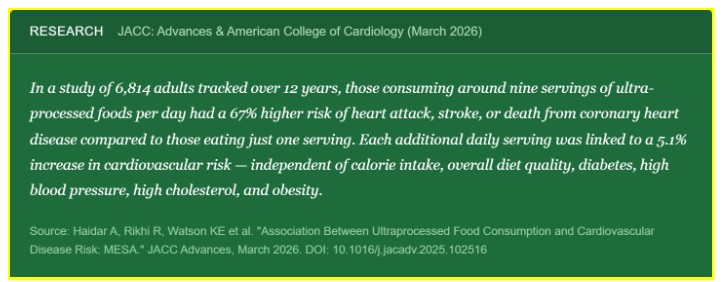
A major study published in March 2026 in JACC: Advances and presented at the American College of Cardiology’s Annual Scientific Session has confirmed what many of us in integrative health have been saying for years: ultra-processed foods are not just bad for your waistline. They are actively damaging your heart.
The research analyzed data from over 6,800 adults across diverse racial and ethnic groups in the United States. The findings are difficult to ignore. People consuming around nine servings of ultra-processed foods per day faced a 67% higher risk of heart attack, stroke, or death from coronary heart disease compared to those eating just one serving a day. And the risk did not suddenly spike at nine servings. Every single additional serving per day was linked to a more than 5% increase in cardiovascular risk, even after controlling for calories, overall diet quality, diabetes, high blood pressure, high cholesterol, and obesity.
That last part matters enormously. This risk existed independent of how many calories the person ate. The problem is not just what ultra-processed foods do to your calorie count. It is what they do to your biology.
What Counts as Ultra-Processed?
Before we get into action, you need to know what we are actually talking about. Researchers used the NOVA classification system, which categorizes foods from unprocessed to ultra-processed. Ultra-processed foods are industrially manufactured products that go far beyond basic cooking. They typically contain ingredients you would never find in a home kitchen: emulsifiers, artificial flavors, color stabilizers, preservatives, and modified starches.
Think chips and biscuits, packaged namkeen, instant noodles and flavored drinks, packaged juices, commercial white bread, ready-to-eat poha and upma mixes, flavored chaas and yogurt drinks, and most fast food. Even many packaged atta blends, instant masala mixes, and so-called health snack bars fall into this category. These are not foods. They are food-like products engineered for shelf life, palatability, and addiction.
Why Nine Servings Is Not as Far Away as You Think
Here is where most people disconnect from research like this. Nine servings sounds extreme. It does not feel like you. But consider a single day that might look perfectly normal to many Indians: two slices of commercial white bread with packaged jam in the morning, a glass of packaged fruit juice, a packet of salty biscuits with chai at 11 a.m., instant noodles or instant upma for a quick lunch, a packet of chips or namkeen in the evening, a cold drink or flavored chaas, a store-bought mithai or cream biscuit after dinner, and a bowl of instant soup before bed. That is eight to nine servings easily, and this person likely believes they are eating reasonably well because most of it feels familiar and homely.
Awareness is the first and most important action step.
What You Can Actually Do About This:
Read ingredient labels, not just nutrition facts. The nutrition panel tells you calories, fat, and sugar. It does not tell you how processed the food is. Flip the product over and read the actual ingredient list. If it contains more than five to six ingredients, or if you see names you cannot pronounce or would not find in your kitchen, put it back. Ingredients like partially hydrogenated oils, maltodextrin, sodium nitrite, carrageenan, and artificial flavors are red flags. This is not about being obsessive. It is about being informed.
👉Decode food labels with Ashwin Bhadri and Luke Coutinho.
Build your meals around single-ingredient or minimally processed foods. Fresh vegetables, fruits, legumes, eggs, plain oats, nuts, seeds, and whole grains cooked from scratch. These are not specialty health foods reserved for wellness enthusiasts. These are simply real foods.. These are just real foods. Your goal is to make the majority of your plate from ingredients that look like what they are. An egg looks like an egg. A lentil looks like a lentil. A chicken breast looks like a chicken breast. That simplicity is your guide.
Replace your most frequent ultra-processed habit, not all of them at once. Most people fail at dietary change because they try to overhaul everything simultaneously. Identify the one ultra-processed food you consume most often. Is it the chips at 4 p.m.? The sweetened coffee drink in the morning? The instant noodles at night? Replace just that one with a real food alternative for two weeks. Then move to the next. Change that sustains ks is change that is built slowly.
Cook in bulk to remove the convenience trap. The biggest reason people fall back on ultra-processed foods is time. Batch-cook on Sundays. Make a large pot of dal or beans, roast a tray of vegetables, hard-boil a batch of eggs. When real food is just as convenient as a packet, the choice becomes easy. The convenience trap only works when you have not planned ahead.
Be especially mindful if you are South Asian — because your baseline risk is already higher. Research has consistently shown that Indians and South Asians develop heart disease younger and more severely than most other populations in the world. We carry a higher predisposition to insulin resistance, visceral fat accumulation, and inflammation. This means that the same amount of ultra-processed foods may hit an Indian body harder than the study’s average suggests. This is not a cause for panic. It is cause for urgency. The good news is that the same real foods that protected our grandparents — dal, sabzi, roti made from scratch, curd, seasonal fruits — are still available to us. The question is whether we are choosing them.
The Deeper Point
This is not about fear. It is not about labeling food as evil. It is about understanding that your body is keeping count even when you are not. The inflammation triggered by ultra-processed foods, the disruption of hunger hormones, the accumulation of visceral fat, the impact on your gut microbiome, these are biological processes happening quietly every day, every meal, every choice.
You do not need to be perfect. You need to be aware. Start there.
Disclaimer: This article is intended for general informational and educational purposes only and does not constitute medical advice. The content shared here is based on published research and should not be used as a substitute for professional medical guidance, diagnosis, or treatment. Always consult your physician or a qualified healthcare provider before making significant changes to your diet, especially if you have a pre-existing health condition.
Want to Reduce Ultra-Processed Foods the Right Way?
It’s not about eliminating everything overnight. It’s about becoming aware of what you eat daily and making small, realistic swaps that your body can sustain.
Our wellness program is designed to help you simplify your food choices, reduce dependence on ultra-processed foods, and build habits that support long-term heart health.
Because good health is not about perfection. It is about consistency you can live with.
Call us at 1800 102 0253 or write to us at [email protected]