No products in the cart.
Frozen shoulders often begin quietly.
One day, lifting your arm to reach for a cup feels uncomfortable.
Wearing a shirt suddenly needs effort. Reaching behind your back becomes something you avoid.
And before you know it, movements you never thought twice about now come with hesitation, pain, and stiffness.

Image Credits: Freepik
This is the reality many people experience with a frozen shoulder. And while it’s often brushed off as a ‘temporary joint problem’ or something that comes with age, we’ve learned through years of working with clients that frozen shoulder is rarely just about the shoulder.
It brings with it frustration, fear, and a sense of helplessness, especially when rest doesn’t seem to help, and everyday activities start feeling like challenges.
So, let us help you understand:
- What frozen shoulder really is
- Why it develops, and how simple, consistent lifestyle changes can make a meaningful difference
- Learn how gentle movement, anti-inflammatory nutrition, stress management, and shoulder posture correction work together to restore mobility and reduce pain, naturally and safely
- Understanding frozen shoulder exercises and home remedies is often sufficient, and seeking frozen shoulder physical therapy treatment becomes necessary when these measures are insufficient
Because healing doesn’t come from doing more, it comes from doing the right things consistently.
What Is a Frozen Shoulder and How Does It Develop?
Frozen shoulder, medically known as adhesive capsulitis, is a condition where the shoulder joint gradually becomes stiff, painful, and difficult to move. However, to truly understand it, we need to look beyond the joint and examine how the body responds to inflammation, stress, and a lack of movement over time.
The shoulder is one of the most mobile joints in the human body.
- It is surrounded by a flexible connective tissue called the joint capsule, which allows smooth, pain-free movement. In a healthy shoulder, this capsule is elastic and well-lubricated.
In frozen shoulders, this capsule becomes inflamed, thickened, and tight.
- Over time, the inflammation leads to fibrosis, a process where the tissue loses its elasticity and forms adhesions.
- These adhesions restrict movement, reduce circulation, and increase pain.
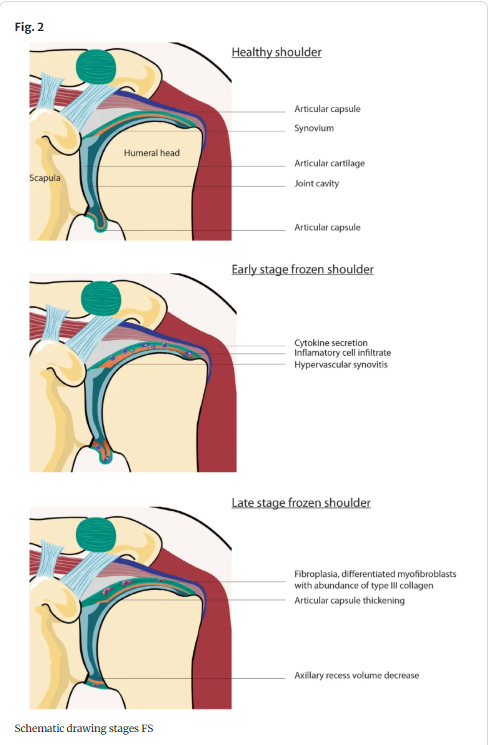
Source: Kraal, T., Lübbers, J., van den Bekerom, M.P.J. et al. The puzzling pathophysiology of frozen shoulders – a scoping review. J EXP ORTOP 7, 91 (2020). https://doi.org/10.1186/s40634-020-00307-w
This is why frozen shoulders are not sudden. It develops slowly and progressively.
The Inflammation–Stiffness Cycle
Science highlights a clear pattern:
- Inflammation irritates the joint capsule
- The body responds by limiting movement to ‘protect’ the area
- Reduced movement leads to less blood flow and lubrication
- Stiffness increases
- Pain worsens
- Even less movement follows
This cycle explains why shoulder pain and stiffness don’t appear overnight. What starts as mild discomfort slowly turns into restricted movement and persistent pain, often without a clear injury.
Why Lack of Movement Makes It Worse
One of the most important expert findings is that immobility accelerates stiffness.
- When we stop moving the shoulder, whether due to pain, fear, or long hours of sitting, the connective tissue around the joint begins to tighten.
- Collagen fibers inside the capsule become dense and disorganized, making the shoulder feel ‘stuck.’
This is also why complete rest rarely helps a frozen shoulder. In fact, prolonged inactivity is one of the biggest contributors to worsening symptoms.
The Real Causes for Frozen Shoulder (It’s More Than Just Age or Injury)
One of the biggest myths around a frozen shoulder is that it’s simply an age-related problem or the result of a past injury. While these factors can contribute, research and real-world clinical experience tell us something very different.
The causes for frozen shoulders are rarely random. In most cases, they are deeply connected to how we live, move, eat, think, and manage stress every single day.
Let’s break this down.
A Sedentary Lifestyle: The Silent Trigger
This is one of the most overlooked causes for frozen shoulders in modern life.
Reduced joint use and prolonged inactivity lead to connective tissue tightening.
- When the shoulder isn’t moved through its natural range regularly, circulation decreases, and the tissues around the joint begin to stiffen.
- Long hours of sitting, minimal upper-body movement, and lack of mobility work slowly condition the shoulder to ‘shut down.’
- Over time, the body adapts to this lack of movement, not by staying flexible, but by becoming rigid.
Poor Posture and Desk Habits
Rounded shoulders and a forward head position, common in desk jobs and excessive screen use, change how the shoulder joint is loaded. Muscles that should stabilize the joint weaken, while others become tight and overactive.
This imbalance creates:
- Uneven stress on the shoulder capsule
- Reduced joint space
- Poor movement patterns
Over time, this constant low-grade stress contributes to inflammation and stiffness, even without pain initially. This is why posture-related issues often go unnoticed until movement becomes restricted.
Chronic Inflammation from Within
Multiple studies associate frozen shoulders with systemic inflammation, not just local joint inflammation.
- Poor nutrition, ultra-processed foods, excess sugar, insulin resistance, and compromised gut health increase inflammatory markers in the body. These markers don’t just affect organs; they impact connective tissues as well.

Source: Kim JY, Gahlot N, Park HB. Basic Science Research in Frozen Shoulder: Current Updates. Indian J Orthop. 2024 Dec 2;59(6):774-784. doi: 10.1007/s43465-024-01294-1. PMID: 40511347; PMCID: PMC12151953.
When inflammation becomes chronic:
- Tissue healing slows down
- Collagen becomes less elastic
- Joints become more vulnerable to stiffness
This internal environment significantly increases the risk of developing frozen shoulders, even in physically active individuals.
Stress and Emotional Tension Stored in the Upper Body
Chronic stress alters muscle tone and increases inflammatory responses.
The shoulders, neck, and upper back are common areas where emotional stress is physically expressed. Prolonged stress keeps muscles in a semi-contracted state, restricting movement and blood flow.
Over time, this constant tension:
- Limits shoulder mobility
- Increases pain sensitivity
- Slows tissue recovery
This is why addressing stress is not optional; it’s essential.
The late American bestselling author Louise Hay, in her book You Can Heal Your Life, spoke extensively about the emotional roots of physical pain.
- She believed that shoulder problems often reflect our perceived ability to carry life’s responsibilities joyfully. When we constantly feel burdened, overwhelmed, or emotionally weighed down, the shoulders quite literally begin to carry that load.
Initially, like many, we were skeptical of this emotional–physical connection. But years of working closely with patients have taught us to deeply respect this link.
We’ve seen how unresolved stress, suppressed emotions, and a ‘pushing through at all costs’ mindset often show up as stiffness, pain, and restricted movement in the shoulders.
To learn more about the impact of suppressed emotions on your physical health, enroll in our online educational course: Luke’s Guide to Overcoming Trauma, Suppressed, and Repressed Emotions.
Hormonal and Metabolic Imbalances
Frozen shoulder is significantly more common in people with:
- Diabetes
- Thyroid disorder
- Metabolic syndrome
Elevated blood sugar levels and hormonal imbalances affect collagen structure and tissue repair. The joint capsule becomes more prone to thickening and fibrosis, making recovery slower if lifestyle factors are not addressed.
Symptoms to Watch Out For (Don’t Ignore These Early Signs)
Frozen shoulder develops gradually, which is why early symptoms are often overlooked.
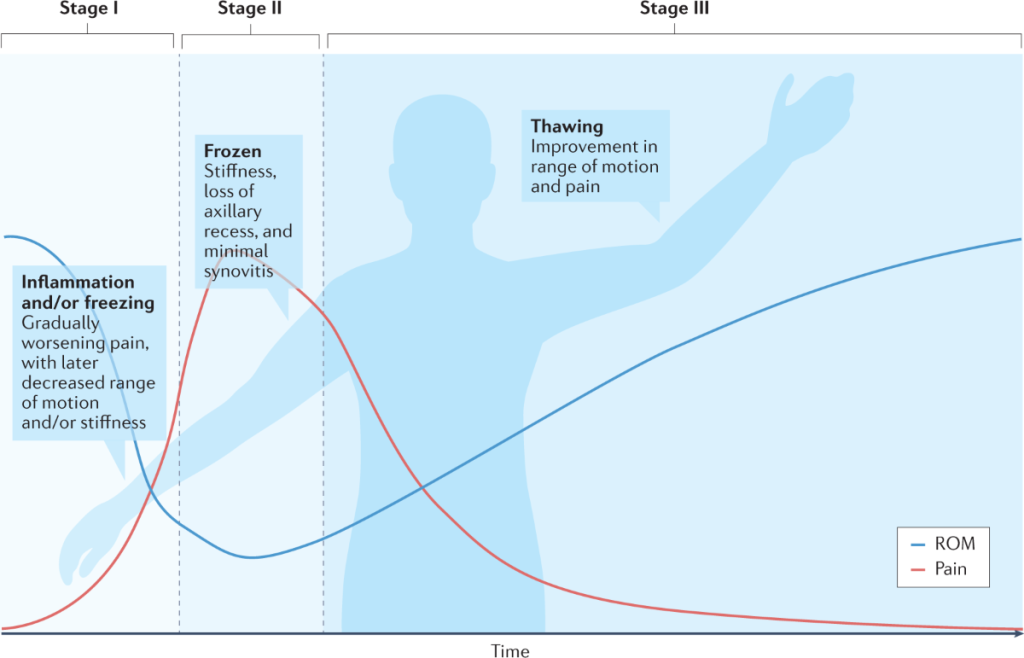
Source: Millar, N.L., Meakins, A., Struyf, F. et al. Frozen shoulder. Nat Rev Dis Primers 8, 59 (2022). https://doi.org/10.1038/s41572-022-00386-2
Watch out for the following symptoms:
- Dull, aching shoulder pain: A deep, persistent ache around the shoulder caused by early inflammation of the joint capsule. It often worsens after inactivity or by the end of the day.
- Gradual loss of range of motion: Difficulty lifting the arm, reaching overhead, or moving the arm behind the back. Movement feels restricted or ‘stuck,’ not just painful.
- Pain during sleep or while turning in bed: Discomfort increases at night due to reduced movement and circulation, making shoulder pain and stiffness more noticeable.
- Difficulty with daily activities: Simple tasks like dressing, grooming, or reaching for objects start to feel challenging due to capsular tightening rather than muscle weakness.
- Symptoms that worsen when ignored: Untreated shoulder pain and stiffness can progress, leading to increased inflammation, reduced mobility, and longer recovery periods.
The earlier you respond to shoulder pain and stiffness, the easier and faster recovery becomes.
Why Rest Alone Doesn’t Heal a Frozen Shoulder
When pain begins, the most natural response is to stop moving. Rest feels safe. Rest feels protective.
But when it comes to frozen shoulders, research tells us a different story.
We discussed this earlier, that prolonged rest and immobilization worsen stiffness, not improve it.
When movement reduces:
- Blood flow to the joint decreases
- Lymphatic drainage slows, allowing inflammatory waste to accumulate
- Collagen fibers become dense and less elastic
- The capsule tightens further
This is why stiffness progresses faster when the shoulder is avoided completely.
Where Do Injections and Physiotherapy Fit In?
Medical interventions such as:
- Corticosteroid injections
- Pain medications
- Frozen shoulder physical therapy treatment
…can help reduce pain and inflammation, especially in severe or advanced cases. Physiotherapy, in particular, plays an important role in guided movement and restoring mobility safely.

Image Credits: Freepik
However, these approaches work best when built on the right lifestyle foundations, not used in isolation.
Without addressing:
- Daily movement habits
- Shoulder posture correction
- Inflammatory nutrition
- Stress and recovery
…relief may be temporary.
Why Home Remedies and Foundations Matter
Many frozen shoulder home remedies, such as heat therapy, gentle massage, and regular mobility, help because they support circulation and movement. But their effectiveness depends on consistency.
Healing doesn’t come from one stretch, one injection, or one therapy session. It comes from doing the right things every day.
When the foundations are right:
- Movement becomes easier
- Pain reduces naturally
- Recovery becomes sustainable
The Mindset Shift
Frozen shoulders don’t heal by doing nothing.
It heals by doing the right amount, in the right way, consistently.
Understanding the causes for frozen shoulders helps us move beyond fear-based rest and towards intelligent, supportive action, where movement, posture, nutrition, and stress management work together.
Looking for holistic support to improve mobility, reduce inflammation, and heal naturally?
👉Explore our Wellness Program for personalised lifestyle guidance.
Frozen Shoulder Home Remedies That Actually Work: Lifestyle-Based Solutions
When it comes to frozen shoulders, there is no single exercise, food, or treatment that works in isolation. Recovery improves when movement, nutrition, posture, and stress regulation work together.
This is where lifestyle becomes the solution, not as an alternative to treatment, but as the foundation that supports recovery.
Gentle Frozen Shoulder Exercises at Home
Low-load, pain-free movement helps maintain tissue elasticity and prevents further capsular tightening. The goal is not to push through pain, but to restore safe mobility gradually.
Effective frozen shoulder exercises at home include:
- Pendulum swings: Use gravity, not muscle force, to gently mobilize the joint
- Wall crawls/wall slides: Encourage a controlled range of motion without strain
- Towel stretches: Assist rotation and flexibility within a comfortable range
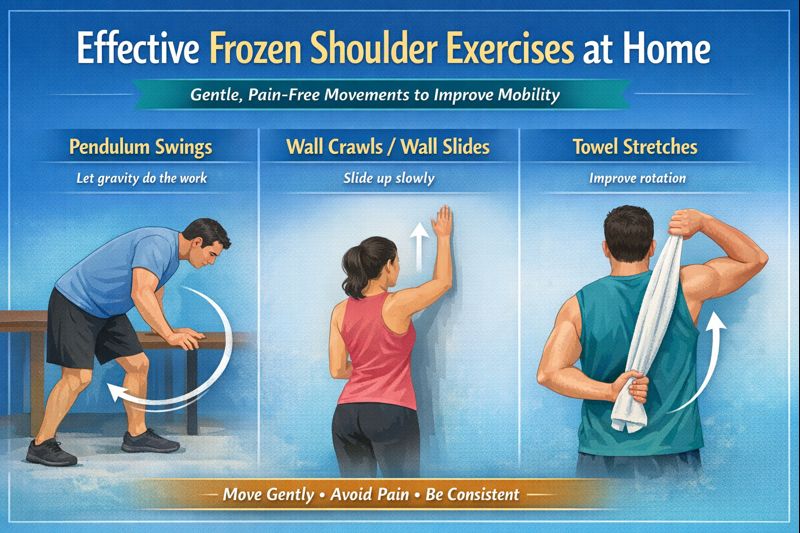
AI-generated image
Even 5–10 minutes daily, done correctly, can make a meaningful difference.
Disclaimer: These exercises are meant to be gentle and pain-free. Avoid forcing movement or pushing through sharp pain. If discomfort worsens or you have an existing injury or medical condition, consult a qualified healthcare professional or physiotherapist before continuing.
Anti-Inflammatory Nutrition That Supports Healing
We discussed earlier that frozen shoulder is associated with systemic inflammation, which means what you eat directly impacts recovery.
An anti-inflammatory diet helps reduce tissue irritation and supports healing:
- Turmeric and ginger: Natural anti-inflammatory compounds
- Omega-3 fats: Found in fatty fish, flaxseeds, and walnuts
- Leafy greens and colorful vegetables: Rich in antioxidants that protect connective tissue
Equally important is reducing:
- Excess sugar
- Refined carbohydrates
- Ultra-processed foods
Lower inflammation means less stiffness, reduced pain, and better movement, making nutrition one of the most effective frozen shoulder home remedies when practiced consistently.
Stress Reduction: The Missing Piece
Chronic stress keeps the nervous system in a heightened state, increasing muscle tension and inflammatory responses.
The shoulders are a common stress-holding area. When stress remains unmanaged:
- Muscles stay tight
- Movement becomes restricted
- Pain sensitivity increases
Simple practices such as breathwork, meditation, and mindfulness help regulate the nervous system, allowing muscles to relax and movement to return more naturally.
Shoulder Posture Correction in Daily Life
Poor posture alters shoulder mechanics and increases joint stress. Forward head posture and rounded shoulders reduce joint efficiency and contribute to stiffness.
Simple shoulder posture correction strategies include:
- Adjusting desk height and screen level
- Keeping shoulders relaxed and down, not hunched
- Taking posture breaks during long sitting hours
- Being mindful of phone and laptop usage
Correcting posture reduces unnecessary strain on the shoulder capsule and supports long-term mobility.
Sunlight & Infrared: A Simple Yet Powerful Addition for Stiff Joints
One often-overlooked lifestyle tool for stiff, inflamed joints is sunlight.
Like we’ve shared in one of our earlier posts, we often prescribe sunlight, and the outcomes of doing this daily have been remarkable.
View this post on Instagram
- Improved mood, better sleep, higher energy levels, and, importantly, reduced inflammation, which means less joint pain and stiffness.
Sunlight exposes the body to infrared rays, which have been scientifically studied for their ability to improve circulation and help reduce pain, swelling, and inflammatory responses in tissues.
For conditions like frozen shoulders, this gentle support can complement movement and recovery.
How to use sunlight mindfully:
- Start with 5 minutes of early morning or late evening sunlight
- Gradually build up to 10–15 minutes
- Avoid peak midday sun, which can be harsh
Living in colder regions or lacking sunlight? Infrared lamps can be a useful alternative, as infrared rays can penetrate clothing and reach deeper tissues.
Interestingly, we’ve also had members of our community comment on excellent improvements in frozen shoulder pain and mobility with sunlight exposure.
Simple and Effective Frozen Shoulder Home Remedies That Actually Help
| Home Remedy | How It Helps | How to Use It Safely |
| Warm compresses/heat therapy | Improves blood flow, relaxes tight tissues, reduces stiffness | Apply a warm compress for 10–15 minutes before exercises or stretches |
| Gentle oil massage (sesame or eucalyptus oil) | Supports circulation and muscle relaxation; may reduce pain sensitivity | Use light pressure; avoid aggressive or deep massage |
How Long Does Recovery Take? (Setting Realistic Expectations)
Frozen shoulder recovery is not linear, and that’s normal.
Frozen shoulder progresses through three overlapping phases:
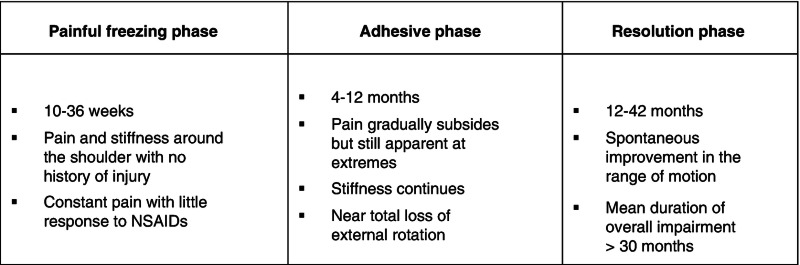
Source: Monjed A. Diabetes and Rheumatology. 2021 Jan 6. In: Almoallim H, Cheikh M, editors. Skills in Rheumatology [Internet]. Singapore: Springer; 2021. Table 21.3, [Frozen shoulder progression phases]. Available from: https://www.ncbi.nlm.nih.gov/books/NBK585735/figure/ch21.Fig5/ doi: 10.1007/978-981-15-8323-0_21
| What Slows Recovery | What Speeds It Up |
|
|
Recovery timelines vary from person to person. What matters most is not speed, but consistency.
When to Seek Frozen Shoulder Physical Therapy Treatment
While many people improve with home-based care, there are times when professional support becomes essential.
Consider frozen shoulder physical therapy treatment if:
- Pain persists despite consistent home care
- Range of motion continues to decline
- Daily activities and sleep are significantly affected
Physical therapy provides:
- Guided and safe joint mobilization
- Progressive movement plans
- Support in rebuilding confidence in movement
However, it’s important to understand that therapy works best when combined with lifestyle correction.
The Bigger Picture: Combine, Don’t Replace
There is no single solution that works for everyone with a frozen shoulder, and that’s an important truth to understand early.
- What works for one person may not work the same way for another.
- Some people respond well to physical therapy, others benefit from medical interventions, and many need a combination of approaches.
This is why lifestyle-based solutions are not an alternative to treatment, but a powerful support system that makes treatment more effective.
Frozen shoulder physical therapy treatment plays a valuable role in guided movement, joint mobilization, and restoring range of motion safely. In certain cases, injections or medications may be required to manage pain and inflammation so movement becomes possible again.
But here’s the key:
No treatment works in isolation if the foundations are ignored.
One Small Check-In Before You Go
Even if you don’t have a frozen shoulder today, your shoulders carry the weight of your daily life, long hours of sitting, screens, stress, and stillness.
Before you move on, take a moment to reflect:
- How often do I move my shoulders through their full range in a day?
- Do I spend more hours sitting than moving?
- Do my shoulders feel lighter after movement or heavier after rest?
If you noticed even one area that could use attention, start with a simple habit:
- Add short movement breaks during the day
- Become aware of your posture while working or using your phone
- Include foods that reduce inflammation and support joint health
The best time to support your shoulders isn’t when pain begins, it’s before it does.
Frequently Asked Questions
What causes frozen shoulders?
Frozen shoulder develops due to chronic inflammation, reduced movement, poor posture, prolonged sitting, stress, and metabolic issues like diabetes. The causes for frozen shoulders are usually lifestyle-driven rather than injury-based, with inflammation causing the shoulder capsule to tighten and restrict movement over time.
Can frozen shoulders heal naturally at home?
Yes, in many cases, frozen shoulders can improve naturally with consistent care. Frozen shoulder home remedies, such as gentle daily movement, heat therapy, anti-inflammatory nutrition, stress management, and posture correction, help reduce stiffness and support recovery when practised consistently.
What exercises help frozen shoulder recovery?
Gentle, pain-free movements work best. Frozen shoulder exercises at home, like pendulum swings, wall slides, towel stretches, and assisted range-of-motion exercises, help improve circulation, reduce stiffness, and gradually restore mobility without aggravating shoulder pain.
How long does it take for a frozen shoulder to improve?
Recovery timelines vary. Frozen shoulders may take several months to improve, depending on severity, consistency of care, and lifestyle factors. Early movement, reduced inflammation, and stress management significantly speed up recovery compared to rest and inactivity.
Does posture affect shoulder stiffness?
Yes. Poor posture places constant strain on the shoulder joint. Shoulder posture correction helps reduce joint stress, improves movement mechanics, and prevents stiffness from worsening, making it a crucial part of frozen shoulder prevention and long-term shoulder health.
Disclaimer: This blog is for educational and informational purposes only and is not a substitute for professional medical advice, diagnosis, or treatment. Always seek the advice of your physician or qualified healthcare provider with any questions you may have regarding a medical condition.
If you’re struggling with a frozen shoulder, don’t wait.
Set up a one-on-one consultation with our team or explore our Wellness Programs to optimize your skin health.
Reach out to us at 1800 102 0253 or write to us at [email protected].