No products in the cart.
“I sleep 8 hours every night, but I’m still exhausted.”
Sound familiar?
Or maybe you’re on the other end: “I only need 5 hours. I feel fine.”

Image Credits: Magnific
Here’s the thing. Both of these statements are missing something crucial.
And that missing piece might be the reason your energy, your recovery, your mood, and even your metabolism are not where they should be.
The debate around sleep quality vs. sleep quantity is one of the most misunderstood conversations in health. People pick a side. They shouldn’t. Because the truth is, you cannot have one without the other.
Let’s break it down the right way.
First, Let’s Talk About What Sleep Actually Is
Sleep is not just “downtime.”
It is one of the five foundational pillars of health in integrative lifestyle medicine, alongside cellular nutrition, adequate exercise, emotional detox, and spirit.
When you sleep, your body does things it simply cannot do while you’re awake:
- Repairs damaged cells and tissues
- Regulates hormones like cortisol, insulin, and testosterone
- Consolidates memory and processes emotions
- Detoxifies the brain through the glymphatic system
- Rebuilds and strengthens the immune system
This is not optional. This is biology. Miss out on sleep, and you are not just feeling tired. You are compromising your body’s ability to heal, think, perform, and live well.
Want to explore more about sleep cycle and benefits, read this:
Understanding REM Sleep, Deep Sleep, and Sleep Cycle Stages: How to Improve Sleep Quality
So, How Much Sleep Do Adults Need?
This is one of the most googled health questions, and the science is fairly consistent.
Most adults need 7 to 9 hours of sleep per night.
This is not a guideline. It is a biological requirement. And when you consistently sleep less than 6 hours, the damage is measurable:
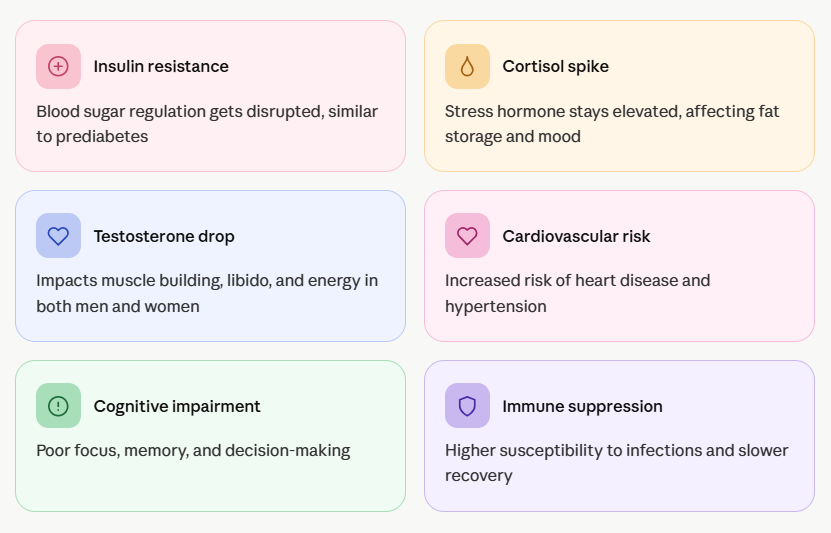
Chronic sleep deprivation is not a badge of honor. It is a slow, invisible health crisis.
Now, What Is Sleep Quality?
Sleep quantity is about duration. Sleep quality is about what actually happens during those hours.
- Your sleep is structured in cycles, each lasting roughly 90 minutes.
- A healthy night of sleep runs through 4 to 6 of these sleep cycles, and within each cycle, your body moves through different stages:
The two most critical stages:
- Deep Sleep (Slow Wave Sleep) This is your physical repair mode. Growth hormone is released here. Muscles are rebuilt. The immune system gets a boost. Your brain clears out waste products. This is non-negotiable for anyone who is training, recovering from illness, or dealing with chronic stress.
- REM Sleep (Rapid Eye Movement) This is your brain’s reset button. Emotional regulation, memory consolidation, decision-making, and resilience all happen here. REM deprivation is linked to mood disorders, anxiety, poor judgment, and even weight gain.
Here’s what poor sleep quality looks like:
- Waking up multiple times during the night (fragmented sleep)
- Lying in bed but not falling into deep or REM sleep
- Stress, anxiety, or a racing mind keeping you in light sleep
- Relying on alcohol to fall asleep (it blocks REM)
- Sleeping in a room that is too warm, too bright, or too noisy
You can be in bed for 8 hours and still not get restorative sleep. Hours spent in bed do not equal hours of actual healing sleep.
The Real Answer: Which Is More Important?
Here is where most people get it wrong. They treat this like a competition.
“Sleep quality over quantity” is incomplete advice.
“Just get more hours” is also incomplete.
The truth is:
Without enough quantity, sleep quality cannot exist. Without sleep quality, quantity becomes useless.
Think of it this way:
| Situation | What Actually Happens |
| 5 hours of “deep sleep” | Still harmful. Your body needed more time in each stage. |
| 8 hours of poor, broken sleep | Suboptimal. You clocked the hours but missed the repair. |
| 7 to 8 hours of good quality sleep | Optimal. Your body gets both the time and the depth it needs. |
Sleep quantity is the foundation. Quality is the multiplier.
You fix quantity first. Then you work on sleep quality.

Image Credit: Magnific
The Brutal Truth Nobody Wants to Hear
Here is something worth saying plainly, because the wellness world often dances around it:
You cannot bio-hack your way out of not sleeping enough.
No supplement, no breathwork session, no meditation app, no cold plunge, no nootropic stack can:
- Replace lost deep sleep cycles
- Restore missed REM sleep fully
- Undo the hormonal damage from chronic sleep deprivation
These tools have their place. But they are not substitutes. They are additions to a foundation that must already exist.
As Luke has said across his consultations and content: “You can gym as much as you want, eat the best food, meditate, and manage stress, but if you don’t have the right quality and quantity of sleep, your whole health goal will not be achieved.”
That is the integrative medicine perspective. Sleep is not a lifestyle luxury. It is a clinical priority.
What Breaks Your Sleep (Without You Realizing It)
Many people struggle with poor sleep and do not know why. Here are some of the most common, often overlooked culprits:
- Cortisol dysregulation: High stress keeps cortisol elevated at night, making it harder to fall into deep sleep. Cortisol and sleep have a deeply connected relationship. When one is off, the other suffers.
- Disrupted circadian rhythm: Your circadian rhythm is your internal 24-hour body clock. It tells your body when to feel awake and when to feel sleepy. Irregular sleep timings, late-night screen exposure, and artificial lighting all disrupt this rhythm.
- Insomnia and a busy mind: Insomnia is rarely just a sleep problem. It is usually a nervous system problem. An overactive, overstimulated nervous system cannot switch into the rest-and-repair mode needed for sleep.
- Late-night eating: Digestion and deep sleep compete. Heavy meals close to bedtime keep your body working when it should be winding down.
- Screen exposure: Blue light from phones and laptops suppresses melatonin, your sleep hormone, pushing your natural sleep time later and later.
What Actually Helps: The Fundamentals That Work
You do not need a complicated routine. You need the right fundamentals done consistently. This is where healthy sleep habits make all the difference.
To improve sleep quality naturally, start here:
- Fix your sleep-wake timing. Go to bed and wake up at the same time every day, including weekends. This is the single most powerful thing you can do to regulate your circadian rhythm and sleep cycle.
- Get morning light. Step outside within 30 minutes of waking up. Natural light signals your brain to stop melatonin production and set the clock for tonight’s sleep.
- Eat your last meal at least 2 to 3 hours before bed. Give your digestion time to settle before you expect your body to repair and restore.
- Reduce late-night stimulation. Work emails, social media, intense conversations, and news at night keep your nervous system activated. Wind down at least an hour before sleep.
- Downregulate your nervous system before bed. Breathwork, light stretching, journaling, gratitude practice, or simply sitting in silence can shift your body from sympathetic (fight-or-flight) to parasympathetic (rest-and-digest) mode. This is where better sleep begins.
- Keep your room cool, dark, and quiet. Your core body temperature needs to drop slightly for you to fall into deep sleep. A cooler room supports this naturally.
A note on sleep and recovery:
- If you are training hard, managing a high-stress lifestyle, or recovering from illness, your sleep need may actually be higher, closer to the 8 to 9 hour end.
- Sleep and recovery are inseparable. Growth hormone, which is released primarily during deep sleep, is your body’s most powerful natural recovery tool.

Image Credits: Magnific
What Science Keeps Telling Us (And We Keep Ignoring)
A few facts worth sitting with:
- Sleeping fewer than 6 hours impairs glucose metabolism in ways that resemble early-stage prediabetes, even in otherwise healthy people.
- Fragmented sleep reduces time spent in deep sleep and REM, affecting emotional regulation the very next day.
- REM deprivation for even a few nights affects decision-making, resilience, and mood in measurable ways.
- One study found that people who sleep less than 7 hours are nearly 3 times more likely to develop a cold when exposed to a virus compared to those who sleep 8 or more hours. (PMCID: PMC2629403)
- Lack of sleep raises ghrelin (your hunger hormone) and lowers leptin (your fullness hormone), which is why poor sleep is directly linked to cravings, overeating, and weight gain.
Sleep does not just restore you. It protects you.
If You Take Nothing Else From This, Take This
Sleep is not a passive activity. It is one of the most active, intelligent, and healing processes your body undergoes every single day. Shortchanging it is not strength or productivity. It is a health cost that accumulates silently and compounds over time.
Your priority order:
- Hit your minimum duration first. Aim for 7 hours as your non-negotiable baseline.
- Then work on quality. Sleep timing, environment, nervous system, and lifestyle habits.
- Be patient. Sleep does not fix in one night. But healthy sleep habits, practiced consistently, create lasting change.
Whether you are managing stress, building muscle, fighting a chronic condition, or simply trying to feel human again, better sleep is not a luxury upgrade. It is the foundation everything else is built on.
Sleep quantity is the foundation. Quality is the multiplier. You need both.
Start tonight.
Disclaimer: The information provided here is for educational and informational purposes only. It is not intended as a substitute for professional medical advice, diagnosis, or treatment. Always consult your healthcare provider before making changes to your lifestyle or healthcare regimen, especially if you have existing medical conditions or are taking prescribed medications.
Looking for support to manage your sleep quality?
We help you find a way.
Set up a one-on-one consultation with our foundational medicine team or explore our Wellness Programs to optimize your lifestyle goals.
Reach out to us at 1800 102 0253 or write to us at [email protected].