No products in the cart.
Feeling anxious before a big meeting?
Lying awake at 2 AM with a racing mind?
Wishing you could just switch off the stress?
There may be a solution hiding right under your nose, literally.
The 4-7-8 breathing technique is a simple, research-backed breathing exercise that takes less than two minutes and requires no equipment, no app, and no experience.
Just you and your breath.
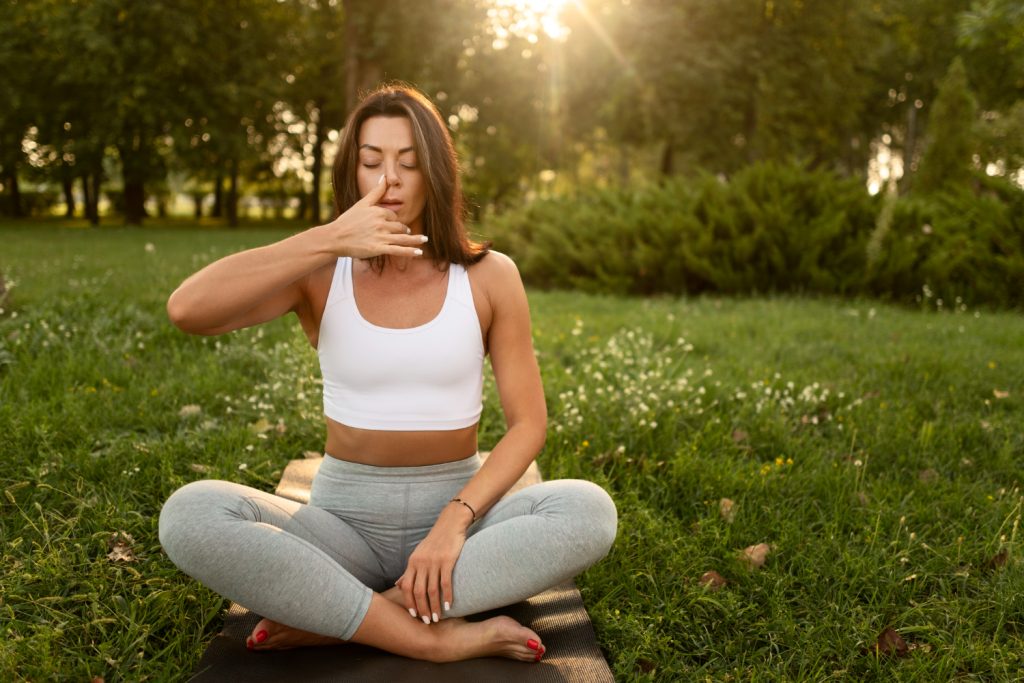
Image Credits: Freepik
In this guide, we’ll walk you through everything you need to know about what it is, where it came from, how to do it step by step, what the science says about its benefits, and exactly when (and when not) to use it.
What Is the 4-7-8 Breathing Technique?
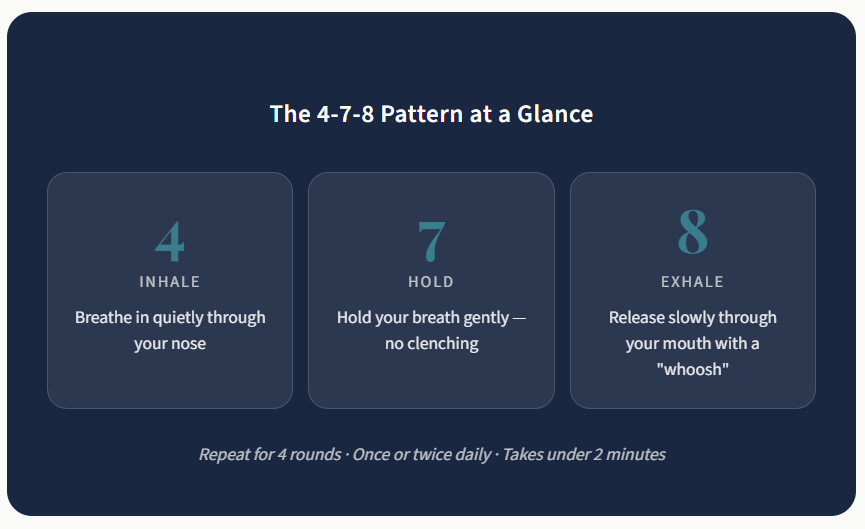
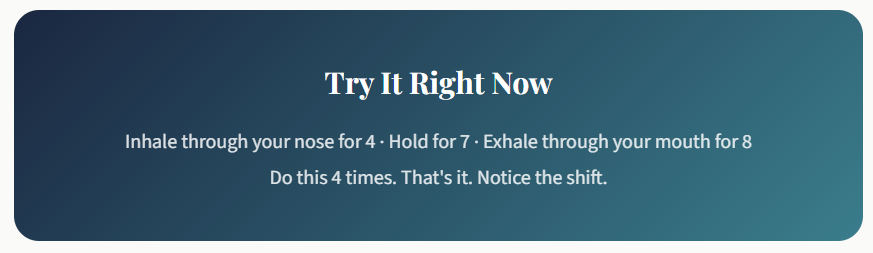
The 4-7-8 breathing method is a structured breathwork practice where you inhale for 4 counts, hold your breath for 7 counts, and exhale slowly for 8 counts.
That’s one cycle.
The idea is to do four of these cycles in a row, which takes under two minutes.
Where Did It Come From? The Origins of 4-7-8 Breathing
The 4-7-8 technique was popularized by Dr. Andrew Weil, an integrative medicine physician from Harvard, who began teaching it around 2015.
- He describes it as a “natural tranquilizer for the nervous system.”
- But its roots go back thousands of years.
The method is grounded in pranayama, the ancient yogic practice of controlling the breath to influence the mind and body.
- “Prana” means life force, and “ayama” means to extend or regulate it.
Yogis have long understood what modern science is now confirming: how you breathe directly shapes how you feel.
How to Do the 4-7-8 Breathing Technique: Step by Step
Good news: there’s no learning curve. Here’s exactly how to do it:
- Find a comfortable position and sit upright or lie down. Relax your shoulders.
- Rest the tip of your tongue on the roof of your mouth, just behind your upper front teeth. Keep it there throughout.
- Exhale fully through your mouth to empty the lungs before you begin.
- Close your lips and inhale quietly through your nose for a count of 4.
- Hold your breath for a count of 7. Don’t strain, stay relaxed.
- Exhale completely through your mouth with a “whoosh” sound for a count of 8.
- That’s one cycle. Repeat 3 more times for a total of 4 rounds.
The counting speed can be flexible; what matters most is the ratio (4:7:8), not the absolute seconds. As you get more comfortable, you can slow the count down for a stronger effect.
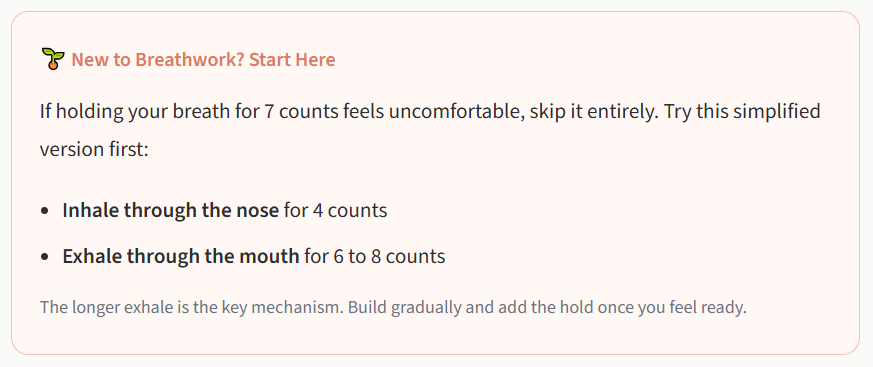
Beginner Modification: Skip the Hold
Why Does It Work? The Science Behind 4-7-8 Breathing
The answer lies in your autonomic nervous system, specifically the tug-of-war between your sympathetic (“fight-or-flight”) and parasympathetic (“rest-and-digest”) branches.
- When you’re stressed, your sympathetic system fires up: heart rate climbs, breathing becomes shallow and rapid, and your body braces for danger.
- The 4-7-8 technique works against this by forcing a long, slow exhale, which directly activates the parasympathetic nervous system via the vagus nerve.
- This signals your brain that you’re safe, and your body begins to relax.
- The extended breath hold also builds carbon dioxide tolerance, which helps regulate respiratory patterns and reduce anxiety-driven hyperventilation.
Research found that the 4-7-8 breathing technique increases parasympathetic activity and improves heart rate variability (HRV), a key marker of how well your body recovers from stress.
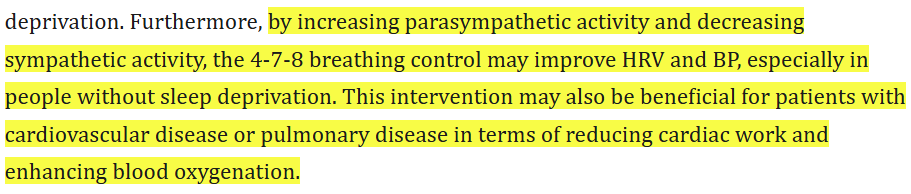
Source: Vierra J, Boonla O, Prasertsri P. Effects of sleep deprivation and 4-7-8 breathing control on heart rate variability, blood pressure, blood glucose, and endothelial function in healthy young adults. Physiol Rep. 2022 Jul;10(13):e15389. doi: 10.14814/phy2.15389. PMID: 35822447; PMCID: PMC9277512.
Proven Benefits of the 4-7-8 Breathing Technique
Here’s what more research says:
Reduces anxiety
A clinical trial found that 4-7-8 breathing significantly reduced anxiety in post-surgical patients. A separate study on COPD patients showed statistically significant improvements in anxiety and depression scores.

Source: Pandekar PP, Thangavelu PD. Effect of 4-7-8 breathing technique on anxiety and depression in moderate chronic obstructive pulmonary disease patients. Int J Health Sci Res. 2019; 9(5):209-217.
Better sleep
A study of 14 people with insomnia found that slow, paced breathing before bed reduced time to fall asleep, cut nighttime awakenings, and increased overall sleep efficiency, effects linked to higher heart rate variability.
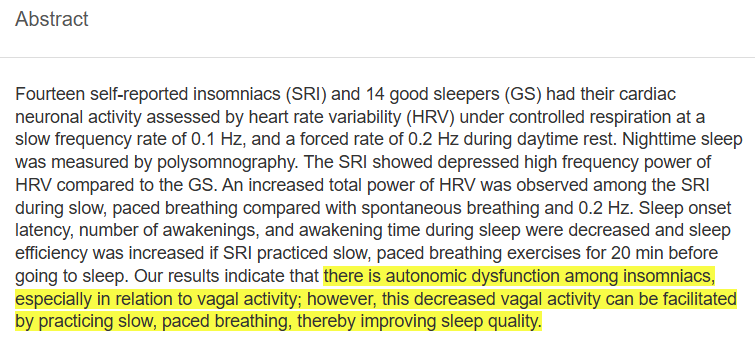
Source: Tsai, H & Kuo, Terry & Lee, Guo-She & Yang, Cheryl. (2014). Efficacy of paced breathing for insomnia: Enhances vagal activity and improves sleep quality. Psychophysiology. 52. 10.1111/psyp.12333.
When Can You Use The 4-7-8 Breathing Technique in Daily Life?
The beauty of this technique is that it fits anywhere. No mat, no silence, no special setting required. Here are the best moments to use it:
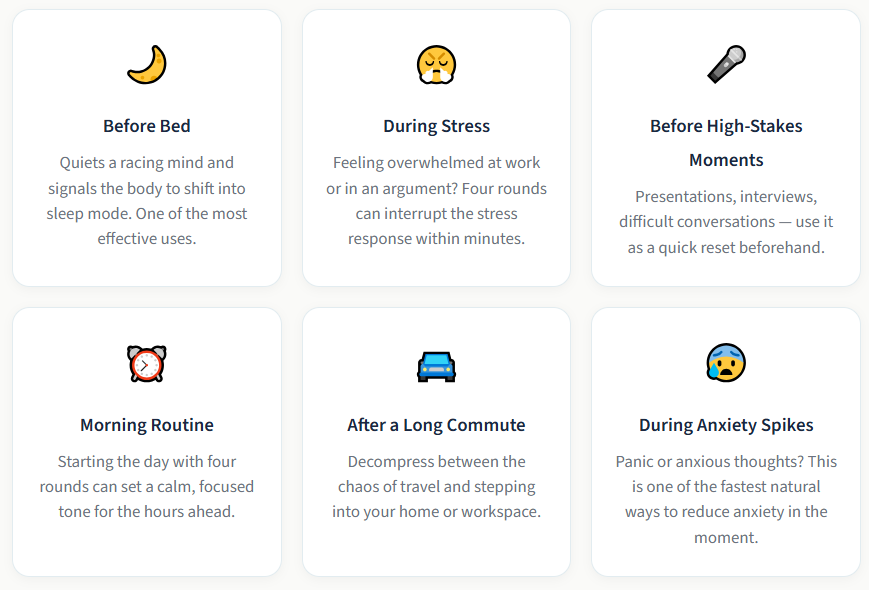
Most experts recommend practicing once or twice daily, even when you’re not stressed. Consistency is what builds the technique’s power over time.
The more you practice, the more your body will incorporate this into its natural stress response.
Who Should Do It and Who Should Be Careful
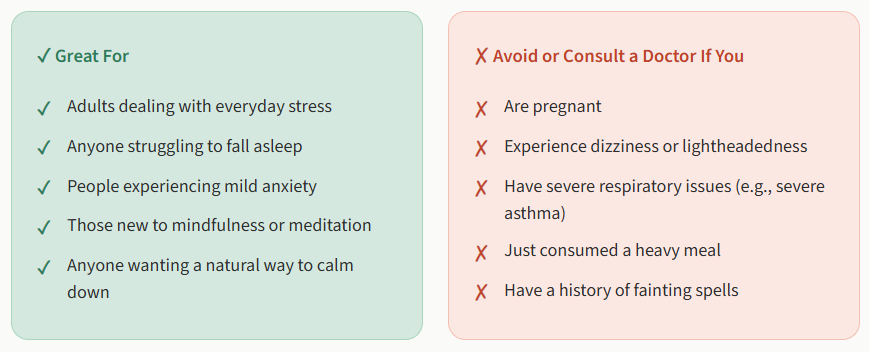
If you feel lightheaded during practice, stop and breathe normally. This is the only commonly reported side effect, and it usually passes quickly. When in doubt, skip the breath hold and stick to the simplified version.
Tips to Make It a Daily Habit
Stack it with existing habits.
Do four rounds right after brushing your teeth at night, or as soon as you sit down at your desk in the morning. Habit-stacking makes it easier to be consistent.
- Start with just 4 rounds. Once it feels natural, usually after a few weeks, you can work up to 8 rounds per session. Don’t rush it.
- Don’t judge the pace. There’s no perfect speed. What matters is the ratio. Go at whatever pace feels comfortable for your body.
- Give it time. Many people feel immediate results, but the deeper benefits of reduced anxiety, better sleep, and improved emotional regulation build with consistent daily practice over days and weeks.
The Last Word
In a world full of expensive wellness products and complicated routines, the 4-7-8 breathing technique is a reminder that some of the most powerful tools are already inside you.
You carry this technique with you everywhere: at 3 AM, in a traffic jam, before a tough conversation, or simply at the end of a long day.
It costs nothing. It takes under two minutes. And science backs it up.
Try it tonight before you sleep, four rounds, and see how you feel.
Disclaimer: This blog is intended for educational and informational purposes only and should not be used as a substitute for professional medical advice, diagnosis, or treatment. Always seek the guidance of your qualified healthcare provider before making any changes to your medications or lifestyle.
Looking for holistic and foundational guidance for managing stress, improving sleep, and building lasting health?
We help you find a way.
Set up a one-on-one consultation with our foundational medicine team or explore our Wellness Programs to optimize your lifestyle goals.
Reach out to us at 1800 102 0253 or write to us at [email protected].