No products in the cart.
What if your brain could grow new cells, even in adulthood?
For decades, we were taught that the brain reaches its peak early in life and then slowly declines. Once childhood is over, brain cells are lost and never return. This belief shaped how we viewed memory loss, emotional burnout, and even ageing itself as inevitable.

Image Credits: Freepik
Modern neuroscience tells a very different story.
Today, we know that the adult brain is far more dynamic than we once imagined. It can adapt, reorganize, and under the right conditions, even generate new brain cells, a process known as neurogenesis.
This discovery has transformed how we understand brain health, resilience, and recovery, especially in adults navigating high stress, mental fatigue, poor sleep, and emotional overload.
And this matters now more than ever.
We’re seeing memory lapses at younger ages, rising anxiety, chronic burnout, and brains that are constantly overstimulated but deeply undernourished. The issue isn’t that the brain is weak; it’s that modern lifestyles interfere with how the brain is designed to heal and renew itself.
This is not about biohacking or quick fixes. It’s about biology. We believe the body, including the brain, has an innate intelligence to heal. Our role is simple: stop fighting it and start supporting it.
What you’ll learn here:
- How neurogenesis works and what it means for the adult brain
- Whether neurogenesis in adults is truly possible
- The difference between neuroplasticity and neurogenesis
- Practical ways to support brain regeneration through lifestyle
- The role of exercise and brain health
- Why sleep and the brain are deeply connected
- How brain health nutrition influences mental clarity
- Simple, sustainable ways to understand how to regenerate brain cells naturally
This is not about doing more. It’s about doing what the brain has been quietly asking for all along.
What Is Neurogenesis and How Does It Support Brain Cell Regeneration?
In the simplest terms, neurogenesis is the brain’s ability to create new brain cells (neurons).
For a long time, this was believed to happen only during early childhood. We now know that brain cell regeneration can continue even in adulthood, when the right internal environment is created.
Modern research has repeatedly shown that the adult brain is not ‘hard-wired’ or fixed. Instead, it remains biologically active, responsive, and capable of renewal. This discovery changed how neuroscience understands ageing, memory, mood disorders, and cognitive decline.

Source: Fuchs E, Flügge G. Adult neuroplasticity: more than 40 years of research. Neural Plast. 2014;2014:541870. doi: 10.1155/2014/541870. Epub 2014 May 4. PMID: 24883212; PMCID: PMC4026979.
Where Does Neurogenesis Happen?
Adult neurogenesis primarily occurs in a small but critical region of the brain called the hippocampus.
The hippocampus plays a central role in:
- Memory formation and recall
- Learning and adaptability
- Emotional regulation and mood balance
This is why conditions like chronic stress, depression, poor sleep, and prolonged inflammation often show measurable shrinkage or dysfunction in the hippocampus. When neurogenesis slows down, these abilities suffer. When it’s supported, they improve.
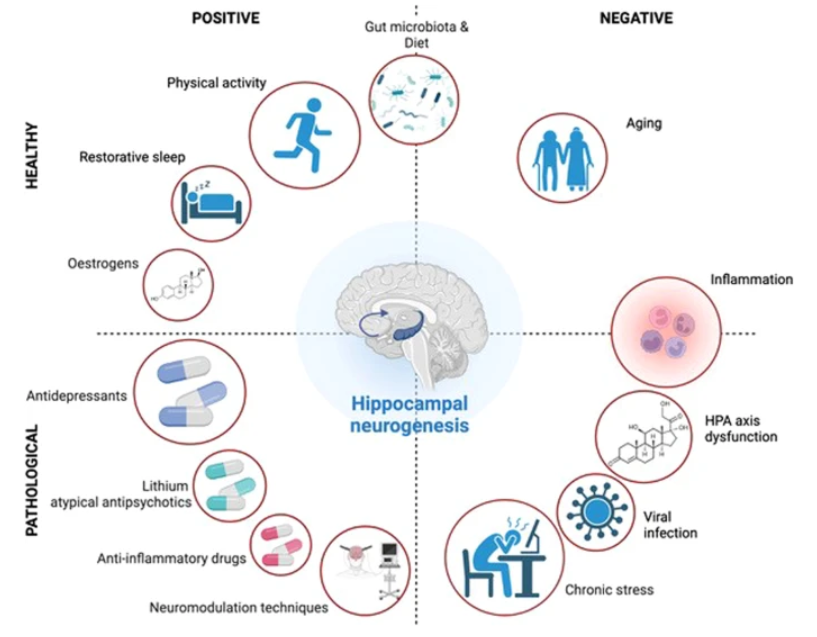
Factors potentially influencing hippocampal neurogenesis in healthy and pathological conditions. Source: Alonso, M., Petit, AC. & Lledo, PM. The impact of adult neurogenesis on affective functions: of mice and men. Mol Psychiatry 29, 2527–2542 (2024). https://doi.org/10.1038/s41380-024-02504-w
Why Neurogenesis Matters More Than You Think
When neurogenesis is supported, it contributes to:
- Better emotional resilience under stress
- Improved learning and adaptability
- Sharper focus and memory
- Greater mental flexibility as we age
When it’s suppressed, often due to chronic stress, poor sleep, sedentary habits, and poor nutrition, the brain shifts into survival mode. Growth is paused. Repair is delayed.
Neurogenesis vs Neuroplasticity: What’s the Difference?
This is one of the most common points of confusion and one of the most important to clarify.
Both neurogenesis and neuroplasticity describe the brain’s ability to change, adapt, and improve. But they are not the same process. Understanding the difference helps you appreciate how lifestyle truly shapes brain health.
Let’s Simplify It
- Neurogenesis = the creation of new brain cells (neurons)
- Neuroplasticity = the brain’s ability to form new connections, pathways, and networks between existing neurons
Optimal brain health needs both.
This is why modern neuroscience increasingly discusses neuroplasticity and neurogenesis together, not as competing ideas, but as complementary processes.
What Science Shows (In Simple Terms)
- Neurogenesis contributes new neurons, particularly in the hippocampus.
- Neuroplasticity determines how well those neurons integrate into existing brain circuits..
- New neurons that fail to form strong connections often don’t survive long-term.
In other words, neuroplasticity decides whether newly formed brain cells become useful or are pruned away.
This is a critical insight from newer research: The brain doesn’t just make cells, it keeps the ones it can use.
Why This Distinction Matters
| For memory |
|
| For emotional balance |
|
| For lifelong learning |
|
Neurogenesis in Adults: Can the Adult Brain Regenerate Naturally?
Let’s address the question head-on, with evidence, not wishful thinking.
The Central Question
Can humans continue to produce new neurons into adulthood, a process called adult neurogenesis?
The answer from emerging research is yes, but with nuance.
What the Latest Science Shows
Investigations, including postmortem analyses of human brains, have found signs of new neurons being produced in the adult hippocampus.
- These studies examined hippocampal tissue from individuals aged 14 to 79 and found immature neurons present regardless of age, suggesting that neurogenesis persists throughout life.
- This counters older views that neuron formation essentially stopped by the late teens.
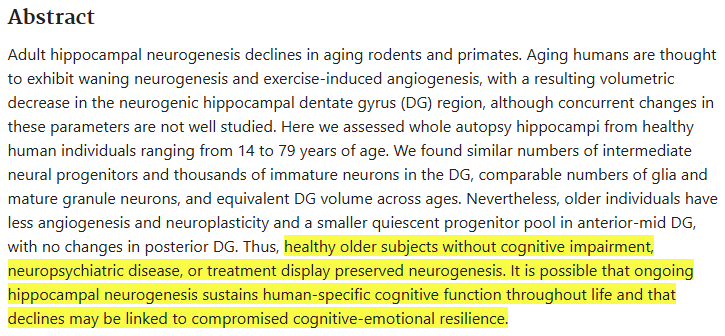
Source: Boldrini M, Fulmore CA, et al. Human Hippocampal Neurogenesis Persists throughout Aging. Cell Stem Cell. 2018 Apr 5;22(4):589-599.e5. doi: 10.1016/j.stem.2018.03.015. PMID: 29625071; PMCID: PMC5957089.
In other words, the adult human brain retains the capacity for new brain cell formation, albeit more slowly and at lower rates than during childhood.
Different From Childhood Brain Growth
It helps to understand the difference:
- Childhood Neurogenesis: rapid, robust, foundational for brain wiring
- Adult Neurogenesis: slower, subtler, influenced heavily by lifestyle and internal environment
The brain’s cellular birth rate declines with age, but even older adults retain thousands of immature neurons in the hippocampus, meaning adult brains still make new cells, challenging the idea that production stops entirely with age.
Conflicting Views and What They Mean
Not every expert agrees on how much neurogenesis occurs in adults, but the tide of evidence leans toward it being a real and measurable phenomenon.
Some argue it may be rare or hard to detect, while others, using advanced tools like machine learning and single-cell gene analysis, have identified genetic markers of neural progenitors (the cells that give rise to neurons) in adult hippocampal tissue.
This suggests:
- The process is real but variable
- It may differ widely between individuals
- It may depend on internal and external environments
Here’s an example of conditions like depression, along with our environment and even medication, that can either inhibit or revive neuroplasticity in the brain.
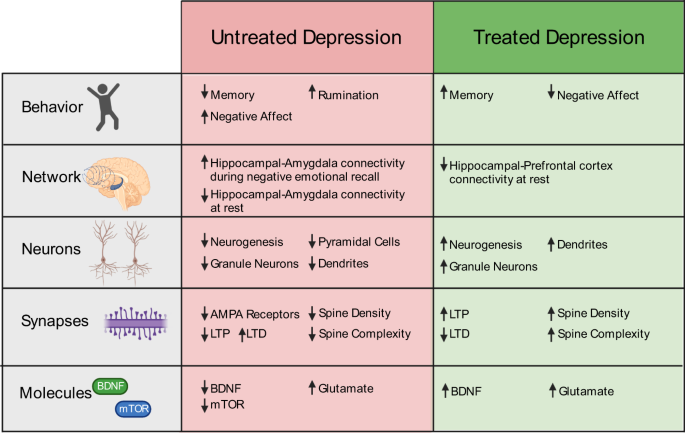
Source: Tartt, A.N., Mariani, M.B., Hen, R. et al. Dysregulation of adult hippocampal neuroplasticity in major depression: pathogenesis and therapeutic implications. Mol Psychiatry 27, 2689–2699 (2022). https://doi.org/10.1038/s41380-022-01520-y
Busting the Myths
Let’s clear up a few common misconceptions:
Myth 1: “Brain cells don’t regenerate.”
Reality: The adult hippocampus can produce new neurons, and this is supported by recent human studies showing immature neurons and progenitor markers in adult brains.
Myth 2: “Brain damage is permanent.”
Reality: While not every form of damage is fully reversible, the brain’s capacity for remodelling and regeneration (neurogenesis + neuroplasticity) means it can adapt and recover more than we ever thought possible.
Reframing Expectations
This isn’t a ticket to instant mental rewiring or overnight memory enhancement. Adult neurogenesis is real, but it’s a slow, ongoing biological process, influenced by things like:
- Sleep quality
- Movement
- Stress levels
- Nutrition
- Mental and emotional environment
Think of it like tending a garden: you can sow seeds any time, but the soil, water, light, and climate determine how many sprout and how strong they grow.
Yes, you can influence brain cell regeneration. But it happens over weeks and months of consistent supportive habits, not in isolated hacks.
In one of our podcasts, leading clinical psychologist and internationally recognized expert in mindfulness and self-compassion, Dr. Shauna Shapiro, also highlights how neuroplasticity and lifestyle together help the brain rewire, heal, and grow. Watch the podcast now:
Lifestyle Habits That Support Brain Cell Regeneration
Understanding science is important. But biology only changes when behavior changes.
We look at lifestyle as the foundation of brain health, not an add-on. As we have already discussed, adult neurogenesis and brain cell regeneration are strongly influenced by daily lifestyle signals, not by extremes, hacks, or short bursts of motivation.
The brain responds to patterns.
Which is why consistency matters more than intensity, and daily habits matter far more than occasional efforts. This isn’t about self-improvement pressure. This is about nourishing the brain in the way it evolved to be nourished.
If you’re asking how to regenerate brain cells naturally, this is where the real work begins.
Exercise and Brain Health: How Movement Stimulates Neurogenesis
Movement is one of the strongest biological signals for brain growth.
Physical activity increases levels of Brain-Derived Neurotrophic Factor (BDNF), often called “fertilizer for the brain.” BDNF supports:
- Survival of new neurons
- Growth of existing neurons
- Stronger connections between brain cells
In simple terms, movement tells the brain it’s safe to grow.
Exercise Types & Effects on BDNF and the Brain
| Type of Exercise | BDNF Response | Brain & Cognitive Effects |
| Moderate Aerobic (e.g., brisk walking, jogging, cycling) | ↑ Moderate to significant increases in peripheral BDNF (often 2–3× baseline) | Supports hippocampal neurogenesis, improved memory and executive function |
| High-Intensity Interval Training (HIIT) | ↑ Higher acute increases of BDNF compared to low/mod intensity | Stronger stimulation of hippocampal, prefrontal activity, may sustain neuroplastic benefits longer |
| Resistance/Strength Training | ↑ Modest increase (less consistent than aerobic alone) | Supports executive function and memory, reduces inflammation |
| Endurance (longer sessions, e.g., long runs) | ↑ Significant acute increase during and shortly after exercise | Enhanced neuroplasticity signaling & improved blood flow |
| Mixed Activity (functional or cognitively engaging movement) | ↑ Moderate increase depending on intensity & duration | Improves coordination, motor learning, executive control |
When movement is part of daily life, exercise and brain health become inseparable.
Sleep and the Brain: Why Rest Is Essential for Brain Cell Regeneration
If movement plants the seeds, sleep is when the brain does the repair work.
Neuroscience research shows that deep sleep is essential for:
- Memory consolidation
- Clearing metabolic waste from the brain
- Supporting neurogenesis in the hippocampus
Sleep deprivation, on the other hand, has been shown to suppress brain cell regeneration, increase inflammation, and impair emotional regulation.
This is why we say sleep is not negotiable; it’s biological maintenance.
No rigid rules here. Just gentle, sustainable cues:
- Consistent sleep and wake times
- Reduced screen exposure before bed
- Creating a sense of safety and calm at night
When sleep improves, sleep and the brain heal together.
Meditation, Stress Reduction, and Mental Stillness
Chronic stress is one of the fastest ways to shut down neurogenesis. Research shows that prolonged exposure to cortisol, the stress hormone, can:
- Damage hippocampal neurons
- Reduce the survival of newly formed brain cells
- Shrink brain regions involved in memory and mood
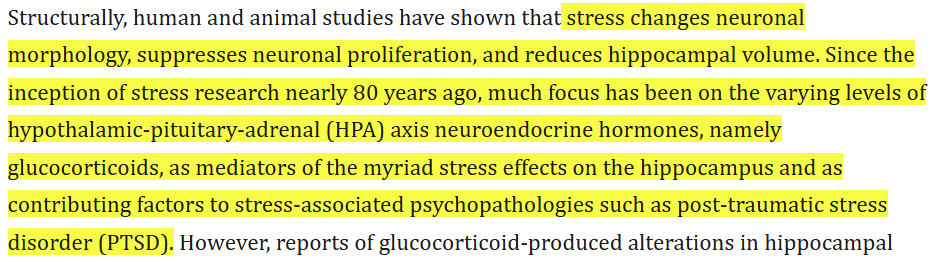
Source: Kim EJ, Pellman B, Kim JJ. Stress effects on the hippocampus: a critical review. Learn Mem. 2015 Aug 18;22(9):411-6. doi: 10.1101/lm.037291.114. PMID: 26286651; PMCID: PMC4561403.
Meditation and stress-reduction practices act as brain protection mechanisms. They:
- Lower cortisol
- Improve emotional regulation
- Support neuron survival and integration
Try this 5-minute ancient metta meditation.
This is not about spirituality. This is about nervous system regulation. Stillness is not a luxury. It’s a biological requirement for brain regeneration.
Brain Health Nutrition: Foods That Support Neurogenesis and Brain Regeneration
The brain is one of the most metabolically active organs in the body, and it’s deeply sensitive to what we eat.
Key nutrients that support brain health nutrition:
- Omega-3 fatty acids for neuronal membrane integrity
- Antioxidants to reduce oxidative stress
- Polyphenols to support neuroplasticity and neurogenesis
There’s also growing evidence around the gut–brain connection, showing that inflammation, gut health, and microbial balance influence mood, cognition, and brain regeneration.
Learn more about it and the 5 ways to improve the gut-brain connection.
A Simple Daily Framework to Support Neurogenesis
If you’re wondering how to regenerate brain cells naturally, the answer isn’t found in doing more; it’s found in doing less, better.
| Lifestyle Changes | What It Looks Like Daily | Why It Supports Neurogenesis |
| Sleep Consistency | Sleeping and waking around the same time, even on weekends | Stable sleep–wake cycles support hippocampal repair, memory consolidation, and survival of new neurons |
| Daily Movement | Walking, gentle strength work, yoga, or functional movement | Increases BDNF, improves blood flow to the brain, and signals a growth-friendly environment |
| Calm Mornings (Before Screens) | 15–30 minutes without news, notifications, or social media | Reduces cortisol spikes, protects hippocampal neurons, and sets a calmer neurological tone for the day |
| Nutrient-Dense Meals | Whole foods, healthy fats, colorful plants, adequate protein | Provides raw materials for neuronal membranes, neurotransmitters, and brain repair |
| Mental Hygiene | Fewer tabs open — mentally and digitally; moments of stillness | Lowers chronic stress, supports neuroplasticity, and allows new brain cells to integrate effectively |
This framework is not rigid. You can add to it, adapt it, or edit it based on your lifestyle, as long as the biology stays respected.
Want personalised guidance to support brain health, focus, and long-term wellbeing?
👉 Explore our Wellness Program for holistic lifestyle support.
The Last Word
The most empowering takeaway from modern neuroscience is not complexity, it’s hope.
You don’t need dramatic changes. You don’t need to do everything at once. What matters are small habits, repeated daily, that tell the brain it is safe to grow.
When lifestyle aligns with biology, neurogenesis and brain cell regeneration become a natural outcome, not a forced goal.
Brain health is not about staying young. It’s about staying alive, aware, and resilient.
And that is a choice you get to make, every day.
Frequently Asked Questions
What is neurogenesis, and why is it important?
Neurogenesis is the process by which the brain forms new neurons, primarily in the hippocampus. It is important because it supports memory, learning, emotional balance, and resilience. Healthy neurogenesis and brain cell regeneration help keep the brain adaptable, sharp, and responsive throughout life.
Can adults really regenerate brain cells naturally?
Yes. Research shows neurogenesis in adults continues, though at a slower rate than in childhood. Lifestyle factors such as sleep, movement, stress regulation, and nutrition strongly influence how to regenerate brain cells naturally and support long-term brain regeneration.
How does sleep affect brain cell regeneration?
Sleep plays a critical role in brain cell regeneration. Deep sleep supports memory consolidation, clears metabolic waste, and allows new neurons to survive and integrate. Chronic sleep deprivation suppresses neurogenesis, increases inflammation, and negatively affects sleep and brain health.
What foods support neurogenesis and brain health?
Brain health nutrition focuses on omega-3 fatty acids, antioxidants, and polyphenols from whole foods. These nutrients support neuronal membranes, reduce inflammation, and promote neuroplasticity and neurogenesis. A healthy gut–brain connection further enhances brain regeneration and cognitive function.
Does stress stop the brain from growing new cells?
Chronic stress can suppress neurogenesis by elevating cortisol, damaging hippocampal neurons, and increasing inflammation. Over time, this reduces brain cell regeneration and emotional resilience. Managing stress through sleep, movement, and mental hygiene helps restore neuroplasticity and brain regeneration.
Disclaimer: This blog is for educational and informational purposes only and is not a substitute for professional medical advice, diagnosis, or treatment. Always seek the advice of your physician or qualified healthcare provider with any questions you may have regarding a medical condition.
If you’re struggling with cognitive or mental health issues, don’t wait.
Set up a one-on-one consultation with our team or explore our Wellness Programs to optimize your skin health.
Reach out to us at 1800 102 0253 or write to us at [email protected].