No products in the cart.
Eating well is only half the equation. What happens after the food enters your body is the part most people never think about.
You swapped processed food for whole food. You are eating more vegetables, more protein, maybe taking iron or a B12 supplement. You are doing everything ‘right.’ And yet something still feels off. Your energy does not quite match what your diet looks like on paper. Your hair is still thinning. Your digestion still feels sluggish.
Here is a possibility no one told you to consider: you might not actually be absorbing what you are eating.
Digestion is not just about breaking food down. It is about converting food into something your cells can actually use. And that process depends on a chain of steps, each one relying on the one before it.
How the digestive cascade works
Most people think of digestion as a simple pipeline: food goes in, nutrients come out. But it is actually a cascade, and if the first step fails, every step after it suffers.
Step 1 Stomach acid (hydrochloric acid) Breaks down protein, kills pathogens, signals the rest of the system to activate. | Step 2 Enzyme release Stomach acid triggers pancreatic enzymes that break fats, carbs, and proteins into usable pieces. | Step 3 Small intestine absorption Nutrients pass through the gut lining into the bloodstream via tiny finger-like villi. | Step 4 Cellular delivery Nutrients reach cells only if the carrier proteins and cofactors are available and functioning. |
Low stomach acid, which is far more common than most people realize, quietly disrupts every single one of these steps. The irony is that the symptoms of low stomach acid, including bloating, reflux, and feeling full quickly, are identical to the symptoms of too much acid, which is why people often reach for antacids and make things significantly worse.
What you are actually missing
When stomach acid is insufficient, the absorption of specific nutrients drops in predictable and measurable ways. Iron requires an acidic environment to convert from its ferric form (iron third-plus, or Fe3+) to its ferrous form (Fe2+), which is the only form the gut can absorb. Vitamin B12 needs acid to separate from food proteins before it can bind to a carrier molecule called intrinsic factor. Protein does not get fully broken into amino acids, which means collagen precursors such as glycine, proline, and hydroxyproline never make it to the tissues that need rebuilding. Even calcium absorption is acid-dependent, which is why long-term antacid use is associated with bone density loss.
And then there is the gut lining itself. When poorly digested food sits in the intestine, it ferments. Think of your gut lining like a tightly woven fishnet. Its job is to allow only properly digested nutrients to pass through while keeping larger, potentially harmful substances out.
The strands of this net are held together by tiny gatekeepers called tight junctions, which help regulate what enters the bloodstream. When the gut barrier becomes disrupted, these gates may become less selective, allowing larger particles such as incompletely digested food components, bacterial fragments, or toxins, to cross more easily.
This process, often referred to as increased intestinal permeability (commonly called “leaky gut”), may contribute to inflammation and influence immune function in some individuals. . A damaged gut lining means a smaller effective absorption area, which compounds the problem further.
You can eat the most nutrient-dense diet in the world and still end up depleted, if the gut does not have the tools to pull those nutrients out.
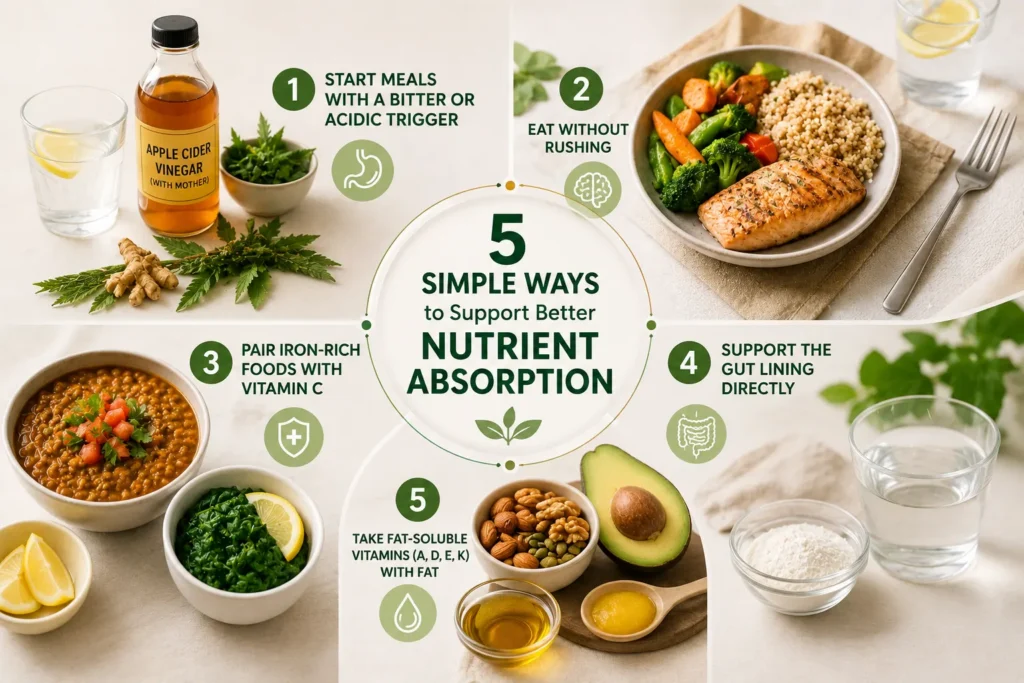
5 Simple Ways to Support Better Nutrient Absorption
Source: AI
- Start meals with a bitter or acidic trigger. A tablespoon of apple cider vinegar (with mother) in water before a protein-heavy meal can stimulate stomach acid production. You can also drink it with the help of a straw to help protect your enamel. Bitters and acidic foods stimulate vagal activity and digestive secretions, helping prepare the stomach and pancreas for incoming food. Traditional cultures often used bitter herbs before meals for this exact reason.
- Eat without rushing. Digestion starts in the brain. The cephalic phase of digestion, triggered by sight, smell, and chewing, accounts for up to 30 percent of your total stomach acid output. Eating fast while distracted essentially skips that phase.Chewing thoroughly mechanically breaks down food while simultaneously signaling enzyme release through the gut-brain connection. Poor chewing places additional strain on the digestive system further downstream.
- Pair iron-rich foods with vitamin C. Iron is one of the most common nutrients people struggle to absorb properly, especially when digestion is compromised. Vitamin C helps convert iron into a form your body can absorb more efficiently. This is why traditional pairings like spinach with lemon or lentils with tomatoes actually work from a biochemical perspective, not just a taste perspective.
Certain food combinations can significantly improve nutrient absorption and digestive efficiency.
Read more here: Food Pairing to Maximize Nutrition
- Support the gut lining directly. Your gut lining is where absorption actually happens. If that lining is irritated or inflamed, nutrients cannot pass through efficiently, no matter how healthy your diet looks. Nutrients and compounds like glutamine, zinc carnosine, and collagen peptides may help support the integrity of the intestinal lining and aid recovery of the digestive surface.
- Take fat-soluble vitamins (A, D, E, K) with fat. Vitamins A, D, E, and K need dietary fat for proper absorption. Taking them on an empty stomach can significantly reduce how much your body actually utilizes. Pairing these nutrients with nuts, seeds, avocado, ghee, olive oil, or a balanced meal improves their absorption and effectiveness.
Nutrition is a two-step process
There is a reason some people eat beautifully and feel mediocre, while others seem to thrive on less. Part of that difference comes down to absorption capacity. The gut is not a passive tube. It is an active, intelligent system that requires upkeep. Stress, aging, antibiotic use, chronic low-grade inflammation, and years of overly processed food all erode its capacity to do its job.
Fixing your diet matters. But so does asking whether your gut is actually equipped to work with what you are giving it. The two questions are not the same, and answering only one of them will only get you halfway there.
The most important nutrient is the one you can actually absorb. Start there.
Persistent bloating, low energy, poor digestion, nutrient deficiencies, hair fall, and fatigue can sometimes point toward deeper digestive and lifestyle imbalances.
Supporting digestion and nutrient absorption can work alongside medical care to improve overall wellness and long-term health outcomes.
Book a one-on-one consultation with our integrative team or explore our Gut Care Program for personalized support.
Call us at 1800 102 0253 or write to us at [email protected].
Disclaimer
This blog is for educational purposes only and is not intended to replace medical advice, diagnosis, or treatment. Please consult your healthcare provider before making significant dietary, supplement, or lifestyle changes.