No products in the cart.
When fatigue, brain fog, weight gain, and low mood persist despite a “normal” thyroid panel, the problem is often not how much thyroid hormone your body produces. It is how efficiently it converts that hormone into a usable form. This distinction changes everything about how you approach recovery.
The Two Hormones Your Panel Does Not Show You
Standard thyroid panels typically measure thyroid-stimulating hormone (TSH) and sometimes T4. What they rarely measure is free T3 (fT3), reverse T3 (rT3), or the ratio between them. This is a meaningful omission.
The thyroid gland produces two primary hormones: thyroxine (T4) and triiodothyronine (T3). Thyroxine (T4) is largely a storage and transport hormone. It is biologically inactive on its own. Your body must convert it into triiodothyronine (T3) to exert its effects at the cellular level. Triiodothyronine (T3) is the active form. It enters your cells, binds to nuclear receptors, and regulates metabolism, energy production, body temperature, cardiovascular function, gut motility, cognitive clarity, and mood.[1]
THYROID HORMONE CONVERSION PATHWAY
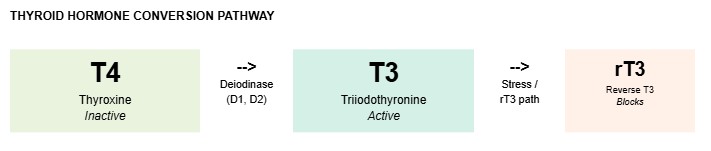
Roughly 80 percent of T3 is produced not in the thyroid gland but in peripheral tissues, primarily the liver, gut, and kidneys, through a process called deiodination. This conversion is performed by a family of selenium-dependent enzymes called deiodinases.[2] When this conversion process is impaired, your thyroid-stimulating hormone (TSH) and T4 can look perfectly adequate while your cells are receiving insufficient T3 to function optimally.
Why Conversion Fails
There is no single cause. Impaired T4-to-T3 conversion is usually the downstream result of several overlapping stressors. Here are the most well-documented ones.
Chronic Stress and Cortisol
Sustained psychological or physiological stress raises cortisol. Elevated cortisol directly suppresses the activity of the type 1 deiodinase enzyme responsible for peripheral T4 to T3 conversion.[3] At the same time, cortisol promotes a competing pathway that converts T4 into reverse T3 (rT3), a structurally similar but functionally inactive molecule that occupies T3 receptors without activating them.[4]
| WHAT THIS MEANS PRACTICALLY A person in a state of chronic stress may have normal TSH, normal T4, and reasonable total T3, yet their cells are receiving far less active T3 than the numbers suggest. The reverse T3 fills the receptor seats like a key that fits the lock but cannot turn it. |
Studies on critically ill patients, as well as in populations with metabolic syndrome and burnout, consistently show suppressed T3 and elevated rT3 as markers of physiological stress response, independent of primary thyroid disease.[5]
Gut Dysfunction
Approximately 20 percent of T4-to-T3 conversion occurs in the gastrointestinal tract. This conversion depends partly on intestinal bacteria that produce an enzyme called sulfatase, which activates thyroid hormone conjugates in the gut.[6] When gut flora is disrupted, as in dysbiosis, intestinal permeability, or inflammatory bowel conditions, this conversion pathway is compromised.
Gut inflammation also raises systemic levels of inflammatory cytokines, particularly interleukin-6 (IL-6) and tumor necrosis factor-alpha (TNF-alpha), which independently inhibit deiodinase enzymes.[7] This creates a feedback loop: gut inflammation impairs conversion, low T3 slows gut motility, and slowed gut motility worsens dysbiosis.
Micronutrient Deficiencies
The deiodinase enzymes that convert T4 to T3 are selenoproteins. Without adequate selenium, their catalytic activity falls. This is among the most replicated findings in thyroid research.[8] But selenium is only part of the picture.
| Nutrient | Role in Thyroid Conversion |
| Selenium | Required cofactor for all three deiodinase enzyme isoforms (D1, D2, D3) that convert T4 to T3. |
| Zinc | Needed for triiodothyronine (T3) receptor binding and thyroid hormone signaling at the nuclear level. |
| Iron | Required for thyroid peroxidase function; deficiency impairs thyroxine (T4) synthesis and conversion. [9] |
| Iodine | Essential substrate for both T4 and T3 synthesis; excess is as harmful as deficiency. |
| Magnesium | Supports ATP-dependent processes that regulate thyroid-stimulating hormone (TSH) release and cellular thyroid sensitivity. |
| Vitamin D | Modulates immune response linked to autoimmune thyroid disease; low levels associated with reduced T3. [10] |
Low-Calorie Diets and Excessive Exercise
The body interprets caloric restriction as a survival signal. In response, it deliberately downregulates T3 production to reduce the metabolic rate and conserve energy. This is well-documented in starvation physiology and has been observed even in moderate caloric deficits over sustained periods.[11] Similarly, excessive training volume without adequate recovery raises cortisol, compounding the suppressive effect on conversion.
Liver Health
The liver is the primary site of peripheral T4-to-T3 conversion, responsible for roughly 60 percent of this process. Non-alcoholic fatty liver disease (NAFLD), alcohol-related liver stress, or even sluggish liver function from poor diet and high toxic load can meaningfully reduce conversion efficiency.[12]
What to Actually Test
A basic thyroid panel typically includes thyroid-stimulating hormone (TSH) and sometimes total T4. To understand conversion, you need a more complete picture. Consider asking your physician for:
| A MORE COMPLETE THYROID PANEL Free T4 (fT4), free T3 (fT3), reverse T3 (rT3), the fT3 to rT3 ratio as a functional indicator, thyroid peroxidase antibodies (TPO-Ab), and thyroglobulin antibodies (TG-Ab) to screen for autoimmune thyroid disease. Also request a complete iron panel, including ferritin, selenium, vitamin D, zinc, and magnesium levels. |
The free T3 to reverse T3 ratio is not a standard diagnostic criterion, but it is increasingly used by functional medicine practitioners as a proxy for conversion efficiency. A ratio below 1.8 to 2.0 (when fT3 and rT3 are both in nanograms per deciliter) is considered by many clinicians to suggest suboptimal conversion, though interpretation should always involve a qualified physician.
The Action Framework
This is where the real work begins. The following are not supplements to take or protocols to follow blindly. They are areas of life requiring honest self-assessment and deliberate, consistent action. Nothing here replaces a clinical evaluation, but all of it is within your control to begin addressing today.
01 Resolve the stress physiology, not just the symptoms
You cannot supplement your way out of a cortisol problem. The enzyme suppression caused by chronic cortisol is upstream of almost every other conversion issue. This means stress management is not a soft lifestyle suggestion. It is a hard biochemical requirement for thyroid function.
The specific actions are:
- Identify your primary cortisol drivers: disrupted sleep, inflammatory food, unresolved emotional conflict, overtraining, or a job that never fully ends.
- Pick one and address it structurally this week. Not mentally. Structurally. Change a schedule, remove a substance, have a conversation, or book an appointment.
- Add a parasympathetic practice you will actually do for at least 10 minutes daily: slow nasal breathing, yoga nidra, walking in nature without your phone.
- If sleep is shorter than seven hours most nights, treat this as the primary problem before anything else.
02 Rebuild gut integrity with specificity, not randomness
Given the gut’s role in T4-to-T3 conversion, gut health is thyroid health. The problem is that “gut health” has become a vague umbrella term that often leads people to buy probiotic supplements without understanding what they actually need.
- If you have not been evaluated for dysbiosis, small intestinal bacterial overgrowth (SIBO), or intestinal permeability, consider asking your physician before purchasing anything.
- Eliminate the most common gut irritants for four to six weeks: ultra-processed foods, refined vegetable oils, alcohol, and artificial sweeteners. Observe your symptoms honestly.
- Introduce fermented foods gradually if tolerated: plain yogurt, kefir, kimchi, or sauerkraut.
- Prioritize prebiotic fiber from whole food sources: cooked and cooled resistant starches, green vegetables, and legumes if well tolerated.
03 Test your micronutrient status and address gaps through food first
Supplementing without knowing your levels is inefficient at best and harmful at worst. High-dose iodine, for example, can worsen autoimmune thyroid disease in susceptible individuals.
- Selenium: Two to three Brazil nuts daily provides roughly 150 to 200 mcg, within the suggested dietary range.
- Iron: If ferritin is below 70 ng/mL, address it. Low ferritin can impair energy and thyroid function even when hemoglobin appears normal.
- Vitamin D: Supplementation of 2,000 to 4,000 IU daily is generally well-tolerated in most adults with low-sun exposure, under medical guidance only.
04 Eat enough, and eat at the right times
If you have been in a caloric deficit for more than eight to twelve weeks, your body has likely adapted by reducing T3 output as a metabolic conservation strategy.
- Consider a structured diet break of two to four weeks at maintenance calories.
- Do not skip meals before or after intensive exercise.
- Very low carbohydrate diets have been associated with reduced T3 levels in some individuals.
- Aim for at least 0.7 to 1 gram of protein per pound of body weight from whole food sources.
05 Support liver function through daily habit, not periodic cleanses
The liver does not need a detox product. It needs a consistent, low-toxin environment to perform its baseline functions.
- Reduce alcohol intake.
- Minimize environmental toxin exposure where practical.
- Eat cruciferous vegetables in cooked form regularly: broccoli, cauliflower, Brussels sprouts, and cabbage.
06 Reconsider your exercise prescription
Exercise is essential for thyroid health and metabolic function. But the type and timing of exercise matter significantly when conversion is impaired.
- High-volume, high-intensity training without adequate recovery raises cortisol chronically and suppresses T3.
- Strength training at moderate intensity supports lean mass and mitochondrial density.
- Walking after meals improves insulin sensitivity and reduces the cortisol response to blood sugar fluctuations.
07 Sleep is the most underrated thyroid intervention
Thyroid-stimulating hormone (TSH) follows a circadian rhythm, peaking in the late evening and early night.
- Prioritize a consistent sleep and wake time.
- Aim for a bedroom environment that is dark, cool, and quiet.
- If you wake regularly between 2 and 4 a.m., this may indicate blood sugar instability or elevated nocturnal cortisol.
A Note on Medication and Medical Oversight
Some individuals with significant T4-to-T3 conversion issues may benefit from a trial of combination therapy: levothyroxine (T4) alongside liothyronine (T3), or in some cases desiccated thyroid extract (DTE), which contains both hormones. This is a clinical decision that requires physician involvement. Mention it in your next appointment if symptoms persist despite optimal lifestyle factors, and bring your lab values, including fT3 and rT3, if you have had them tested.
There is a growing body of research suggesting that a subset of hypothyroid patients may have persistently reduced quality of life on levothyroxine (T4) monotherapy compared to those receiving combination T4 and T3 therapy.[21] This conversation is increasingly being had in clinical endocrinology circles, even if it has not yet reached mainstream practice universally.
The Deeper Principle
When energy production breaks down at this level, the body is not malfunctioning randomly. It is usually responding to real signals: chronic stress, poor fuel, damaged gut lining, nutrient depletion, accumulated toxic burden, or sleep debt. Treating the labs without treating the life that produced those labs rarely resolves the problem at its root.
The goal is not to bypass your body’s responses. It is to remove the conditions that are forcing it into a protective, conservation mode. When you do that consistently and systematically, thyroid function, along with energy, mood, metabolic rate, and cognitive clarity, often follows.
This takes time. Weeks to months, not days. And it requires the kind of honest inventory that supplement marketing never encourages you to do: looking at how you are sleeping, how you are eating, how you are responding to stress, and whether your daily choices are supporting or depleting your biology.