No products in the cart.
Let us be blunt with you, because nobody else will be.
Right now, at this very moment, millions of people are unknowingly eroding one of the most precious things they own.
Not their money.
Not their health.
Their brain.
We’re watching a silent cognitive drift unfold in real time.
Not just in teenagers.
Not just in Gen Z.
In adults spending 7, 8, sometimes 10+ hours a day glued to screens, scrolling through content that their brain never asked for and doesn’t need.

Image Credits: Freepik
The result?
A generation, across all ages, that is struggling to focus for more than a few minutes.
Forgetting things they just read.
Making reactive, emotionally-charged decisions.
Feeling mentally exhausted without doing anything meaningful.
Feeling creatively hollow. Disconnected. Scattered.
This isn’t laziness. This isn’t a personality flaw. This is biology. And it has a name.
Brain rot.
That’s exactly why we’re putting this challenge on the table today. And we want to ask you directly, are you in?
What Exactly Is Brain Rot? The Effects of Screen Time on Your Brain Explained
In 2024, brain rot was chosen as Oxford’s Word of the Year.
“Brain rot” isn’t a formal medical diagnosis you’ll find in a textbook.
But ask any clinician working closely with patients today, and they’ll tell you the same thing; it’s a very real, very observable pattern.
- The clinical descriptor being used in informed circles is Cognitive Neuroplastic Atrophy Syndrome, or CNAS.
- It refers to a reversible decline in executive function, attention span, and neuroplasticity, driven by chronic overstimulation of the brain’s dopamine reward circuits.
In plain language?
- Your brain gets hooked on the constant novelty of social media, short-form video, and endless scrolling.
- Every swipe, every new post, every notification delivers a tiny hit of dopamine, the brain’s reward chemical.
- Over time, your brain starts expecting this rapid-fire stimulation as the norm.
- Anything slower, reading a book, having a deep conversation, sitting with your thoughts, starts to feel unbearable. Boring. Painful, even.
This is the impact of social media on mental health that nobody is talking about honestly enough.
- It’s not just about comparing culture or toxic content.
- It’s neurological. It’s structural.
- The architecture of your brain is literally being reshaped by how you spend your attention.
- And the attention span decline causes problems that run deeper than willpower or discipline.
This is a dopamine system that has been chronically hijacked, and it needs to be reclaimed deliberately.
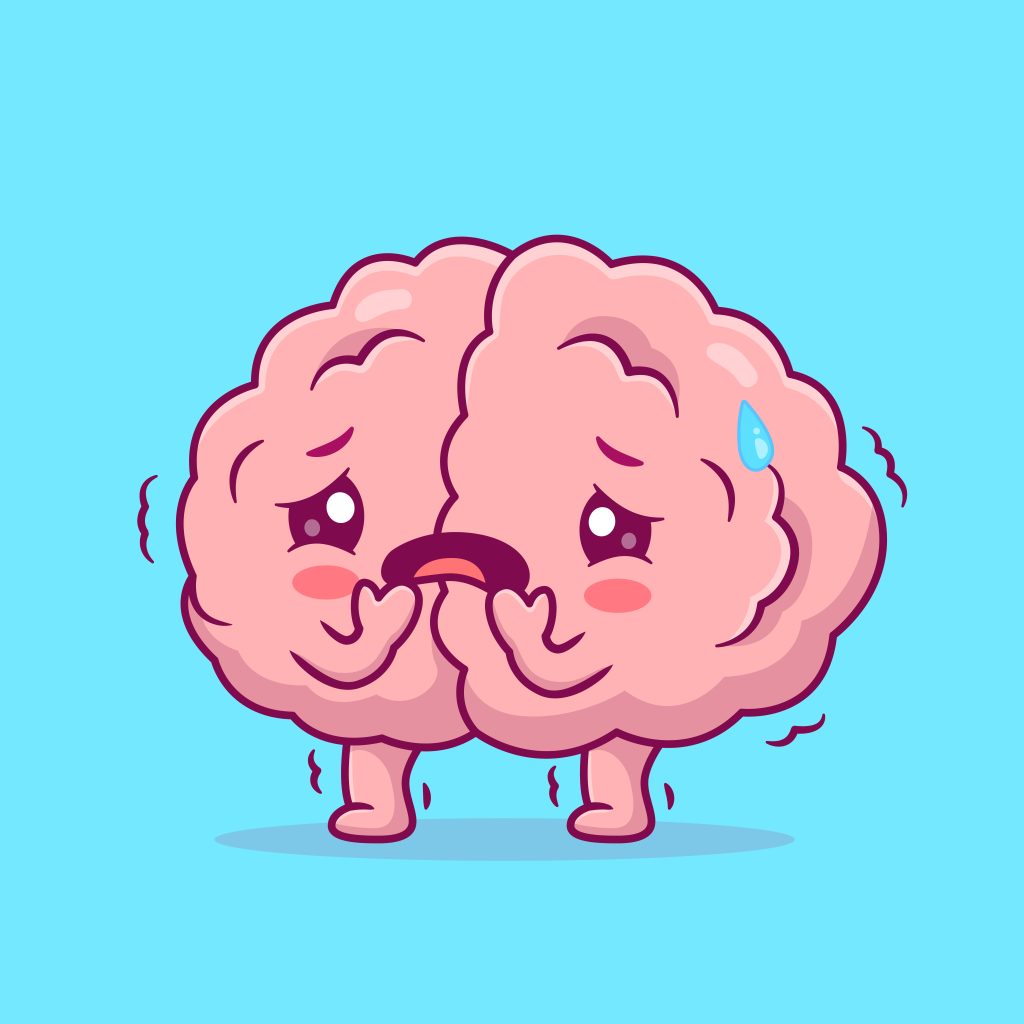
Image Credits: Freepik
How 2.5 Hours of Scrolling Triggers a Neurological Avalanche
Here’s where it gets deeply uncomfortable.
Experts say that as little as 2.5 to 3 hours of passive, mindless scrolling per day is enough to begin dulling your focus, shrinking your attention span, and slowing neuroplasticity.
That’s not binge-watching for 10 hours. That’s just your average afternoon on social media.
And here’s the chain reaction that unfolds inside your brain when this becomes a daily pattern:
- Step 1 — FOMO kicks in. You’re scrolling, and your brain starts detecting what you might be missing. The fear of missing out is not just an emotion. It’s a neurological trigger.
- Step 2 — The amygdala takes over. Your amygdala, the brain’s threat-detection and emotional response center, gets activated. You’re no longer in a calm, thinking state. You’re in a reactive, emotional state.
- Step 3 — Cortisol stays elevated. Your body releases cortisol, the primary stress hormone. Chronic cortisol elevation from constant digital stimulation keeps your nervous system in a low-grade state of stress and alertness — even when you think you’re just relaxing.
- Step 4 — The hippocampus takes a hit. Your hippocampus, the brain’s memory center, is highly sensitive to cortisol. Chronic stress literally shrinks it over time, impairing memory consolidation, learning, and emotional regulation.
This is not a metaphor. This is measurable neuroscience. And it’s happening inside the heads of people who think they’re just casually scrolling before bed.
Brain Rot Symptoms You Might Be Ignoring Right Now
So what does this actually look like in real life? Here are the cognitive fatigue symptoms and brain rot symptoms I see regularly:
- Attention span collapse. You start reading something, an article, a book, or even a message, and your mind drifts within 30 seconds. You reread the same paragraph three times. You give up and open another app instead.
- Declining working memory. You walk into a room and forget why you’re there. You lose your train of thought mid-sentence. You struggle to hold multiple pieces of information in your head simultaneously.
- Shrinking gray matter in the prefrontal cortex. This is the most alarming one. The prefrontal cortex, your brain’s command centre for reasoning, decision-making, impulse control, and emotional regulation, literally loses gray matter volume with chronic overstimulation. Less gray matter means poorer decisions, more impulsivity, and lower emotional intelligence.
- Dopamine dysregulation. Real-world experiences start feeling flat and unrewarding. A sunset feels ordinary. A meaningful conversation feels slow. Your brain has been calibrated to expect hyper-stimulation, and everything else pales in comparison. This is how neuroplasticity and brain health begin to deteriorate quietly.
- Emotional reactivity. You find yourself snapping more easily, feeling anxious without reason, struggling to feel genuinely present in your own life.
If any of this sounds familiar, we want you to know: this is not who you are.
This is what chronic overstimulation has done. And it is reversible.
The Anti-Brain Rot Challenge: A 12-Week Plan to Improve Focus, Attention, and Neuroplasticity
This is where we shift from awareness to action. Because awareness without action is just anxiety.
The Anti-Brain Rot Challenge is a structured, science-backed, 12-week protocol designed to reset your dopamine system, rebuild your attention, and restore genuine cognitive function.
The digital detox benefits are not theoretical; they are measurable, documented, and life-changing.
Here’s how it works:
Weeks 1–2: Detox — Reset the System
This is the hardest phase. And the most necessary one.
- A complete digital fast: zero social media, no passive scrolling, no algorithm-driven content. This isn’t punishment. This is medicine.
- What happens neurologically during this phase is remarkable. Your D2 dopamine receptors, which have been chronically downregulated from overstimulation, begin to re-sensitize.
- Your brain starts recalibrating what “reward” actually means.
- Sustained attention improves by up to 42% during this detox phase.
This is how you begin to break phone addiction, not through willpower alone, but by giving your neurochemistry the space it needs to reset.
Weeks 3–6: Rebuild — Strengthen the Circuits
With your dopamine system beginning to stabilize, it’s time to actively rebuild the neural circuits that chronic scrolling has weakened.
Mono-task training (doing one thing at a time, with full presence) begins to re-establish the deep focus pathways in your prefrontal cortex.
No background music.
No second screen.
Just one task, fully attended to.
- 20-minute nature walks, taken daily without your phone, have been shown to boost BDNF (Brain-Derived Neurotrophic Factor) by up to 28%.
- BDNF is essentially fertilizer for your brain; it promotes the growth of new neurons, enhances learning, and directly supports neuroplasticity.
The benefits of nature for mental health go far deeper than stress relief.
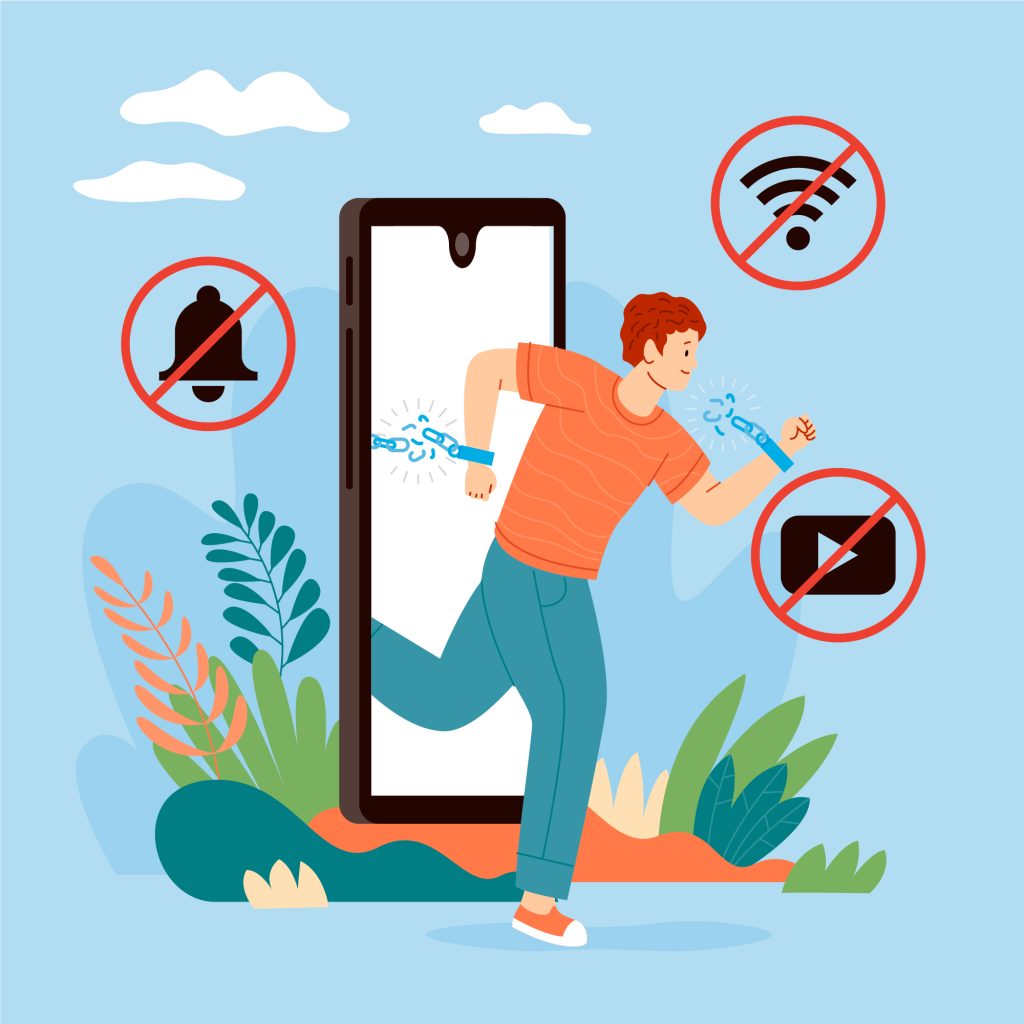
Image Credits: Freepik
Weeks 7–12: Reintroduce — Conscious Re-engagement
This phase is not a return to old habits. It is a completely different relationship with technology, one you control, not one that controls you.
- You can begin reintroducing social media, but only in its most intentional form.
- Curated, chronological feeds only, no algorithm-driven recommendations that are designed specifically to spike your dopamine and keep you stuck.
- Keep usage under 30 minutes per day.
The cognitive gains you’ve rebuilt are genuinely worth protecting, and this boundary is what maintains them.
Ongoing: The Weekly Dopamine Fast
Once a week, every week, commit to a 24-hour dopamine fast.
No social media.
No streaming.
No novelty-seeking digital consumption.
- Regular dopamine fasting cuts compulsive phone-checking behaviors and plays a critical role in preventing relapse back into CNAS patterns.
This is how to reduce screen time habits in a way that actually sticks, not through restriction alone, but through regular neurological recalibration.
How to Improve Cognitive Function Naturally: The Real-World Antidotes to Digital Excess
The challenge gives you the framework. But the antidotes are what sustain it.
Your brain was never designed for nonstop novelty, rapid content switching, or fragmented attention.
It was designed for depth.
For sustained engagement.
For stillness.
And when we strip away the digital noise, we discover that the most powerful cognitive tools are the oldest and simplest ones.
Real-world conversation.
- Not texting, not voice notes, but face-to-face, eye contact, present conversation, activates neural circuits that no screen interaction can replicate.
- It regulates emotion, builds empathy, and strengthens cognitive endurance.
Nature exposure does more than relax you.
- It directly regulates your vagus nerve, the master nerve that connects your brain to your gut, heart, and immune system.
- When your vagus nerve is functioning well, your nervous system shifts from chronic fight-or-flight into rest, repair, and genuine cognitive clarity.
- This is one of the most underestimated benefits of nature for mental health.
Breathing exercises for mental clarity
- Slow, deliberate, diaphragmatic breathing is not a wellness trend.
- They are neurological tools.
- Slow breathing activates the parasympathetic nervous system, lowers cortisol, and creates the internal conditions in which your prefrontal cortex can actually do its job.
- Even five minutes of intentional breathwork before a focused work session can measurably shift your cognitive state.
Mindful pauses, moments of deliberate stillness throughout the day, act as circuit breakers.
- They interrupt the compulsive checking loop before it starts, and they give your nervous system the micro-recoveries it needs to sustain attention over hours, not second
In one of our podcasts, leading clinical psychologist and internationally recognized expert in mindfulness and self-compassion, Dr. Shauna Shapiro, also highlights how neuroplasticity and lifestyle together help the brain rewire, heal, and grow. Watch the podcast now.
These habits, practiced consistently, are how to improve cognitive function naturally.
Image Credits: Freepik
Your Gray Matter Is Precious. Are You In?
Let us leave you with this.
Gray matter loss is not inevitable.
Cognitive decline is not your destiny.
Neuroplasticity, your brain’s extraordinary ability to rewire, rebuild, and recover, is available to you at any age.
Youth are more vulnerable, but no group is immune. And no group is beyond help.
But here’s the truth that we need you to sit with: recovery begins the moment you reduce overstimulation.
Not next Monday.
Not after the next season of your favorite show.
Right now.
Today.
Your brain thrives on depth, not speed. On meaning, not novelty. On presence, not stimulation.
And every small, consistent habit you build shifts your nervous system one step further from chaos and one step closer to clarity.
Brain rot is reversible. But only if you act now.
Share this with someone who needs to hear it. Because the most powerful thing you can do for the people you love is to show them that their brain health is worth fighting for.
Be Educated. Not Influenced.
Disclaimer: This blog is for educational purposes only and does not constitute medical advice. Individuals with neurological conditions, attention disorders, mental health diagnoses, or those on medication should work with their healthcare provider to customize digital boundaries. If you experience screen-related headaches, anxiety, or sleep issues, please seek professional assessment.
If you’re struggling with cognitive or mental health issues, don’t wait.
Set up a one-on-one consultation with our foundational medicine team or explore our Wellness Programs to optimize your skin health.
Reach out to us at 1800 102 0253 or write to us at [email protected].