No products in the cart.
Protein powders are no longer confined to gym bags. People aren’t buying them only to “get lean” or “get big.” They’re buying them because modern life itself has created protein gaps.
Busy workdays. Long commutes. Hormonal transitions. Recovery after illness. Age-related muscle loss. Across life stages, there’s a growing understanding that strength and metabolism aren’t aesthetic goals, they’re health foundations.
Today, protein powders show up everywhere:
- Morning smoothies
- Hospital recovery plans
- Women’s nutrition routines
- Aging parents’ daily rituals
- On-the-go meals when food gets skipped but health can’t
Protein is no longer a supplement. It’s daily nutrition.
And when something becomes part of everyday health, trust is not optional.
The Problem Most Labels Don’t Address
Here’s the uncomfortable truth: What’s written on the label isn’t always what’s inside the tub.
Across the global nutrition industry, and increasingly in India, independent testing has repeatedly identified:
- Protein content that doesn’t match label claims
- Amino spiking disguised as “high protein”
- Heavy metal contamination
- Undisclosed fillers and additives
- Consumers relying on marketing rather than evidence
This isn’t about one brand. It isn’t about fear.
It’s about accountability in a category people consume every single day.
A “good” protein isn’t defined by bold numbers or influencer endorsements.
“24g per scoop” means little if the protein isn’t biologically complete.
A flashy label means nothing if safety hasn’t been verified.
A responsible protein must be:
- Honest about what’s inside
- Complete in its amino acid profile
- Tested for heavy metals and toxins
- Free from unnecessary additives
- Transparent about sourcing and quality
Anything less is marketing — not nutrition.
Why This Conversation Matters in India
In India, large dietary datasets consistently show the same pattern:
Calorie intake skews heavily toward carbohydrates, while protein intake remains low, and protein quality is rarely discussed.
Protein powders became the fix:
A scoop in milk
A shake after a walk
A backup on days when proper meals don’t happen
The risk doesn’t come from protein itself.
It comes from daily, long-term use without transparency.
When a product becomes a habit for months or years, it stops being a casual purchase. What the body tolerates occasionally is very different from what it processes every day.
How the Protein Conversation Became Incomplete
Mainstream protein marketing narrowed the conversation to a single question:
“How many grams?”
Labels got louder “24g, 27g, 30g per scoop” training consumers to treat protein like a scoreboard. But human biology doesn’t work that way.
The body doesn’t use grams. It uses what those grams become after digestion.
That detail isn’t academic — it’s the most important part.
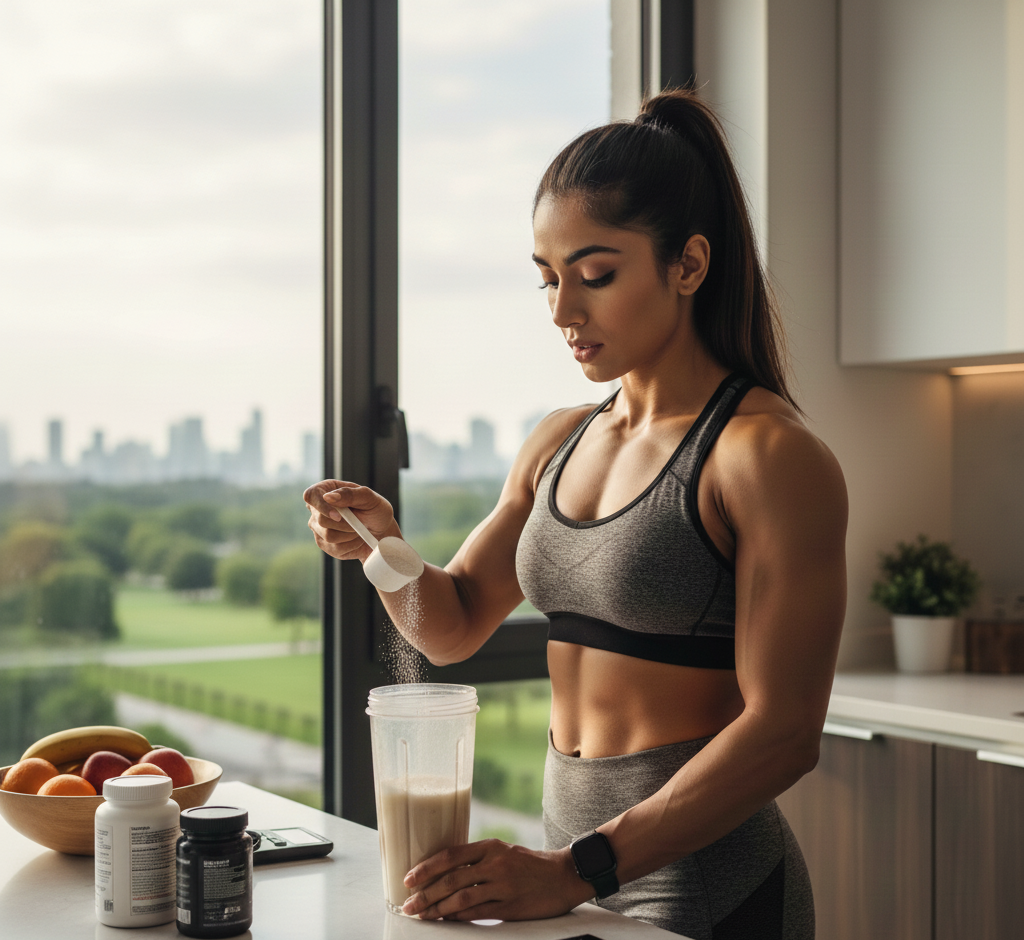
Picture credit: Gemini AI
What Protein Actually Does Inside the Body
Protein isn’t a single substance. It’s a chain made of smaller units called amino acids.
When you consume protein, digestion breaks it down into individual amino acids and peptides. These are absorbed into the bloodstream and used to:
- Repair tissue
- Maintain muscle
- Support immunity
- Form enzymes and hormones
- Sustain metabolic pathways
If protein is the building material, amino acids are the bricks. The body can only build well if it receives the right mix.
This is why the true “active component” of any protein powder isn’t the scoop itself, it’s the amino acid delivery the body ultimately receives.
Why Amino Acids Matter More Than Protein Numbers
Nine amino acids are essential, meaning the body cannot make them. If even one is too low, the body can’t effectively use the others, a concept known as the limiting amino acid.
This is why two powders with identical protein numbers can behave very differently in the body.
Leucine deserves special mention. It acts like a biological “start signal” for muscle protein synthesis, flipping the switch that tells the body to rebuild. This matters not just for athletes, but for aging adults, recovery, and metabolic health.
Protein quantity without amino acid completeness is an incomplete promise.
Where the Trust Gap Really Begins: Label Accuracy
As protein powders became mainstream, trust became fragile.
Recent India-focused investigations published in peer-reviewed medical journals tested commercially available protein products and reported widespread issues with mis-labelling and contamination. These findings matter because people aren’t using these products occasionally, they’re using them daily. Lippincott Journals+2
When label claims don’t match lab reality, consumers don’t just lose money. They lose health certainty.
Amino Spiking: How “High Protein” Can Be Artificially Inflated
Many routine protein tests estimate total nitrogen and convert it into “protein.” The flaw? Free amino acids also contain nitrogen.
By adding inexpensive amino acids like glycine or taurine, a manufacturer can inflate nitrogen levels, and therefore reported “protein” without providing intact, complete protein.
The result:
- The label looks impressive
- The biological value is lower
- The consumer pays for performance they don’t receive
This is why full amino acid profiling isn’t optional if honesty is the goal. It’s what reveals whether a protein is complete or artificially propped up.
This is why the phrase “protein grams” can become misleading: a number can be inflated without delivering the same biological value as complete protein. Media reporting in India has recently begun describing this practice more openly for consumers, precisely because it exploits how routine testing can be interpreted. The Economic Times+1
The Contamination Issue: Why Daily Use Changes the Stakes
Protein powders are concentrated products. Concentration amplifies both nutrition and risk.
In India-specific testing published in peer-reviewed literature, heavy metal detection was not rare. The same publicly discussed Indian investigation reported lead detection in a large proportion of samples, along with cadmium and arsenic in a smaller—but still concerning—fraction. PMC+1
Global third-party testing initiatives have also continued to publish protein-category contamination data, including heavy metals and other compound classes, using advanced analytical techniques (for example, ICP-MS for heavy metals and LC-MS/MS for multiple chemical screens). Their findings have consistently reinforced the same consumer takeaway: plant-based proteins often show higher contaminant risk profiles than consumers assume, and contamination patterns can vary sharply by source and processing. Clean Label Project
Daily intake turns “trace amounts” into cumulative exposure.
Plant Proteins vs Whey: Different Risks, Same Need for Testing
Plant proteins reflect their environment. Soil and water quality influence heavy metal uptake, and storage conditions affect fungal toxin risk. Because many plant proteins are naturally lower in certain essential amino acids, formulation shortcuts become more tempting.
Whey proteins tend to have stronger amino acid profiles, particularly leucine, but dairy introduces its own questions around sourcing, residue control, and processing standards.
Neither source is inherently safer.
Quality depends on testing, not protein type.
The Part Consumers Often Miss: Most Powders Aren’t Just Protein
Many protein powders are engineered for taste and texture. That can introduce:
- Sweeteners
- Fillers
- Gums and stabilizers
- Artificial flavors and colors
Some may be legally permitted, but legality isn’t the same as suitability for long-term daily use. If someone turns to protein for cleaner nutrition, the scoop shouldn’t become a delivery system for unnecessary additives.
How Pink Tiger Evaluates Protein: A 4-Step Framework
Pink Tiger was created to answer a simple question:
How does an everyday person choose a safe, effective protein without decoding lab reports?
Our evaluation follows four non-negotiable steps:
1. Ingredient Screening
Products are first assessed for formulation integrity. Artificial sweeteners, maltodextrin, refined fillers, synthetic colours, and flavours are scrutinized. If the formulation is compromised, it doesn’t move forward.
2. Label Accuracy Verification
Independent nutritional testing confirms whether label claims reflect reality.
3. Amino Acid Profiling
Full profiling confirms completeness and detects spiking or nitrogen inflation.
4. Safety Screening
Heavy metals and relevant toxins (including aflatoxins where applicable) are assessed to evaluate long-term daily safety.
Testing isn’t treated as a checkbox. It’s treated as a system designed to answer real consumer questions.
Pink Tiger Verified Top Protein Powders of 2025
The following products met Pink Tiger’s baseline standards for ingredient integrity, label accuracy, amino acid completeness, and safety screening at the time of testing:
- SuperYou Fermented Yeast Protein
- The Func. Lab Plant Protein
- Nutrabay Pure Whey Protein Concentrate
- Dame Health Plant Protein For Men
- Dame Health Pure Plant Protein for Women
- The Whole Truth Whey Protein Isolate
- The Whole Truth Whey Protein Isolate + Concentrate
- Oziva Bioactive Plant Protein Powder
- Oziva Protein & Herbs for Women | Whey Protein with Ayurvedic Herbs & Multivitamins
- Wellbeing Nutrition Whey Protein Isolate
- Protuff Belgian Chocolate Plant Protein
- Naturaltein Max Whey Protein
- Ace Blend Unflavoured Plant Protein Complex
- Cosmix No-Nonsense Plant Protein
- Pod Nutrition Plant Protein
Inclusion indicates that these products cleared minimum evidence-based standards — not that they are identical or universally suitable.
Why Pink Tiger Exists
Pink Tiger wasn’t born out of outrage. It was born out of frustration.
Consumers shouldn’t need to understand chromatography charts or amino acid spectra to choose better nutrition. Pink Tiger exists to translate complex science into clear, practical guidance and to bridge the gap between consumers, independent testing, and brands.
The goal has never been fear. The goal has always been clarity.

Conclusion: Better Protein, Not Louder Protein
Protein can support recovery, preserve muscle, stabilize metabolism, and improve quality of life as we age but only when it’s real, complete, accurately represented, and safe for long-term use.
The problem isn’t that people want protein.
The problem is that too many people have been taught to trust numbers without understanding what those numbers mean — and what else may be entering the body along with them.
The future of nutrition isn’t more protein. It’s better protein.
Be educated, not influenced.
FAQs
1. What are the risks of consuming protein powder daily?
Daily protein powder use can increase cumulative exposure to contaminants like heavy metals, excess additives, or inaccurate protein content if the product is not independently tested and formulated transparently.
2. How do I know if a protein powder is actually high quality?
High-quality protein powders are verified for label accuracy, complete amino acid profiles, absence of spiking, and screened for contaminants such as heavy metals and aflatoxins.
3. What is amino acid spiking in protein powders?
Amino acid spiking is the practice of adding free amino acids to inflate protein numbers on lab tests without providing the same nutritional or muscle-building benefits as complete protein.
4. Are plant-based protein powders safer than whey protein?
Neither is inherently safer. Plant proteins are more prone to environmental contaminants, while whey proteins require careful screening for residues related to dairy sourcing. Quality depends on testing, not the protein source.
5. Why do some protein powders not match their label claims?
Differences can occur due to raw material variability, processing losses, or formulation practices like nitrogen inflation, which is why independent verification is important.
6. Can protein powders contain heavy metals in India?
Yes. Recent studies and media reports in India have detected heavy metals in protein powders, making independent testing important for long-term daily consumers.
7. Why is amino acid profiling important in protein supplements?
Amino acid profiling confirms protein quality, ensures essential amino acids are present in the right balance, and helps detect practices like amino acid spiking that reduce real nutritional value.
References
- Philips CA, et al. Citizens Protein Project: A self-funded, transparent study analysing popular protein supplements in India. Medicine (LWW), 2024. Lippincott Journals
- Philips CA, et al. The Citizens Protein Project 2. Medicine (LWW), 2025. Lippincott Journals+1
- Business Standard. 70% of protein powders in India mislabelled; 14% contain toxins, study reports. July 2025. Business Standard
- India Today. Report on protein powders: contaminants, aflatoxin signals, amino-acid inflation concerns. Nov 2025. India Today
- Clean Label Project. Protein Powder Category Report / Whitepaper (heavy metals & multi-contaminant screening methods). Jan 2025. Clean Label Project
- NutraIngredients. Protein products tested in India don’t meet label claims (reporting on study parameters including toxins/metals). Apr 2024. NutraIngredients.com
- Ministry of Statistics & Programme Implementation (MoSPI), Government of India. Nutritional Intake in India 2022–23 & 2023–24 (protein intake trends). 2025. Ministry of Stats & Program Implementation
- Economic Times Health (coverage referencing the ICMR-INDIAB India-wide dietary pattern study published in Nature Medicine, linking high carbohydrate intake and low protein contribution to rising diabetes and obesity). Sept 2025. Economic Times Health
Disclaimer:
The content presented here is based on publicly available research, independent testing reports, and general nutritional science as of 2025. It is not intended to diagnose, treat, cure, or prevent any disease, nor should it be considered medical, dietary, or professional health advice. Readers should consult a qualified healthcare professional, registered dietitian, or physician before starting, changing, or discontinuing any supplement, especially if pregnant, breastfeeding, managing a medical condition, or taking medication. Product inclusion, evaluation frameworks, and brand mentions reflect testing and standards at the time of assessment and do not guarantee suitability for every individual.
To get a list of Pink-Tiger verified products or to know more, click here.
About the Author:

Team Luke | Luke Coutinho Holistic Healing Systems
For over 14 years, Luke Coutinho and Team Luke have worked with thousands of people across conditions, ages, and life stages. Team Luke is a collective of highly trained nutritionists, clinical dietitians, doctors, yoga and fitness experts, life coaches, and emotional counselors, all working under one philosophy and one standard of care.
At the heart of everything we do is Foundational Medicine, a science-backed framework built on six pillars: Food Science & Nutrient Synergy, Adequate Holistic Movement, Deep Sleep, Emotional Wellness & Mental Health, Nature (Your Internal & External Environment), and Spirit & Breathwork. Every piece of content published on this platform is rooted in that same belief: that the body thrives best when its foundations are strong. Our mission is simple and clear: to address root causes of illness and make wellness accessible, practical, and sustainable for all.
Connect with Team Luke:
Call: 1800 102 0253 | Email: [email protected]
Follow Luke:
Instagram: @luke_coutinho | Facebook: @LukeCoutinhoOfficial | X: @LukeCoutinho17 | YouTube: @LukeCoutinho | LinkedIn: Luke Coutinho