No products in the cart.
Sleep is not a reward you earn after a long day. It is the foundation on which everything else in your life stands. Your immunity, your metabolism, your hormones, your mood, your ability to love and lead and show up fully. Every single one of these depends on what happens when you close your eyes at night.
The Government of India gave us something remarkable. The Time Use Survey (TUS) 2024 tracked 454,192 people across 139,487 households in every corner of this country. It recorded how we spend every 30 minutes of our day, from 4 AM to 4 AM. And tucked inside this data is one of the clearest pictures we have ever had of how India is sleeping, and perhaps more importantly, what it tells us about the quality of our rest and recovery.
We have spent over 15 years working with clients across conditions, supporting individuals living with cancer, diabetes, hormonal imbalances, and beyond. And here is what our experience has taught us, repeatedly and without exception: when we address sleep, almost everything else begins to shift. Quality Deep Sleep is one of our six foundational pillars of health because it supports and strengthens every other pillar.
Sleep is not what happens after everything else is done. Sleep is what makes everything else possible.
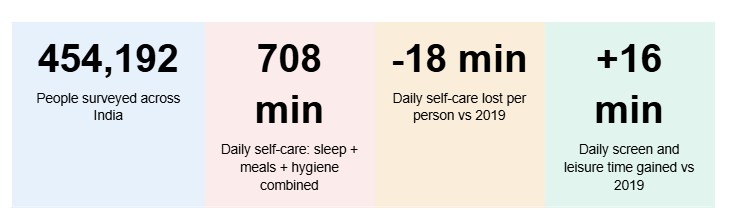
KEY NUMBERS FROM TUS 2024 (OFFICIAL MOSPI DATA)
Source: AI
What the Data Is Actually Showing Us
Let us be clear about what the TUS 2024 measures. The survey combines sleep, meals, bathing, and personal hygiene into one category called self-care and maintenance. It does not isolate sleep alone. But it gives us every number we need to understand what is happening.
In 2024, people aged six and above spent 708 minutes per day on all self-care activities combined. That is down from 726 minutes in 2019. We lost 18 minutes of daily self-care time in five years. That may not sound dramatic. But over a year, that is 109 hours of recovery time that simply disappeared.
Where did those 18 minutes go? The survey tells us clearly.
Time spent on culture, leisure, mass media, and sports went up by 16 minutes per day in the same period. We traded self-care for screen time. The long-term impact of these changing habits deserves our attention.
THE 2019 TO 2024 SHIFT (OFFICIAL TUS 2024 DATA, ALL FIGURES MINUTES PER DAY)
| Activity | 2019 | 2024 |
| Leisure, media and culture | 143 min/day | 159 min/day (+16) |
| Self-care and maintenance | 726 min/day | 708 min/day (-18) |
| Urban leisure and media | 162 min/day | 176 min/day |
| Rural leisure and media | 135 min/day | 151 min/day |
| Urban self-care | 715 min/day | 701 min/day (-14) |
| Rural self-care | 731 min/day | 711 min/day (-20) |
Every extra minute we spend in front of a screen before bed is a minute we are taking from our body’s most powerful repair system. This is not just our opinion. It is arithmetic.
The Gender Truth the Data Cannot Hide
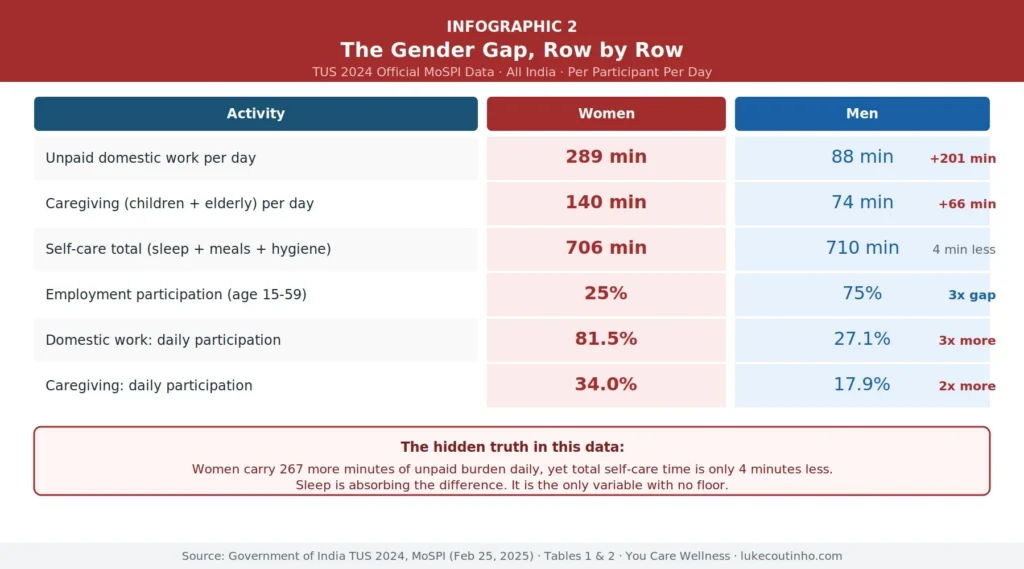
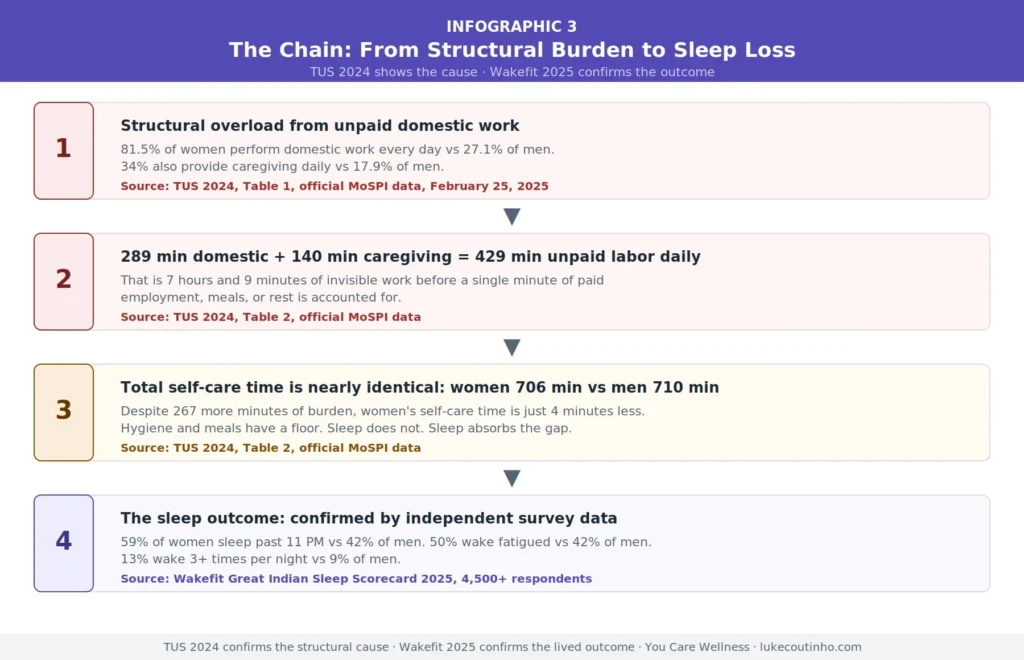
This is the part of the data we want every household in India to read together. Not as a gender debate. As a health conversation. Because what the TUS 2024 reveals about how women are living their days has direct, measurable consequences for how they are sleeping, recovering, and aging.
Here is the critical context: The TUS 2024 bundles sleep inside self-care time. It does not give us a standalone sleep number. But it gives us every other number we need. And when you lay those numbers out, the pattern becomes difficult to ignore.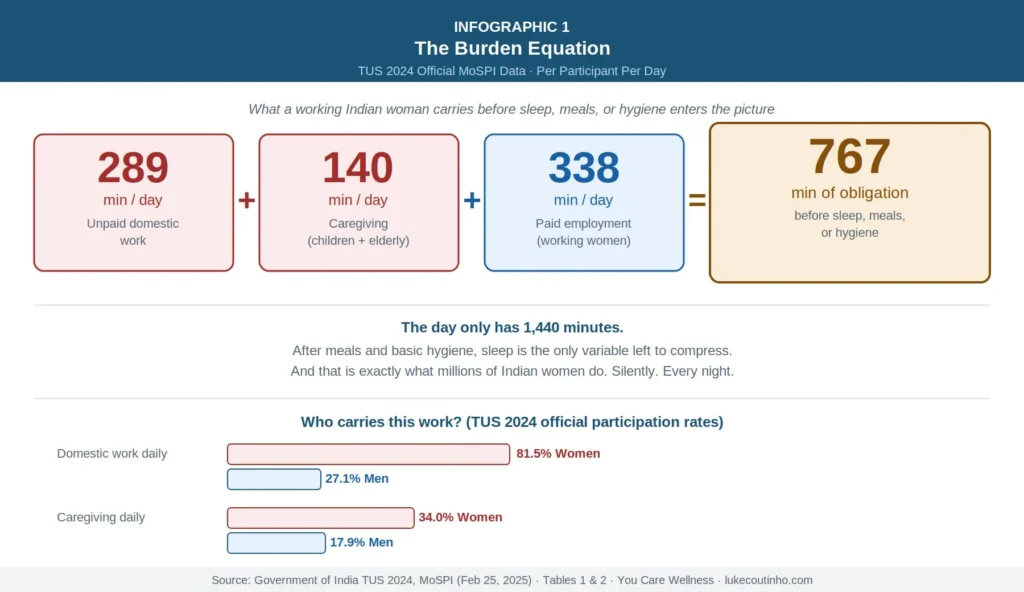
Source: AI
Source: AI
| 767 minutes of obligation. The day only has 1,440 minutes. After meals and basic hygiene, sleep is the only variable left to compress. And millions of Indian women compress it, silently, every single night. Not because they choose to. Because the structure of their day leaves no other option. |
Source:AI
Source: AI
What Poor Sleep Is Actually Doing Inside You

Source: Magnific
We want to be specific here. Because sleep deprivation sounds abstract until you understand what it means at a cellular level. This is not about feeling groggy the next morning. This is about what is happening inside every system of your body, night after night.
- Hormonal disruption: When you sleep fewer than seven hours, cortisol stays elevated. Chronically high cortisol drives insulin resistance, visceral fat accumulation, and systemic inflammation. India continues to carry one of the world’s highest burdens of diabetes. Fragmented sleep is one of the fuels that keeps that fire burning.
- Immune suppression: Your immune system does most of its repair work during deep sleep. Protective cytokines, the proteins that fight infection and inflammation, are produced and released in this window. Cut your sleep and you cut your immune response. Every single night.
- Cardiovascular strain: Poor sleep raises blood pressure and increases the risk of heart attack and stroke. Research links consistently sleeping fewer than six hours to a 13% increase in all-cause mortality risk. That is not a marginal number. That is a measurable shortening of your health span.
- Brain and emotional health: Memory consolidation, emotional regulation, decision-making, and creative problem-solving all require adequate sleep. Sleep-deprived adults show measurable cognitive impairment equivalent to being legally drunk. And sleep deprivation is now one of the leading contributors to anxiety and depression in India.
- Weight and metabolic health: Leptin, the hormone that signals fullness, drops with poor sleep. Ghrelin, the hunger hormone, rises. Sleep-deprived people are biologically programmed to seek high-sugar, high-fat foods. No nutrition plan, however excellent, can fully compensate for chronic sleep deprivation.
- Stem cell regeneration and repair: Your body regenerates and repairs itself during sleep. Stem cells mobilize, tissue heals, and cellular damage from the day is addressed. Without adequate deep sleep, this repair cycle is disrupted. The body falls behind on its own maintenance.
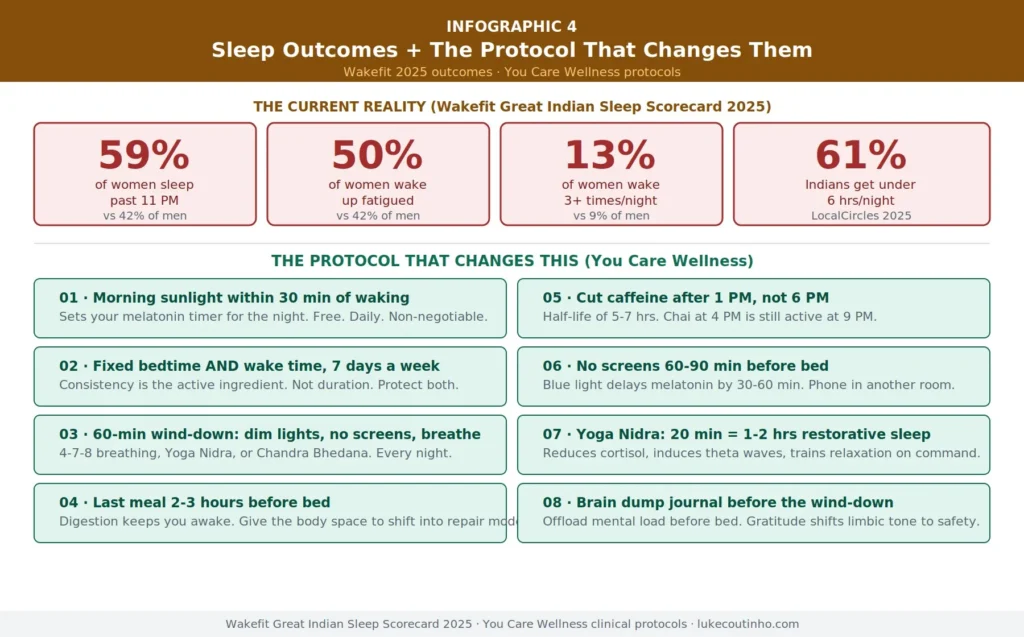
| 13% Higher mortality risk for sleeping under six hours consistently | 11.3 days Annual productivity lost per sleep-deprived employee | 61% Indians getting under six hours of uninterrupted sleep |
The Practical Protocol: Here Is How We Fix This
This is where we move from data to action. From knowledge to practice. Everything I am sharing here comes from over 14 years of working with clients navigating real lives, real schedules, and real constraints. These are not generic tips. They are biology-backed, experience-tested protocols that we use at You Care Wellness every single day.
Give each protocol a genuine 21-day run before you judge the results. Your circadian rhythm took years to drift. It will not reset in three nights. But it will reset.
1: Fix your circadian rhythm first. Everything else builds on this foundation.
Your circadian rhythm is not a preference or a lifestyle choice. It is a 24-hour biological clock encoded in every cell of your body. It governs when cortisol rises to wake you, when melatonin signals your brain that it is time to rest, when growth hormone is released to repair you, and when each organ does its deepest maintenance work. When this clock is misaligned, no supplement, no nutrition plan, and no breathwork can fully compensate. We fix the clock first.
10 to 20 minutes of morning sunlight within 30 minutes of waking
Why it works: Morning light signals the suprachiasmatic nucleus, your master biological clock, to stop melatonin production and begin the cortisol awakening response. This single act sets the timer for when melatonin will rise again that night, roughly 14 to 16 hours later. If you get sunlight at 6:30 AM, melatonin rises naturally around 9 to 10 PM. Skip the sunlight and your body clock drifts.
What to do: Step outside within 30 minutes of waking. No sunglasses. Face toward, not directly at, the sun. Even overcast outdoor light is 10 to 50 times stronger than indoor lighting. Cannot go outside? Sit by an open window. This is the single most powerful free sleep intervention available to every person in India, and it costs nothing.
Fix your bedtime and wake time before anything else. Both. Not just one.
Why it works: The brain releases melatonin on a schedule anchored to your consistent wake time. If your wake time shifts by two hours day to day, your melatonin release becomes erratic and sleep quality collapses regardless of total hours in bed. Consistency is the active ingredient, not duration.
What to do: Choose a fixed wake time that is sustainable every day, including weekends. Count back seven to eight hours. That is your target bedtime. Weekend drift of more than 60 to 90 minutes undoes five days of rhythm building. We recommend aiming for sleep between 9:30 PM and 10:30 PM for most adults. Start with the wake time and protect it like a non-negotiable appointment.
Build a 60-minute wind-down routine your nervous system can learn to trust
Why it works: The nervous system does not have an off switch. It has a dimmer. You cannot transition from full cortisol mode, responding to messages, managing household tasks, to deep sleep in 10 minutes. Done consistently at the same time each night, a wind-down routine becomes a biological signal. Your brain starts releasing melatonin in anticipation before you even lie down.
What to do: Begin 60 minutes before your target bedtime. Dim all lights in your home (bright overhead lighting suppresses melatonin even without screens). Stop eating. Put your phone in another room. Use this time for 4-7-8 breathing (inhale four counts, hold seven, exhale eight), left nostril breathing (Chandra Bhedana), Yoga Nidra (20 minutes provides the restorative benefit of one to two hours of light sleep), light reading, or gratitude journaling. What does not belong in this window: news, social media, heated conversations, and work emails.
2: Make your bedroom biologically incompatible with wakefulness.
Most Indian bedrooms are actively working against sleep. Bright lights, screens, phones charging at arm’s reach, and synthetic fabrics that trap heat. Every one of these sends a biological signal to your brain to stay alert. Changing the environment and sleeping often improves without any other change at all.
Temperature: 18 to 21 degrees Celsius
Your core body temperature must drop by one to two degrees to initiate deep sleep. A cool room accelerates this. Use a thin cotton sheet, a fan, and breathable natural fabrics. Avoid synthetic nightwear that traps body heat.
Complete darkness: eye mask if needed
Even small amounts of light through closed eyelids suppress melatonin. Street lights, standby lights on devices, and a phone face-up on the bedside table. All of it matters. Use blackout curtains or a good eye mask.
Consistent sound environment
Sudden noise causes cortisol spikes that pull you out of deep sleep. A white noise app, a fan, or earplugs in a noisy urban environment helps create the consistent sound floor your brain needs.
No screens in the bedroom
Your brain learns through association. If you work, scroll, and watch videos in bed, it stops associating your bed with sleep. Charge your phone in the hall. Bed is for sleep. This is one of the core principles of clinical sleep medicine.
No vigorous exercise within three hours of bed
Exercise raises core temperature and cortisol for two to three hours. Morning or early evening movement actively improves sleep quality. Late-night workouts work against it.
Keep a consistent association
If your environment changes your brain’s cue, everything shifts. A bedroom that looks, feels, and smells the same every night builds a powerful sleep association over time.
3: Eat and drink in alignment with your biology, not your social schedule.
We are a country of late dinners, heavy dinners, and chai at 5 PM. Every one of these habits is working directly against the biology of deep sleep. Food timing is one of the most underrated levers for sleep quality, and one of the easiest to begin adjusting.
Finish your last meal at least two to three hours before your target bedtime
Why it works: Digestion is metabolically active. When you eat at 9 PM and try to sleep at 10 PM, your heart rate is elevated, your core temperature stays high, and your liver, stomach, and gut are all running. This is the opposite of what the body needs to initiate deep sleep. Research consistently shows that late meal timing is associated with fragmented and non-restorative sleep.
What to do: If your bedtime is 10:30 PM, your last meal should be by 7:30 to 8 PM. Move dinner 30 minutes earlier each week until you reach your target. If hunger arrives late, warm turmeric milk, ashwagandha milk, or chamomile tea are acceptable. These actively support sleep rather than disrupting it.
Cut caffeine after 1 PM, not after 6 PM
Why it works: Caffeine has a half-life of five to seven hours. A cup of chai at 4 PM still has half its caffeine active in your blood at 9 PM. It blocks the adenosine receptors that signal sleep readiness, so you may feel tired but cannot fall into deep sleep. Most Indians are simultaneously chronically under-slept and chronically over-caffeinated, and the second problem is feeding the first.
What to do: Remove all caffeine, including chai, coffee, green tea, and cola, after 1 PM. If you feel you cannot function without afternoon caffeine, that is important information. It tells you how sleep-deprived you already are. The answer is better sleep, not more caffeine.
Use food to support melatonin and calm the nervous system
Why it works: Melatonin synthesis requires tryptophan, which food provides, converted first to serotonin and then to melatonin. GABA, the brain’s primary calming neurotransmitter, is supported by magnesium and B6. Chronic stress depletes both rapidly, and most sleep-deprived Indians are deficient in both.
What to do: Include these regularly, especially at dinner: warm A2 milk, banana, almonds and pumpkin seeds (magnesium), spinach and methi (magnesium and folate), and ashwagandha in warm milk at night, which lowers cortisol and supports GABA. Avoid alcohol as a sleep aid. It helps you fall asleep but suppresses REM sleep entirely and fragments the second half of the night.
4: You cannot sleep your way out of a stressed nervous system.
This is the pillar most sleep advice skips entirely. You can do everything right, the right bedtime, the dark room, the early dinner, and still lie awake. Because your nervous system is stuck in sympathetic overdrive. Chronic stress, unprocessed emotions, accumulated mental load: these keep cortisol elevated long after the day has ended. You lie down and your mind begins to race. This is not a sleep problem. This is an emotional wellness and nervous system problem, and it needs a different solution.
4-7-8 breathing and left nostril breathing are foundational, not optional
Why it works: Extending the exhale beyond the inhale directly stimulates the vagus nerve, shifting the autonomic nervous system from sympathetic (fight-or-flight) to parasympathetic (rest-and-repair) mode. Left nostril breathing, or Chandra Bhedana, activates the right hemisphere of the brain, the hemisphere associated with rest and creativity rather than analytical stress processing. These are physiological levers with measurable effects.
What to do: 4-7-8 technique: inhale for four counts, hold for seven, exhale for eight. Do four cycles before bed. Chandra Bhedana: close the right nostril with your right thumb, inhale slowly through the left nostril for five counts, hold for five, exhale for eight. Five to ten minutes of this lying in bed moves most people into sleep before they finish. Try it tonight.
Yoga Nidra: the most underused sleep tool in the country
Why it works: Yoga Nidra is a guided body-scan meditation practiced lying down. Clinical research shows it reduces cortisol, lowers heart rate, and induces the theta brain wave state that characterizes early sleep, often within 10 to 20 minutes. Twenty minutes of Yoga Nidra is documented to provide the physiological restoration equivalent to one to two hours of light sleep. Over time, it trains the body to relax on command.
What to do: Use a guided Yoga Nidra recording from YouTube or any meditation app. Twenty to thirty minutes in the wind-down window is ideal. You do not need a yoga practice or any prior experience. You lie flat on your back and follow the guidance. We recommend this especially to working mothers, anyone in a caregiving role, and anyone whose mind refuses to switch off at night.
Offload your mental load before bed, not while lying in bed
Why it works: The most common cause of lying awake at night is unprocessed mental content. The to-do list for tomorrow, the conversation that did not go well, the financial worry, the parenting anxiety. When you enter bed without a structured mental offload, your brain uses that quiet to process everything you suppressed during the day. This is why 2 AM anxiety feels enormous even when the problem itself has not grown.
What to do: Ten minutes of journaling before your wind-down begins: write down every worry, task, and unresolved thought. Get it out of your head and onto paper. This signals to the brain that the content has been acknowledged. Then write three things you are genuinely grateful for. Gratitude shifts your limbic system from threat-detection mode to safety mode, and safety is the biological precondition for deep sleep.
Specific to Indian women.

Source: Magnific
Negotiate a non-negotiable sleep window the way you would negotiate a school admission
Your sleep is not a personal indulgence. It is the biological foundation of your capacity to give, care, work, and show up for everyone who depends on you. Have an explicit family conversation about your sleep window. Name the hours. Put them on the household schedule. If dinner is at 7:30 PM, children’s bedtime is 9 PM, and your sleep window is 10 PM to 5:30 AM, that needs to be understood and respected by everyone in the home. Most women have never once treated their own sleep as a household priority. This is the day that changes.
Start your wind-down before your last task, not after
The pattern in most households is this: finish the kitchen, finish the children, then collapse into bed already wired and depleted. The adrenaline from completing tasks does not drop the moment you sit down. It takes 45 to 60 minutes to clear. Start your wind-down breathing or brief Yoga Nidra after the children are asleep but before the kitchen is done. A 10-minute left nostril breathing session in that window will lower your cortisol more meaningfully than no breathing at all.
A 20-minute afternoon rest is biological repair, not laziness
If uninterrupted nighttime sleep is not achievable in your current season of life, a 20-minute rest between 1 PM and 3 PM, even without sleeping, lowers cortisol, restores prefrontal cortex function, and partially compensates for nighttime sleep loss. This is backed by research into napping and cognitive recovery. The key is 20 minutes maximum. Beyond 30 minutes you enter slow-wave sleep and wake groggy. Set a timer. Lie flat. Eyes closed. Even if you do not sleep, the physiological rest is real and beneficial.
Redistribute domestic load as a health conversation, not a gender argument
The TUS 2024 shows women doing 201 more minutes of domestic work than men per day. Use this information to start open and compassionate conversations at home about sharing responsibilities and creating more space for recovery. Not an argument. A health briefing. Children aged eight and above can take on age-appropriate household tasks. A partner who understands that the current distribution is literally shortening the time their family has with a healthy, energized mother is a partner capable of choosing differently. Your health is the conversation. Start it with love, and with the data.
Screens before bed are not just a bad habit. They are a biological intervention against sleep.
84 to 90% of Indians use their phones before bed. The TUS 2024 shows screen and leisure time increasing by 16 minutes per day since 2019. These two facts together explain a significant portion of India’s sleep crisis. The biology here is specific and important.
No screens 60 to 90 minutes before bed, and here is exactly why
Why it works: Blue light wavelengths between 450 and 480 nanometers block melatonin production by activating the same retinal receptors that respond to daylight. One hour of screen exposure before bed delays melatonin onset by 30 to 60 minutes and can reduce melatonin levels by up to 50%. This means even if you get into bed on time, your body is not biologically ready to enter deep sleep. You lie awake, reach for the phone, and the cycle deepens.
What to do: Phones in another room 60 minutes before your target bedtime. If this feels impossible at first, begin with 30 minutes and extend by 10 minutes each week. Switch all devices to warm color mode from 6 PM onward as a permanent setting. Use blue light filter glasses if evening screen use is unavoidable for work. These are harm reduction steps, not replacements for the full practice.
Replace the scroll with a signal. What you do instead is as important as what you stop.
Why it works: The phone is not only a light problem. It is a dopamine loop. Put it down without a replacement activity, and the brain will reach back for it within minutes. You need something that genuinely holds your attention in the wind-down window and moves your nervous system toward calm.
What to do: What works for our clients: a physical book, a gentle music playlist or instrumental Indian classical (which activates the parasympathetic nervous system directly), a warm bath or shower 60 to 90 minutes before bed (the body temperature drop afterward accelerates sleep onset), gratitude journaling, or preparing tomorrow’s clothes and priorities so the morning mental load is already resolved. Make the wind-down window something your body learns to anticipate and welcome.
The 21-day commitment. Your circadian rhythm took years to drift out of alignment. It will not reset in three nights. Give any protocol a genuine 21-day run. The first week may feel harder, because your brain is rewiring old patterns. By day seven you will notice the first shifts. By day 21 you will not want to go back. We have seen this with thousands of clients across conditions. The protocol works. But only when you do.
When to seek clinical support
These protocols address behavioral and structural causes of poor sleep. But there are clinical sleep disorders that require medical assessment. Please speak with your healthcare provider if you experience any of the following: loud snoring with gasping or reported pauses in breathing during sleep, which may indicate obstructive sleep apnea; persistent difficulty falling or staying asleep despite four or more weeks of consistent effort; an irresistible urge to move the legs at night; or regularly waking with paralysis or hallucinations at sleep onset. These are not lifestyle issues. They are medical conditions. And one in three Indians who suspects a sleep disorder has never once discussed it with a doctor. Your health deserves that conversation.
Sleep is not the reward you earn after a long day. Better sleep is rarely the result of one perfect night. It is the outcome of small, consistent habits practiced every day. As we often say, consistency over intensity. Small wins every day.
What We Can Learn From This Data
The purpose of data is not to create fear. It is to create awareness and inspire action.
The Time Use Survey provides an opportunity to reflect on our relationship with rest.
Ask yourself:
- Am I protecting my sleep as carefully as I protect my work commitments?
- Am I spending too much time on screens close to bedtime?
- Am I aligned with my natural circadian rhythm?
- Am I creating enough space for recovery throughout the week?
- Am I prioritizing the habits that support deep and restorative sleep?
Small changes practiced consistently can create meaningful improvements over time.
Struggling with poor sleep, fatigue, stress, or low energy levels?
Our Wellness Program takes a personalized and integrative approach to health, helping you identify lifestyle factors that may be affecting your sleep, recovery, and overall well-being.
Through nutrition, movement, sleep hygiene, emotional wellness, and lifestyle modifications, our expert team helps you build sustainable habits that support long-term health.
Call us at 1800 102 0253 or write to us at [email protected].
Disclaimer
The information provided in this article is for educational purposes only and is not intended to replace professional medical advice, diagnosis, or treatment. Always consult your healthcare provider before making changes to your nutrition, lifestyle, supplements, exercise routine, or medications.
References:
- Government of India, MoSPI. Time Use Survey (TUS), January to December 2024. Official PIB press release, February 25, 2025. All TUS figures cited are from the official Tables 1, 2, and 3.
- Wakefit Great Indian Sleep Scorecard 2025, 8th Edition. 4,500+ respondents, March 2024 to February 2025.
- LocalCircles. How India Sleeps 2025. 41,000 respondents across 309 districts.