No products in the cart.
Vitiligo does not hurt.
It does not weaken your body.
It does not reduce your lifespan.
And yet, for many people, it becomes one of the most emotionally disruptive experiences of their life.
Why?
Vitiligo doesn’t just change the skin. It changes how you see yourself, how you imagine others see you, and, if left unaddressed, it can quietly reshape your entire sense of worth. The emotional journey is real, and it deserves the same care as the physical one.
The Real Shock of Vitiligo Is Not the Patches
The moment vitiligo appears, something deeper gets activated.
Not just fear of the condition.
But fear of:
- Being seen differently
- Being judged
- Losing attractiveness
- Losing control
This doesn’t come from vitiligo.
This comes from years of conditioning.
Somewhere along the way, most of us learned: “How I look is directly linked to my worth.” Vitiligo simply disrupts that belief.
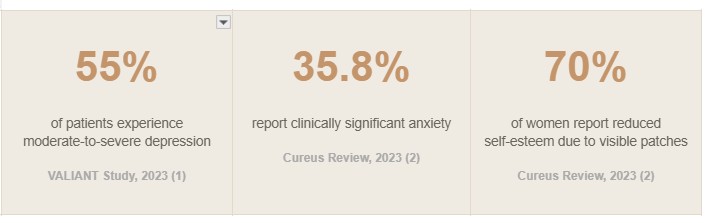
Did you know? As per research:
Why Vitiligo Hits Differently Than Other Conditions
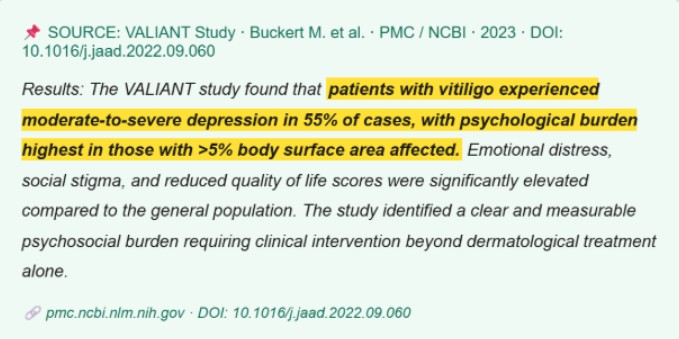
Unlike many chronic conditions, vitiligo is visible. It announces itself to the world before you have had a chance to process it yourself. Unlike pain, fatigue, or internal illness, vitiligo is something others can see, which means it intersects directly with how we are perceived, judged, and received socially. Research bears this out: the global VALIANT Study (2023) found that 55% of patients experience moderate-to-severe depression, with burden highest in those with more than 5% body surface area affected.
This visibility creates a unique emotional burden. The condition itself causes no physical discomfort, no pain, no cognitive decline, no life-threatening progression. And yet, the psychological weight can feel enormous. That contrast between physical harmlessness and emotional heaviness is worth sitting with. The suffering is real, but its source is largely relational and internal, which means it is also something we have genuine power to work with.
Whether you choose to undergo treatment, use topical applications, or embrace your skin as it is, remember to care for your emotional health alongside it. Your journey is not just about what changes on the surface, but also about how supported, steady, and at peace you feel within.
The Science Behind the Stress: The Brain–Skin Axis
The connection between emotional stress and vitiligo is not just anecdotal, it is physiological. A 2024 review confirmed that psychological stress activates two major biological pathways the sympathetic nervous system (SNS) and the HPA (hypothalamic-pituitary-adrenal) axis, which in turn influence skin immunity and drive melanocyte loss through neuropeptides and stress hormones. In plain terms: chronic emotional stress can directly worsen vitiligo progression(3).
What this means practically: Managing your emotional state is not separate from managing your vitiligo, it is part of it. The coping tools below are not just psychological comfort. They are, in a very real biological sense, skin care.
How Gender Shapes the Emotional Experience
The emotional impact of vitiligo is not identical across genders. Research shows 70% of women report reduced self-esteem, compared to 54% of men with the gap widest when patches affect the face, hands, and other visible areas.
Men are not exempt. While they face less scrutiny over skin perfection, men with vitiligo often feel acute pressure to appear unbothered, suppressing emotional distress because expressing it conflicts with expectations of stoicism. This can drive deeper isolation and unspoken suffering.
Understanding this isn’t about assigning blame to society, it’s about recognising that your emotional response has a context. You didn’t arrive at these feelings randomly. They were shaped. And what was shaped can be reshaped.
6 Practical Emotional Coping Tools
These are not quick fixes. They are practices — things that accumulate quietly over time and build a new internal foundation. And given what the brain–skin axis research tells us, they are among the most direct interventions available.
BREATHWORK & NERVOUS SYSTEM RESET
The 2024 Brain–Skin Axis review confirms that stress directly activates the SNS, the same pathway that worsens vitiligo progression. Breathwork is one of the few tools that can manually interrupt that activation. Slow, deliberate breathing sends a direct signal to the nervous system that the threat has passed, lowering cortisol and reducing the physiological cascade that reaches your skin. This is not relaxation as a luxury. It is biological self-regulation. Try This: Before entering a social situation that triggers anxiety, spend 2 minutes doing box breathing: inhale for 4 counts, hold for 4, exhale for 6, hold for 2. Repeat. Notice the shift before you walk in.
NAME THE BELIEF, NOT JUST THE FEELING
Beneath “I feel ugly” is almost always a deeper belief: “My worth depends on my appearance.” Surface emotions, shame, fear, sadness are symptoms. The belief is the root. Affirmations aimed at the feeling bounce off an untouched belief. But questioning the belief itself creates the possibility of real change. Stigma lowers self-esteem not through logic but through repetition — and it can be undone the same way.
MEDITATION AS PERSPECTIVE PRACTICE
Meditation does something more fundamental than making you feel better; it creates space between the thought and the thinker. When a difficult or self-critical thought arises, meditation training allows you to observe it rather than become it. That gap, even a fraction of a second, is where freedom lives. For people with vitiligo, where intrusive thoughts can be relentless, this space can make the difference between a thought that passes and one that shapes your entire day. Try This: Each morning, sit for 10 minutes. When a self-critical thought arises, label it: “There is a thought about my skin.” Don’t argue with it. Just name it and return to your breath. Do this for 14 consecutive days before evaluating.
SEEK COMMUNITY, NOT JUST INFORMATION
Information about vitiligo is widely available. What is far harder to find and far more healing is the felt experience of being understood by someone who knows it from the inside. The VALIANT Study noted that psychosocial burden is highest in those with more extensive vitiligo, confirming that the social dimension is a primary driver of suffering. The community directly addresses this. Visibility of others thriving with vitiligo expands your sense of what is possible for you. Try this: Find one community this week – an online forum, a local support group, or even one person who has shared their vitiligo experience publicly. Don’t join to give advice. Join to listen and to be seen.
AUDIT YOUR VISUAL ENVIRONMENT
The Cureus Review highlights that stigma, not the condition itself, is the primary driver of lowered self-esteem in vitiligo. Stigma is a social construct, maintained through what we see and consume. Your social feed is not neutral: a visual environment built on narrow, curated ideals of flawless skin is slowly recalibrating your baseline of “normal.” Research on social comparison suggests it materially affects self-perception. Try this: Spend 15 minutes this week unfollowing accounts that trigger comparison or inadequacy, and replacing them with accounts featuring diverse skin and people with visible conditions living fully.
COACHING OR THERAPY FOR ROOT WORK
The research is consistent: depression rates of 25–55% and anxiety rates of nearly 36% point to a population carrying an enormous emotional load largely without professional support. The five tools above build a strong daily practice. But childhood conditioning, what you were taught about worth, beauty, and belonging often requires guided, structured work to genuinely shift. Coaching and therapy are not for people who are struggling. They are for people who are serious about healing. Try this: Write one sentence about what you were taught about beauty growing up. Then ask: Whose voice is that? Your parents’? Your culture’s? Your own? If it isn’t yours, consider who could help you rewrite it.
Talking to the People Around You
One of the most practically challenging aspects of vitiligo is navigating other people’s reactions. Well-meaning comments (“Have you tried this remedy?”, “You should cover that up”) can land painfully. Stares from strangers can feel dehumanising. And the people closest to you may simply not know how to respond.
You are not obligated to educate everyone. But choosing in advance how you want to respond, having a simple, calm answer ready for common questions, reduces the emotional tax of repeated explanations. Something as straightforward as “It’s vitiligo – a skin condition. It doesn’t hurt and it isn’t contagious” closes most conversations gracefully, from a place of confidence rather than defensiveness.
For the people closest to you: tell them what you need. Not what vitiligo is. What you need. Whether that’s space, normalcy, or just someone to sit with you in it without trying to fix it.
The Longer Arc: What Acceptance Actually Looks Like
Acceptance is not the moment you look in the mirror and feel beautiful. That may come but it is not the destination. Acceptance is when vitiligo stops being the lens through which you experience your whole life. When you can go to a gathering, be in photographs, wear what you want, fall in love, pursue what matters and have vitiligo simply be a fact about you, not a verdict.
That shift is not achieved through willpower. It is achieved through sustained inner work, community, honest reflection, and the gradual recognition that the things vitiligo threatened to take from you were never the real source of your worth to begin with.
A final thought: Vitiligo has a way of pointing directly at the wounds that were already there, the inherited beliefs about beauty, worth, and belonging that were never truly yours. In this sense, it can be one of the most clarifying experiences of a life. Not easy. But clarifying.
Want to understand vitiligo better? Click on the blog to explore everything you need to know.
About the Expert
Leena Gupta is a transformational life coach and wellness expert, and the author of Anchor Within, published by Penguin Random House India. Her work centres on helping individuals build emotional resilience, navigate inner challenges, and develop a deeper sense of self-awareness through mindfulness and practical tools.
If this resonated with you and you’re looking for more personalised support, you can consider booking a one-on-one consultation with her to begin your journey inward.
Call: 1800 102 0253 or write to us at [email protected].