No products in the cart.
You ate a full meal. You should feel energized. Instead, you feel heavy, foggy, and like you could fall asleep mid-sentence.
Or it’s 4 PM and you’re desperately reaching for something sweet, even though you had lunch two hours ago.
You’ve probably told yourself it’s just how you are. Slow metabolism. Afternoon slump. Needs coffee to function.
It is none of those things. What you’re experiencing has a name: a blood glucose crash. And it is quietly affecting your energy, your weight, your hormones, and your long-term health every single day.
Glucose Is Not the Enemy. Instability Is.
Let’s kill a myth first. Glucose is not bad. Carbohydrates are not bad. Insulin is not bad.
Your brain consumes roughly 20% of your body’s total glucose supply. Your muscles rely on it for every contraction. Your red blood cells run exclusively on it. Glucose is not the villain. It is your body’s primary currency for energy.
What your body cannot tolerate well is rapid, repeated swings.
Here is what happens when you eat carbohydrates: they break down into glucose in your small intestine and enter your bloodstream. Your pancreas detects the rise and releases insulin, a hormone that acts like a key, unlocking your cells so glucose can enter and be used for energy. Clean, efficient, exactly as designed.
The problem begins when glucose floods the bloodstream too fast, typically from refined carbs, sugary drinks, or large portions eaten quickly with little fiber or protein. Your pancreas responds by releasing a large surge of insulin to compensate. That surge often overshoots, pulling blood sugar down too low, too fast. That drop is the crash. That is the fog. That is the craving. That is the fatigue that has nothing to do with how much sleep you got.
What Repeated Spikes Are Actually Doing to Your Body
A single glucose spike is something your body handles. It is repeated, daily spikes over months and years that change your biology.
Every time insulin surges, your cells are being flooded with a signal they eventually start to tune out. Over time, cells require more and more insulin to produce the same response. This is insulin resistance, and it does not announce itself. It builds quietly. Fatigue, stubborn belly fat, afternoon brain fog, and difficulty losing weight are often early signs, long before any blood test raises a flag.
Insulin is also your primary fat storage hormone. When it is chronically elevated, your body is in a near-constant state of storing fat, particularly visceral fat around the abdomen, which is metabolically active and drives further inflammation.
There is another mechanism worth understanding: glycation. When excess glucose circulates in the bloodstream, it binds to proteins and fats in a process called glycation, forming compounds called AGEs, advanced glycation end products. AGEs stiffen tissues, damage collagen, impair organ function, and are directly linked to accelerated cellular aging. This is one reason that chronically elevated blood sugar affects your skin, your joints, your eyes, and your cardiovascular system, not just your energy levels.
Your Grandparents Ate Rice. Why Were They Fine?
This is one of the most important questions in modern nutrition and the answer is not the food itself.
Your grandparents ate rotis. They ate rice. They ate ghee. Same staples many people eat today. But their glucose response was fundamentally different, because the system around their food was different.
They walked after meals, which activates muscle contractions that pull glucose out of the bloodstream independently of insulin, through a separate pathway involving GLUT4 transporters. They worked physically, meaning their muscles were consistently using glucose as fuel. They ate earlier dinners, giving their bodies time to process glucose before the metabolic slowdown of sleep. They slept by 10 PM, and deep sleep is when insulin sensitivity resets for the next day.
Their food also had more fiber naturally, from less processing, fresher vegetables, and whole grains that had not been stripped of their outer bran. Fiber physically slows the movement of food through your digestive tract, meaning glucose enters your bloodstream gradually rather than in a flood.
Same carbohydrates. A completely different physiological outcome.
The Other Variables Nobody Talks About
Food is only one input. Here is what else is driving your glucose.
Chronic stress elevates cortisol, which directly raises blood sugar by triggering your liver to release stored glucose, a survival mechanism designed for short-term emergencies. When stress is constant, so is the glucose release.
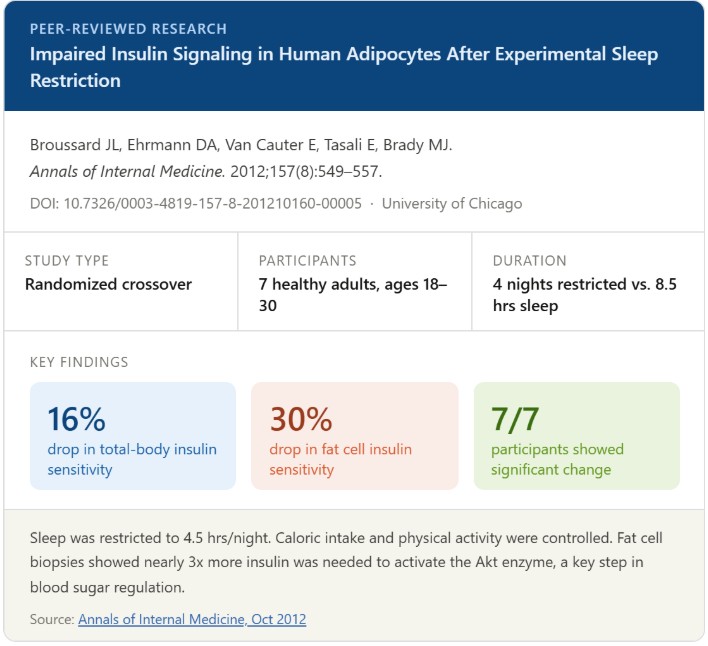
Poor sleep, even one bad night, measurably reduces insulin sensitivity the following day. A study published in the Annals of Internal Medicine showed that just four nights of sleep restriction reduced insulin sensitivity by 16 percent. Your metabolism is deeply tied to your sleep quality.
Low muscle mass is a hidden driver that almost nobody addresses. Muscle is your body’s largest glucose reservoir. The more muscle you carry, the more glucose you can absorb and store after a meal without requiring high insulin levels. Building muscle through resistance training is one of the most effective long-term strategies for blood sugar control.
How to Actually Stabilize Your Blood Sugar
No extreme protocols. Just physiology applied practically.
#1 Sequence your meals. Start with fiber, vegetables, soups, or salad. Then eat protein, dal, eggs, paneer, curd, or fish. Eat carbohydrates last. Research shows this sequence alone can reduce post-meal glucose spikes by 30 to 40 percent by slowing gastric emptying and blunting the speed of glucose absorption.
#2 Move after you eat. A 10-minute walk after meals activates muscle glucose uptake through the GLUT4 pathway mentioned earlier, independent of insulin. It is one of the simplest and most effective tools available.
#3 Build muscle. Prioritize at least two sessions of resistance training per week. More muscle means a larger buffer for glucose storage and better baseline insulin sensitivity.
#4 Increase fiber gradually. Aim for 25 to 30 grams a day from whole food sources: vegetables, legumes, whole grains, seeds. The key word is gradually. A gut that has been living on 15 grams a day needs time to adapt. Jumping to fiber supplements overnight causes bloating and cramping, not because fiber is harmful, but because your gut microbiome needs time to adjust.
#5 Protect your sleep. Treat 7 to 8 hours of quality sleep as a metabolic intervention, not a luxury.
#6 Manage stress as a biological priority. Breathwork, walks in nature, reducing screen overstimulation, these are not soft suggestions. They directly reduce cortisol and improve insulin sensitivity.
What Changes When Glucose Stabilizes
Steady blood sugar means steady energy, not the kind that depends on caffeine or willpower, but energy that is simply there. Cravings quiet down because your brain is no longer in emergency mode hunting for a quick glucose fix. Hormones begin to rebalance. Inflammation drops. Cognitive clarity returns. Over months, the downstream effects touch everything from skin quality to sleep depth to mood stability.
This is not a trend. This is your body functioning the way it was designed to, once you stop creating the conditions for chaos.
Your body has never been working against you. It has been responding, precisely and faithfully, to the signals you send it every day.
Change the signals. The body follows.
Want to hear this explained in Luke’s own words? Watch the full video:
The biggest enemy is living inside your body
Disclaimer: This content is created for educational and informational purposes only and is not intended as medical advice, diagnosis, or treatment. Always consult a qualified healthcare professional or registered dietitian before making changes to your nutrition, exercise routine, or lifestyle, especially if you have a pre-existing health condition such as diabetes, insulin resistance, or any metabolic disorder.
Ready to take charge of your health?
Start with awareness, not fear.
Build a strong, sustainable foundation through the basics that truly matter: food, sleep, movement, emotional balance, and the right guidance.
Begin your journey with our Wellness Program, designed to support what your body actually needs.
Looking for something more personalised?
Book a one-on-one consultation with Team Luke and get a plan tailored to your unique journey.
📞 Call us at 1800 102 0253
📧 Or write to us at [email protected]